Udemy Ideogram AI Prompt

Google Flow & Veo 3: AI Filmmaking Essentials Full Course (2026)
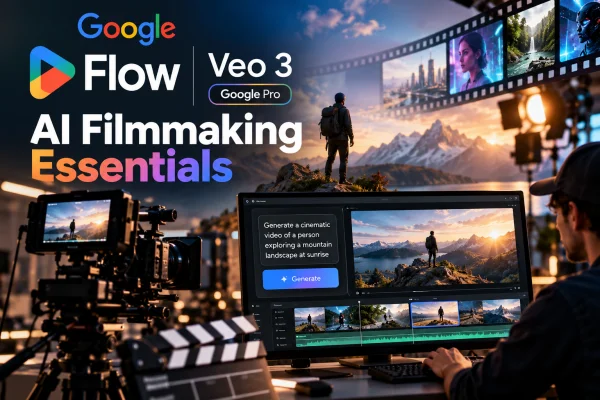
By John Boyle • Posted: Jul 31, 2026

Course Details

Pricing Free
Difficulty Beginner
Duration Approximately 15.5 Hours On-Demand Video
Language English
Certificate Available

Course Curriculum & Description

AI Filmmaking Essentials with Google Flow Veo 3 (Google Pro) is a complete beginner-friendly course that teaches you how to create professional AI-generated videos using Google Flow and Google Veo 3.

This is the Google Flow full course for filmmaking: a Google Flow course that takes you from Google Flow basics and Veo 3 introduction, through AI video prompting, video generation, cinematic storytelling, and professional production, to advanced projects.

Learn cinematic prompting, AI storytelling, shot composition, scene transitions, character consistency, camera movements, and professional production workflows to create high-quality short films, advertisements, social media content, YouTube videos, and commercial AI videos.

This hands-on course combines practical projects with industry techniques to help creators produce cinematic AI videos quickly and efficiently.

Course curriculum

Module 1: Introduction

  1. Course overview
  2. Google Flow basics
  3. Google Veo 3 introduction
  4. Setting up your workflow

Module 2: AI Video Prompting

  1. Prompt engineering fundamentals
  2. Cinematic prompts
  3. Scene descriptions
  4. Camera directions

Module 3: Video Generation

  1. Text-to-video creation
  2. Image-to-video workflows
  3. Scene generation
  4. Character consistency

Character consistency in Module 3 is what makes an AI character video series possible with Google Flow: you learn to keep a character consistent across scenes, rather than generating a new look in every clip.

Module 4: Cinematic Storytelling

  1. Storyboarding
  2. Scene transitions
  3. Camera movements
  4. Visual storytelling

Module 5: Professional Production

  1. Editing workflows
  2. Export settings
  3. Video optimization
  4. Publishing AI videos

Module 6: Advanced Projects

  1. Commercial advertisements
  2. Short films
  3. YouTube videos
  4. Marketing content

Requirements

  1. Basic computer skills
  2. Internet connection
  3. Google Account
  4. No prior filmmaking experience required

FAQ - add these to the existing FAQ section

  1. Is this a Google Flow full course?
  2. Yes. This Google Flow course covers the full filmmaking workflow in six modules: introduction and setup, AI video prompting, video generation, cinematic storytelling, professional production, and advanced projects.
  3. Is this a Google Flow training course, masterclass, or workshop?
  4. Searchers use Google Flow training, Google Flow masterclass, Google Flow workshop, and Google Flow courses for the same type of course. This page is the AI Filmmaking Essentials Google Flow Veo 3 course. If you run a separate live workshop or masterclass with a different syllabus, give it its own page - do not rename this course to match every search variant.
  5. Can I create an AI character video series with Google Flow using this course?
  6. Yes, as a project type within this course. Module 3 covers character consistency, and Module 6 covers YouTube videos and marketing content, so you can apply those techniques to a character series. Note: the search phrase "Udemy - create an AI character video series with Google Flow" is a specific Udemy course title search. This page is AI Filmmaking Essentials with Google Flow Veo 3, not a course renamed to that title. Do not claim this page is that exact Udemy course unless you have verified the provider listing matches this syllabus.
  7. Is this the Google AI Professional Certificate?
  8. No. Google AI Professional and Google AI Professional Certificate are a separate Google AI course and certificate programme. They are linked below as a related Google course, but they are not this Google Flow filmmaking course. Do not target Google AI Professional Certificate keywords on this page.
  9. Is this a Google filmmaker course?
  10. Yes, in the sense searchers mean it: a Google filmmaking course using Google Flow and Veo 3 to create cinematic AI videos, from prompting and storyboarding to editing, export and publishing.
  11. Do I need prior filmmaking experience?
  12. No. The requirements state: basic computer skills, internet connection, a Google Account, and no prior filmmaking experience required.

What You Will Learn

  • After completing this course
  • you'll be able to:
  • Create cinematic AI videos
  • Master Google Flow workflows
  • Generate professional AI films
  • Write advanced video prompts
  • Design realistic AI scenes
  • Produce engaging marketing videos
  • Create consistent AI characters
  • Build commercial-quality AI video projects

Course Highlights

Google Flow Masterclass
Google Veo 3 Training
AI Video Generation
Cinematic Prompt Engineering
AI Storytelling
Camera Motion Techniques
Commercial AI Video Creation
Beginner Friendly
Hands-on Projects
Certificate of Completion


Tagged Topics & Skills

Categories:

Ready to Start Learning?

Enroll directly on the official Udemy website to begin your lessons.

Open Course Website

Associated AI Tools

Gemini AI

Gemini AI is Google's family of generative AI models and the AI assistant available through the Gemini app. It can understand and work with text, images, files, audio, video, and code, helping users with writing, research, learning, analysis, brainstorming, coding, and creative tasks. Gemini also connects with Google products and services to support everyday productivity.Uses of Gemini AIGemini AI can help users write emails, articles, social media posts, summaries, presentations, study notes, and other types of content. It can also analyze uploaded documents and images, answer questions, explain difficult topics, brainstorm ideas, translate content, and assist with coding and software development. Its multimodal capabilities allow users to work with different types of information in one conversation.Gemini is also useful for research and productivity. Users can use features such as Deep Research, connect Gemini with supported Google apps, create reports, generate and edit images, and create AI-generated video through Google's video-generation tools. Depending on the plan and region, Gemini can also provide access to additional AI models and higher usage limits.Gemini AI Models & Sub-ModelsGemini 3.8 Flash is Google's latest high-performance Flash model, designed for complex agentic tasks at scale. It focuses on combining strong reasoning with speed and efficient execution, making it suitable for coding, automation, research, and AI agents.Gemini 3.7 Flash is a powerful workhorse model designed for coding, reasoning, and agent-based workflows. It is particularly useful when applications need a balance between intelligence, speed, and cost efficiency.Gemini 3.5 Flash-Lite is designed for high-volume tasks where speed and efficiency are important. It is suitable for everyday AI workloads such as summarization, classification, content processing, and other tasks that need fast responses.Gemini 3.1 Pro is designed for more complex tasks that require stronger reasoning and deeper understanding. It can work across text, files, images, and video and is useful for advanced coding, research, problem-solving, and creative work.Gemini 3.1 Deep Think is a specialized reasoning model designed for difficult scientific, research, engineering, and mathematical problems. It provides deeper reasoning capabilities for challenges that require more complex problem-solving.Gemini Omni Flash is Google's newer multimodal model family focused on real-world reasoning and generative creation. It supports creative workflows and video-generation capabilities and is available through Gemini and Google AI Studio depending on access and region.Gemini Flash-Lite is an efficient model designed for speed and everyday tasks such as summarization and brainstorming. Gemini Flash provides a stronger balance between speed and reasoning, while Gemini Pro is designed for more advanced tasks involving complex reasoning, mathematics, coding, files, images, and video.Gemini Deep Research is an AI research feature that can investigate a topic, gather information, and create detailed research reports. It is useful for market research, academic research, business analysis, competitive research, and other information-heavy tasks.Gemini Image Models include Google's image-generation and editing models, including the Nano Banana family and Gemini image models. These can be used to create, modify, and refine visual content from natural-language instructions.Veo is Google's generative video model family used for AI video creation. Current Google AI offerings include Veo 3.1 and related video-generation capabilities through Gemini and Google Flow, depending on the user's plan and region.PricingGemini AI has a Free access option with standard usage limits. Google also offers Google AI Plus, Google AI Pro, and Google AI Ultra plans that provide higher usage limits and expanded access to advanced Gemini models and features. The exact limits and available features can vary by country and can change over time.Free: Yes, standard Gemini accessPaid: Yes, Google AI Plus, Pro, and UltraFree Trial: Availability varies by plan, promotion, and regionBest Use CasesGemini AI is best suited for students, professionals, marketers, writers, developers, researchers, business teams, educators, and everyday users who want one AI assistant for a wide range of tasks. It can be used for content creation, research, coding, studying, document analysis, brainstorming, business reports, image creation, video generation, data analysis, and productivity. Its ability to work across text, images, files, audio, video, and Google's wider ecosystem makes Gemini especially useful for people who already use Google Workspace and other Google services.
Free

Lium AI

Lium AI is an agentic AI platform built for analyzing complex, real-world data. It connects databases, files, APIs, scientific data, and internal tools so AI agents can work across different data types and formats. Lium can write code, build reusable tools, analyze large datasets, and turn complex information into reports, charts, datasets, and other useful outputs.Uses of Lium AILium AI helps teams ask questions about their data using natural language instead of manually building complex data pipelines. It can combine structured databases with documents, spreadsheets, images, sensor data, satellite information, scientific files, and other specialized formats to find relationships and generate useful insights.The platform is particularly useful for industries working with large and complicated datasets. It can support geospatial analysis, energy research, space and aerospace projects, infrastructure, scientific research, competitive intelligence, supply-chain analysis, operational analytics, and other data-heavy workflows. Lium can also automatically provision computing resources when an analysis requires heavy processing.Lium AI Models & Sub-ModelsLium Agentic AI is the core AI system that works with connected data, tools, and computing resources. Instead of simply answering a question, Lium can plan work, write code, use tools, analyze information, and produce a finished result.Lium Connections provides secure access to external data sources such as Amazon S3, Azure, Google Cloud, databases, uploads, and other connected systems. Lium brokers these connections so agents can access information without exposing the underlying credentials.Lium Artifacts turns connected data into a virtualized workspace that AI agents can work with. This allows large and distributed datasets to be used without requiring everything to be moved into a single location.Lium Tools allows AI agents to create and reuse custom tools for specific data-analysis tasks. These tools run in sandboxed environments and can become part of the team's reusable workflow, reducing the need to solve the same problem repeatedly.Lium Compute Plane provides computing power for demanding analysis. When a task requires more processing than a normal computer can provide, Lium can automatically scale computing resources without requiring users to manage servers or clusters.Lium Workspaces keep datasets, tools, analyses, and outputs connected across projects. Useful results can become reusable knowledge and infrastructure, allowing future agents and team members to build on previous work instead of starting from scratch.Multimodal Data Intelligence allows Lium to reason across different types of information, including databases, spreadsheets, time-series records, satellite imagery, audio, video, GIS data, seismic files, genomics data, and other specialized formats. This is one of Lium's main differences from general-purpose AI assistants.PricingLium offers a Free starting option that allows users to try the platform and start an analysis. For business and enterprise customers, pricing is based on the organization's requirements, subscription terms, included tokens, and usage. The platform's terms state that enterprise subscriptions can include a specified number of tokens with additional charges for usage beyond the included amount.Free: Yes, free access to get startedPaid: Yes, business and enterprise plansFree Trial: Yes, users can start with a free analysisBest Use CasesLium AI is best suited for researchers, data scientists, engineers, analysts, enterprises, and teams working with large or complicated proprietary datasets. It can be used for scientific research, geospatial intelligence, satellite and space data, energy analysis, infrastructure monitoring, competitive intelligence, supply-chain analytics, operational research, and complex data engineering. Its ability to connect different data sources, automatically scale computing, build reusable tools, and preserve previous analyses makes it especially valuable for organizations where important decisions depend on large amounts of specialized data.
Free

INVIDEO AI

InVideo AI is an AI-powered video creation platform that helps users turn prompts, scripts, ideas, images, and other content into complete videos. It combines AI video generation, editing, avatars, voiceovers, stock media, and access to 200+ AI models in one workspace. It is designed for creators, marketers, businesses, educators, and teams that want to produce videos faster.Uses of InVideo AIInVideo AI can create videos from simple text prompts and help users produce advertisements, social media videos, YouTube content, product videos, explainers, presentations, tutorials, and marketing campaigns. Its AI workflows can handle scripting, visuals, voiceovers, editing, and other production steps, allowing users to create videos without advanced video-editing skills.The platform can also generate and edit images, create AI avatars, add voiceovers and music, convert images into videos, and work with professional stock footage. Users can access different AI models for specific creative tasks and choose models directly or ask InVideo to route the generation automatically.InVideo AI Models & Sub-ModelsInVideo v4 Agent is InVideo's AI filmmaking agent that can create long-form videos from a single prompt. It can coordinate different models and production steps to create videos of up to 30 minutes, making it useful for YouTube videos, educational content, storytelling, and other larger projects.Video Generation Models include models such as Google Veo 3.1, Sora 2, Kling 3.0, Seedance 2.0, Runway Gen-4.5, Luma Ray 3.2, Pixverse, Wan, Hailuo, LTX, Vidu, and Grok Imagine Video. These models provide different capabilities for generating realistic, cinematic, animated, and creative video content.Image Generation Models include GPT Image 2, Recraft 4, Ideogram 4, Midjourney V7, Nano Banana 2, Nano Banana Pro, Flux 2, Seedream 5.0, Krea v2, Qwen Image 2.0, and Kling 3.0 Image. They can be used for creating characters, scenes, product visuals, thumbnails, advertisements, and other images used inside video projects.AI Avatar Models allow users to create videos featuring digital presenters and talking characters. InVideo's model library includes avatar technologies such as Kling Avatar, HeyGen Photo Avatar, and P-Video Avatar, giving creators different options for presenter-based content.AI Voice & Audio Models provide voice, speech, music, dubbing, and other audio capabilities. InVideo's current model ecosystem includes technologies such as ElevenLabs Music, HeyGen Lipsync, Kling Lipsync, Pixverse Lipsync, and other audio/video models for producing more complete AI-generated videos.AI Editing & Enhancement Models help modify and improve generated media. The available ecosystem includes tools for video upscaling, image editing, background removal, object removal, relighting, motion control, video extension, lip-sync, and other post-production tasks.PricingInVideo AI offers a Free plan with limited weekly credits and access to selected AI features. Paid plans provide larger credit allowances and broader access to AI models and workflows. Current individual plans shown by InVideo include Plus, Max, Generative, and Elite, while separate Starter, Plus, and Max options are available for team/business use. Pricing and credits can change as model costs change.Free: Yes, limited weekly creditsPaid: Yes — Plus, Max, Generative, Elite, and team/business plansFree Trial: Yes, through the Free plan; no card is required to start.Best Use CasesInVideo AI is best suited for YouTubers, social media creators, marketers, ecommerce brands, agencies, educators, businesses, and professional video teams. It can be used for YouTube videos, Reels, Shorts, advertisements, product demonstrations, UGC-style content, training videos, explainers, promotional campaigns, AI-generated films, and social media content. Its biggest advantage is the ability to access a large collection of leading image, video, audio, and avatar models from one platform while using AI agents to handle much of the video-production workflow.
Free

Related Courses

PW Gyaan-E AI & Tech Courses: ChatGPT, Excel, Python & Everyday AI Skills Freemium
PW Gyaan-E / Physics Wallah

PW Gyaan-E AI & Tech Courses: ChatGPT, Excel, Python & Everyday AI Skills

PW Gyaan-E’s AI & Tech category offers practical courses and guides covering ChatGPT, Gemini, Prompt Engineering, NotebookLM, Excel, Python, AI tools, coding, video editing, Canva, and everyday technology skills. Courses use short 8–10 minute Hinglish lessons, quizzes, and self-paced learning.

Beginner
AI Foundations – OpenAI Academy | Free AI & ChatGPT Course Free
OpenAI 70 minutes

AI Foundations – OpenAI Academy | Free AI & ChatGPT Course

Learn AI fundamentals, large language models, ChatGPT prompting, context-setting and responsible AI use in OpenAI Academy’s free, self-paced 70-minute course. Practice real workplace tasks and earn a shareable digital badge by completing the course and passing the assessment with at least 80%.

Beginner
Building with Llama 4 Free
DeepLearning.AI 1 hour 20 minutes

Building with Llama 4

Learn to build AI applications with Meta's Llama 4 models in this beginner-friendly DeepLearning.AI course. Explore Mixture-of-Experts architecture, multimodal image reasoning, image grounding, long-context understanding, prompt optimization and synthetic data generation through practical examples.

Amit Sangani
Beginner