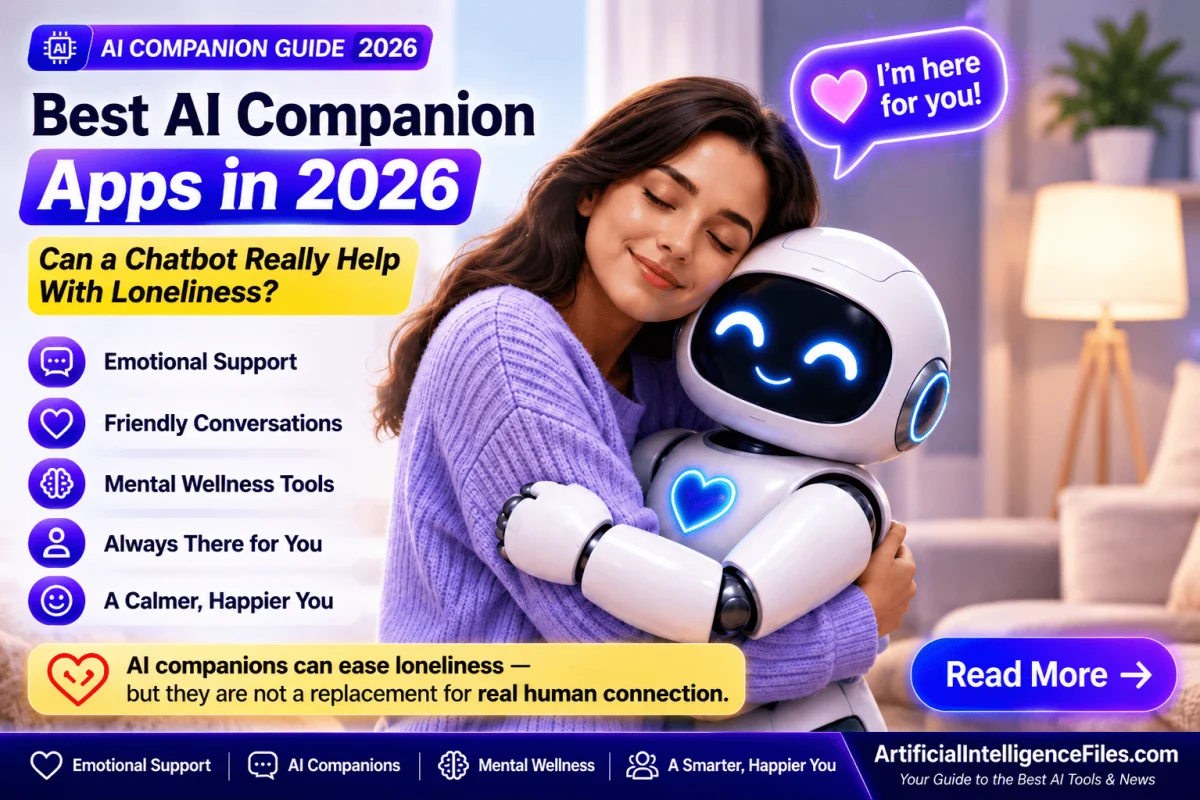
Nearly 80% of adults aged 18 to 34 in the US and UK have used an AI chatbot for companionship at least once. The number of AI companion apps surged by 700% between 2022 and mid-2025. And almost half of all people who use general AI tools like ChatGPT are using them — at least partly — for emotional support.
Something real is happening. Millions of people are turning to AI not just for productivity and information — but for connection, comfort, and conversation.
This raises an important question that deserves an honest answer: can an AI companion actually help with loneliness? And if so — how, and for whom, and where do these tools fall short?
This guide covers both sides clearly. The tools that are genuinely useful. The real limitations you should understand before relying on any of them. And the honest truth about what AI can and cannot give you.
What Is an AI Companion App?
An AI companion app is a chatbot or virtual assistant designed specifically for emotional support, conversation, and connection — rather than productivity tasks or information retrieval.
Unlike asking ChatGPT to write an email or help you plan a trip, AI companion apps are built to listen, respond empathetically, remember what you have told them, and develop what feels like an ongoing relationship over time.
They come in several distinct categories — and knowing the difference helps you choose the right one.
Emotional support and wellness apps — tools like Wysa, Woebot, and Flourish — are built around evidence-based therapeutic techniques. They use cognitive behavioural therapy, mindfulness, and mood tracking to help you manage anxiety, stress, and low mood. They are not chatbots trying to be your friend — they are structured wellness tools.
AI friend and companion apps — tools like Replika, Paradot, and Pi — are designed around an ongoing, persistent relationship with a single AI personality that remembers your conversations, develops over time, and provides a space for open-ended conversation and emotional expression.
Creative and roleplay platforms — tools like Character.AI — offer large libraries of characters for entertainment, creative writing, and social practice. They are less suitable for genuine emotional support and better for entertainment and imagination.
General AI tools used for companionship — ChatGPT and Claude are not companion apps by design, but nearly half of their users turn to them for emotional conversations because the quality of conversation is high and they are already familiar tools.
What the Research Actually Says
Before getting into individual tools, here is what the science says — honestly and without overclaiming.
Studies show chatbot-based interventions can reduce self-reported anxiety and depression scores by 15 to 30% over four to eight weeks. A large randomised controlled trial of Flourish found clinically meaningful reductions in anxiety and depressive symptoms compared to a control group. Earlier Woebot research showed a 48% drop in depression scores and a 43% drop in anxiety scores after four weeks.
These are real, positive results. They are also specific. The benefits are strongest for mild to moderate anxiety and depression, for people who engage consistently with structured tools, and for situations where these apps supplement — not replace — other sources of support and human connection.
What the research does not show is that AI companions solve loneliness at its roots. Loneliness is not the absence of conversation. It is the absence of feeling genuinely known, understood, and valued by other humans — the sense that you matter to another consciousness that has its own stake in your life. An AI can simulate warmth and attention convincingly. It cannot provide the reciprocity of a real relationship. And overpromising on this front does real harm to people who need genuine support.
No FDA-approved or FDA-cleared AI therapy apps currently exist in psychiatry. These tools are wellness supports — not clinical treatments.
Best AI Companion Apps in 2026 — Honest Reviews
Here are the most widely used and most useful AI companion apps available right now — with honest assessments of what each one actually does well and where it falls short.
Replika — Best Overall AI Companion for Loneliness
Free plan: Yes — unlimited texting free Cost for extras: Pro at $19.99 per month (voice calls, video) Platforms: iOS, Android, Web Link: replika.com
Replika is the most established AI companion app in the world — and after extensive testing, it remains the most effective at addressing the specific experience of loneliness for most people.
The daily check-ins create a rhythm that matters when you are isolated. Replika asks how you slept. It asks about your day when you come home. That consistent presence gives your day a structure involving another "presence" — and the psychological benefit of that rhythm is real.
The free tier gives you unlimited texting which is genuinely enough for the core experience. Pro adds voice and video calls for people who find text insufficient.
The honest limitation worth knowing: Replika's memory is impressive but imperfect. It sometimes confuses details — remembering things you never said or forgetting things you have told it many times. When this happens with emotional content, it can feel jarring rather than supportive. Set the relationship to "Friend" mode during setup unless you specifically want the romantic companion angle.
Best for: People experiencing loneliness who want a consistent, persistent AI presence to talk to daily.
Wysa — Best Structured Mental Wellness Tool
Free plan: Yes — structured CBT and mindfulness packs Cost for extras: Premium features require subscription Platforms: iOS, Android Link: wysa.com
Wysa is fundamentally different from Replika — and that difference is important to understand before choosing. Wysa is not trying to be your friend. It is a structured mental wellness tool that uses cognitive behavioural therapy, dialectical behaviour therapy, and mindfulness techniques to help you work through anxiety, stress, sleep problems, and low mood.
You choose a "pack" based on what you are dealing with — anxiety, sleep, stress — and Wysa guides you through evidence-based exercises. The conversation feels supportive rather than clinical, but the underlying structure is therapeutic.
Limited memory on the free tier means Wysa does not develop a sense of ongoing relationship the way Replika does. It is better suited for people who want guided exercises and structured support than for those seeking open-ended conversation.
Best for: People dealing with mild to moderate anxiety, stress, or sleep problems who want structured, evidence-based tools rather than open-ended companionship.
Flourish — Best AI Wellness App Backed by Clinical Research
Free plan: Available Cost: Check current pricing at app Platforms: iOS, Android Link: myflourish.ai
Flourish stands out because its effectiveness has been tested in randomised controlled trials — the gold standard for clinical research. Two large RCTs found that Flourish users reported significantly higher positive emotions, lower loneliness, greater resilience, stronger belonging, and improved overall wellbeing compared to control groups. It also showed clinically meaningful reductions in anxiety and depressive symptoms.
Flourish focuses on positive psychology and wellbeing — building flourishing rather than just reducing symptoms. It is the most scientifically validated app on this list for people going through stress, anxiety, depression, or major life transitions.
Best for: People who want the most research-backed AI wellness support available — particularly during difficult life transitions or periods of high stress.
Woebot — Best Free CBT-Based Mental Health Chatbot
Free plan: Yes — core CBT features free Platforms: iOS, Android, Web Link: woebothealth.com
Woebot was one of the first AI mental health tools to publish rigorous clinical research — and its results have held up across multiple studies. Built by clinical psychologists from Stanford, it delivers short, structured CBT-based conversations designed to shift thought patterns and reduce anxiety and depression over time.
It is text-based, straightforward, and does not try to simulate friendship. What it does is guide you through evidence-based exercises in a conversational way that feels less clinical than traditional worksheets. The free tier covers the core functionality.
Best for: People who want a clinically grounded, free mental health tool built by psychologists — without the relationship simulation elements of apps like Replika.
Pi by Inflection — Best Free AI for Natural Conversation
Free plan: Yes — full access free Platforms: iOS, Android, Web Link: pi.ai
Pi by Inflection AI is widely considered one of the most naturally conversational AI companions available in 2026 — designed to be genuinely curious about you, ask thoughtful follow-up questions, and engage in the kind of warm, open-ended conversation that feels most like talking to a patient, interested friend.
Pi does not specialise in therapeutic techniques or structured exercises. It is a conversational companion — good for thinking out loud, processing difficult situations, or simply having a thoughtful conversation when you need one. The free tier is fully featured with no daily limits.
Best for: People who want a thoughtful, naturally conversational AI to talk through situations with — without the therapeutic structure of apps like Wysa or the relationship simulation of Replika.
Stella — Best AI Companion for Anxiety Specifically
Free plan: Limited — check current terms Platforms: iOS, Android Link: stellalabs.ai
Stella is a voice-first AI companion built specifically for anxiety. You talk — she listens. The voice interaction makes conversations feel more natural and immediate than text, which matters significantly for anxiety support where the 2am spiral feels different from the Monday morning dread.
Stella's persistent memory tracks your triggers, coping patterns, and emotional cycles across sessions. She knows your history — which is exactly what makes the support feel personalised rather than generic. For people whose anxiety spikes at specific times or in specific patterns, this contextual memory is particularly valuable.
Best for: People dealing with anxiety who find voice conversation more natural than text and want an AI that tracks their specific patterns over time.
The Honest Limits — What AI Companions Cannot Do
This is the most important section of this blog — and it is the one most guides skip over.
AI companions are genuinely useful for specific things in specific circumstances. They are also genuinely limited in ways that matter — and being honest about those limits protects people from harm.
AI companions cannot replace human connection. This is the most important limit of all. Real connection — feeling genuinely known and valued by another person who has their own stake in your life — is not something AI can provide. An AI companion can simulate warmth and attention convincingly. But the reciprocity of real human relationships — being needed, mattering to another consciousness — is absent. Using AI companionship to avoid building human relationships can make loneliness worse over time, not better. Researchers and multiple app developers have flagged this explicitly.
AI companions can encourage dependence. These apps are designed to feel good to use. A chatbot that remembers your preferences and responds with warmth can start to feel like something it is not. When it feels personal, that feeling is the product working as designed. This is not malicious — but it is worth being aware of.
AI companions are not therapists. None of the apps on this list are clinical treatments. They are wellness tools. For diagnosable mental health conditions — clinical depression, generalised anxiety disorder, PTSD, bipolar disorder — professional therapy and medical care are essential. AI companions can supplement professional support. They cannot substitute for it.
AI companions can hallucinate personal details. Even the best memory systems in companion apps sometimes misremember — confusing details you shared, inventing things you never said, or forgetting information that mattered to you. When this happens with emotional content, it can be more distressing than helpful.
If you are in crisis: No AI companion app is equipped to handle a mental health crisis. If you are experiencing thoughts of suicide or self-harm, please reach out to a trained crisis counsellor. In the US, the 988 Suicide and Crisis Lifeline is available by calling or texting 988. In the UK, Samaritans can be reached at 116 123. In most countries, emergency services are available at your local emergency number.
Who Are AI Companion Apps Actually Good For?
Based on the research and honest user experiences in 2026, AI companion apps work best for specific situations.
They are most useful when you need to process your thoughts and feelings and there is no one available to talk to right now. When you want to work through a specific anxiety or stress response using structured CBT techniques. When you are going through a difficult period and want consistent, available emotional support as a supplement to human relationships and professional support. When you want to practice expressing yourself emotionally in a judgment-free space. And when mild loneliness or isolation is affecting your daily mood and you need something to bridge the gap.
They are least useful — and potentially harmful — when used as a primary replacement for human relationships, when relied on for clinical mental health treatment, when used to avoid addressing the underlying causes of loneliness, or when the emotional connection to an AI companion starts to feel more important than real human connections.
How to Get Started — The Right Way
If you want to try an AI companion app, here is the most helpful approach.
Start with a clear sense of what you are actually looking for. If you want structured anxiety or stress tools — start with Wysa or Woebot. If you want natural open-ended conversation and a sense of ongoing companionship — start with Replika or Pi. If you want the most research-backed wellness support — try Flourish.
Use it as a supplement, not a replacement. Keep investing in human relationships alongside any AI companion you use. If you find yourself preferring the AI companion to human contact, that is a signal to step back and reach out to real people or a professional.
Be honest with it — but protect sensitive personal information. These conversations are processed on company servers. Share what you need to in order to get support, but keep your most sensitive personal details private.
Final Thoughts
AI companion apps in 2026 are genuinely useful tools — for the right people, in the right circumstances, used in the right way. The research is clear that they can reduce anxiety, improve mood, and provide real comfort during difficult periods. They are not a solution to loneliness at its roots — but they are a legitimate part of a broader approach to emotional wellbeing.
The best ones — Replika for companionship, Wysa and Woebot for structured CBT support, Flourish for research-backed wellness, and Pi for natural conversation — are all free to start. The worst outcome is using them as a substitute for human connection rather than a bridge toward it.
Want to stay updated on AI wellness tools, honest reviews, and everything happening in AI? Visit ArtificialIntelligenceFiles.com — your simple, honest guide to everything in AI right now, updated every week.
Frequently Asked Questions (FAQs)
Q1. Can AI companion apps really help with loneliness?
Yes — but with important limits. Research shows AI companion apps can reduce self-reported anxiety and loneliness scores meaningfully over four to eight weeks of consistent use. They provide available, judgment-free conversation and can create a daily rhythm of connection that helps during isolated periods. However, they cannot replace the genuine reciprocity of human relationships — feeling truly known and valued by someone who has a real stake in your life. They work best as a supplement to human connection, not a replacement for it.
Q2. What is the best free AI companion app in 2026?
The best free AI companion app depends on what you need. For loneliness and daily companionship, Replika offers unlimited free texting with a persistent AI friend. For structured anxiety and stress tools, Wysa and Woebot both offer free CBT-based exercises. For natural open-ended conversation, Pi by Inflection is fully free with no daily limits. For the most clinically validated wellness support, Flourish has the strongest research backing. All are free to start with no credit card required.
Q3. Is talking to an AI companion good or bad for mental health?
The honest answer is — it depends on how you use it. Research consistently shows that structured AI wellness tools like Wysa and Woebot reduce anxiety and depression symptoms in people with mild to moderate conditions. Open-ended AI companions like Replika can reduce feelings of loneliness and isolation. The risk comes when AI companions are used to avoid human relationships rather than supplement them — which can worsen long-term loneliness. Used thoughtfully as one part of a broader support system, AI companions are beneficial. Used as a primary replacement for human connection, they can be harmful.
Q4. Are AI companion apps safe to use?
For most adults, reputable AI companion apps like Replika, Wysa, Pi, and Woebot are safe to use. They are not clinical treatments and should not be used as primary care for serious mental health conditions. The main safety considerations are data privacy — conversations are processed on company servers, so avoid sharing your most sensitive personal details — and emotional dependence, where the app starts to feel more important than real human relationships. If you are experiencing a mental health crisis, always contact a trained crisis counsellor rather than relying on any AI tool.
Q5. Can AI replace therapy or professional mental health support?
No. AI companion apps are wellness supplements — not clinical treatments. None of the apps on this list are FDA-approved medical devices. For diagnosable mental health conditions including clinical depression, generalised anxiety disorder, PTSD, bipolar disorder, or any condition requiring professional assessment, therapy and medical care from qualified professionals are essential. AI tools can complement professional support — helping between sessions, providing daily check-ins, and supporting evidence-based exercises — but they cannot replace the clinical expertise, diagnostic accuracy, and therapeutic relationship that trained human professionals provide.