Here is something most job seekers do not realise until it is too late.
The first person to review your resume in 2026 is not a person at all.
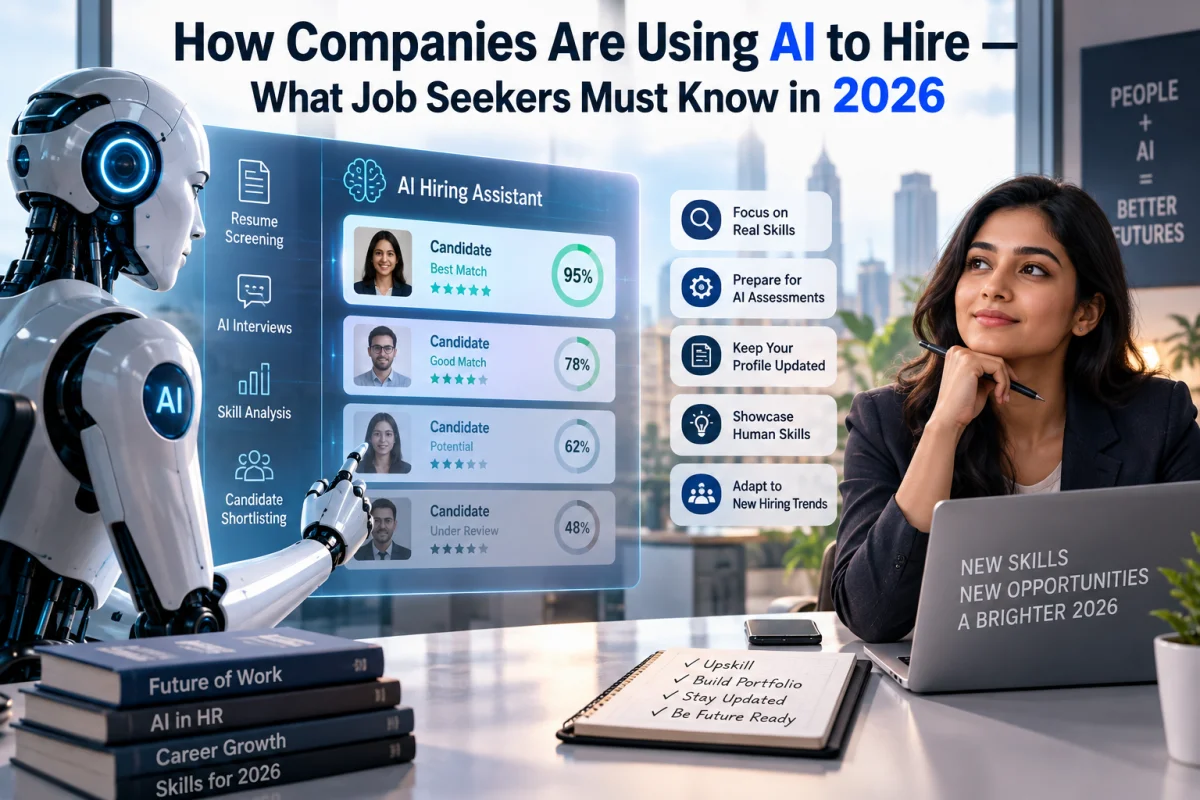
91% of employers now use AI tools to screen resumes. AI sits on both sides of the hiring process — recruiters use it to screen 90% of incoming applications, generate interview questions, score video answers, and rank candidates by predicted fit. And increasingly, the LinkedIn message you receive from a "recruiter" was personalised and sent by an AI tool, not a human.
If you are not aware of how these systems work, you are applying to jobs blind — and losing out to candidates who understand the game.
This guide explains exactly how AI hiring systems work in 2026, what they are looking for, and precisely what you can do — using free tools — to dramatically improve your chances of getting through to a human hiring manager.
How AI Screens Your Resume — What Actually Happens
When you submit a job application online, your resume rarely goes directly to a human recruiter in 2026. It enters an Applicant Tracking System — ATS — which uses AI to parse, analyse, and score your application before any human sees it.
Here is the exact process your resume goes through.
First, the ATS parses your document into plain text — stripping away formatting, columns, tables, graphics, and unusual fonts. If your resume uses a complex two-column design or icons, the parsing often scrambles the content entirely — putting your skills section where your work experience should be, or missing entire sections.
Second, the AI compares your parsed text against the job description using what are called embeddings — a form of AI analysis that looks for semantic similarity, not just exact keyword matching. Modern ATS systems do not just check whether the word "project management" appears — they look for evidence of project management capability across how you describe your work.
Third, the system generates a match score. Most companies set a minimum threshold — candidates below it are never reviewed by a hiring manager regardless of their actual qualifications. 75% of qualified candidates are filtered out at this stage alone, according to recruitment research.
Fourth, if you clear the threshold, your resume enters a ranked shortlist. The recruiter typically reviews the top 10 to 20% of scored applications.
Understanding this process changes how you approach every application.
What AI Is Actually Looking For in Your Resume
Modern AI screening in 2026 has moved significantly beyond simple keyword matching. Here is what it is evaluating — and what most job seekers miss.
Keyword alignment with the job description. This remains the most important factor. The AI compares your resume against the specific job posting — not against some generic idea of what the role requires. This means a single generic resume no longer works. Each application needs specific tailoring. Copy exact phrases and terms from the job description naturally into your resume — the skills section, the job title, the key responsibilities.
Measurable achievements, not duties. AI systems in 2026 are increasingly trained to distinguish between resumes that list duties — "responsible for managing projects" — and resumes that describe impact — "delivered 12 projects on time and under budget, reducing average delivery time by 30%." Numbers and measurable results dramatically improve your match score.
Communication quality and clarity. This surprises many people. AI screening tools now evaluate writing clarity and structure as a signal of workplace effectiveness — because communication quality correlates with performance across most roles. Clear, direct sentences with specific details score higher than vague, generic descriptions.
Consistency and credibility signals. AI systems cross-reference information — checking that dates align across your experience, that claimed skills match described responsibilities, and that progression makes logical sense. Unexplained inconsistencies create friction in the scoring.
Formatting that AI can read. A beautiful two-column design that impresses a human can completely break ATS parsing. Use a clean single-column format, standard section headings, no tables, no text boxes, no icons or graphics, and a standard font. PDF and Word formats are both accepted by most systems in 2026, but always check the job posting's preference.
AI Video Interviews — What They Analyse and How to Prepare
A growing number of companies in 2026 use AI-powered video interview platforms — tools like HireVue and Spark Hire — as a screening step before any human interview takes place.
These platforms record your responses to pre-set questions and analyse them automatically. Here is exactly what the AI is evaluating.
Speech patterns and pace. The AI analyses how clearly you enunciate, how steadily you speak, and whether you use excessive filler words — um, uh, like, you know. Practise your answers out loud, not just in your head. Record yourself and watch it back.
Eye contact and engagement. Look directly at your camera — not at your own face on the screen. Looking at the camera reads as direct eye contact to the AI analysis system. Position your camera at eye level. Frame your face in the upper third of the screen with front lighting and a neutral background.
STAR framework answers. The keyword density that comes from structuring your answers as Situation, Task, Action, Result consistently scores well with AI scoring models. Every behavioural question — "Tell me about a time when..." — should be answered in STAR format with specific, measurable results in the Result section.
Keyword relevance. AI video platforms analyse the content of what you say, not just how you say it. Weave the job description's key terms naturally into your answers. Do not parrot the job description word for word — but demonstrate familiarity with the role's priorities through the language you use.
Both HireVue and Spark Hire offer free practice tools on their websites — use them before any real AI video interview so the format is familiar.
The AI Resume Trap — What to Avoid
Here is something that catches thousands of job seekers in 2026.
Between 40% and 80% of job applicants now use AI to write resumes and cover letters. And 68% to 80% of hiring managers say they can identify AI-generated applications — and are actively rejecting them.
This creates a contradiction that many job seekers do not navigate correctly. ATS systems need keyword-optimised, clearly structured content. Human reviewers — who see your application after you pass the ATS — are rejecting anything that reads as generic AI output.
The answer is not to avoid AI — it is to use it correctly.
Use AI to optimise your resume's keyword alignment and structure. Use it to identify what is missing. Use it to generate bullet point options. Then rewrite everything in your own voice, with your specific experiences and authentic details. The AI gets your content right. You make it sound like you.
A resume that is 80% your genuine voice — with specific, authentic details from your experience — and 20% AI-assisted keyword optimisation will consistently outperform both a generic human-written resume and a fully AI-generated one.
Free AI Tools That Give Job Seekers a Real Advantage in 2026
Here are the most practical free tools available right now for navigating AI hiring systems.
ChatGPT is the most versatile free job search tool available. Use it to compare your resume against a specific job description and identify keyword gaps, generate tailored bullet points for specific roles, practise interview questions and get detailed feedback on your answers, and research companies before interviews. Paste the full job description and your current resume into ChatGPT and ask: "What keywords are missing from my resume? What bullet points should I add to improve my match for this role?"
Claude is particularly strong for writing — use it to improve the clarity and impact of your resume's language, rewrite vague duty descriptions into achievement-focused bullet points, and draft cover letters that sound genuinely human rather than AI-generated. Claude's natural writing quality makes it the better choice for the final writing pass on any application document.
Rezi is a free AI resume tool built specifically for ATS optimisation. It evaluates your resume on a 23-point scoring system — keyword usage, formatting, section structure, achievement language — and tells you exactly what to fix. The free tier gives you access to the core scoring and optimisation features.
Jobscan compares your resume against a specific job description and gives you a percentage match score — the same approach the ATS uses. The free tier gives you a limited number of scans per month, which is enough to optimise your most important applications.
Google Gemini with web search enabled is excellent for company research before interviews. Ask it to summarise a company's recent news, explain their products or services simply, and identify what challenges they are currently facing — giving you context that makes your interview answers much more relevant and impressive.
What the LinkedIn Message From a "Recruiter" Actually Is
This is something almost nobody talks about honestly — and it changes how you should respond to recruiter outreach.
Tools like SeekOut, hireEZ, and Gem allow recruiters to write a single message template and have AI personalise and send it to 200 candidates per day. The personalisation — your name, your current role, a reference to something from your profile — is automated. The enthusiasm and urgency in the message are also typically scripted.
The hit rate of unsolicited recruiter messages converting into interviews dropped from around 40% in 2022 to approximately 12% in 2026 — partly because volume has increased so dramatically that candidates are responding less, and partly because AI-generated outreach is increasingly obvious.
The practical implication: do not treat every recruiter message as a high-signal opportunity. Respond to the ones where the role genuinely matches your skills and goals. When you respond, be specific about the role and why you are interested — recruiter AI assistants actively filter out one-line "yes, interested!" replies in favour of responses that demonstrate actual engagement with the specific opportunity.
Is AI Hiring Fair? The Honest Answer
This is the question every job seeker deserves an honest answer to — and the reality is complicated.
AI hiring systems can remove some forms of human bias from early screening — they do not see your name, photo, or age when evaluating keyword match. In theory, this could make early screening more meritocratic.
In practice, AI hiring systems inherit the biases present in their training data. If a company's best-performing employees historically came from a narrow set of universities, industries, or backgrounds, an AI trained on that data may systematically disadvantage candidates from other paths — without any human explicitly intending this. The EU AI Act's high-risk rules, which specifically cover AI in employment decisions, will address some of these concerns when they take full effect in 2027 — requiring documented testing for bias and mandatory human oversight of AI hiring decisions.
For job seekers navigating this now: you cannot control the training data of the systems evaluating you. What you can control is making your actual capabilities as visible and clear as possible — using the optimisation techniques in this guide to ensure your genuine qualifications are not being filtered out by formatting errors or keyword gaps that hide your real value.
A Practical Action Plan — What to Do This Week
Here is the most useful thing you can take from this guide — a specific action plan you can complete in a few hours.
Take your current resume and paste it into ChatGPT alongside the job description for the next role you want to apply for. Ask ChatGPT to identify every keyword gap, every duty description that could be rewritten as an achievement, and every section that could be clearer. Use its suggestions as raw material — then rewrite everything in your own voice.
Run the updated resume through Jobscan to check your match score. Aim for at least 65 to 75% keyword match on every targeted application.
Format your resume in a clean, single-column design with standard headings. Remove all graphics, tables, text boxes, and unusual fonts. Save it as a Word document or clean PDF depending on what the application specifies.
Practise your top ten interview questions with Claude — answering in STAR format and asking for specific feedback on each answer. Do this out loud. Then record yourself answering them and watch the playback.
And most importantly — build your network. Referrals bypass AI screening entirely. One relevant connection who can refer you internally is worth more than fifty perfectly optimised applications.
Final Thoughts
AI has genuinely transformed hiring in 2026 — and pretending otherwise leaves you at a significant disadvantage. The job seekers who understand how these systems work and adapt their approach accordingly are landing interviews at dramatically higher rates than those who continue sending the same generic resume to every job posting.
None of this replaces the fundamentals — doing work that matters, building real skills, and connecting with people in your field. But understanding the AI layer that now sits between your application and the human who will eventually hire you is no longer optional. It is simply how hiring works now.
Want to stay updated on AI tools, career tips, and the latest news in artificial intelligence? Visit ArtificialIntelligenceFiles.com — your simple guide to everything happening in AI right now, updated every week.
Frequently Asked Questions (FAQs)
Q1. How does AI screen resumes in 2026?
AI resume screening works in four steps. First, the Applicant Tracking System parses your resume into plain text — which is why complex formatting often causes problems. Second, the AI compares your content against the job description using semantic similarity analysis, not just keyword matching. Third, it generates a match score. Fourth, candidates above a minimum threshold enter a ranked shortlist for human review. 75% of qualified candidates are filtered out at this stage alone — making ATS optimisation one of the most important parts of job searching in 2026.
Q2. What do AI video interview systems actually analyse?
AI video interview platforms like HireVue and Spark Hire analyse several dimensions simultaneously. They evaluate speech clarity, pace, and filler word frequency. They track eye contact — looking at your camera reads as confident eye contact to the system. They analyse the content of your answers for keyword relevance to the role. And they evaluate how well your answers are structured — STAR format answers that include specific, measurable results consistently score well with AI scoring models. Both platforms offer free practice tools to help you prepare.
Q3. Should I use AI to write my resume in 2026?
Use AI as an optimisation tool, not a ghostwriter. Between 40% and 80% of applicants now use AI to write resumes, and 68% to 80% of hiring managers say they can identify AI-generated applications and are rejecting them. The effective approach is to use AI — particularly ChatGPT and Rezi — to identify keyword gaps, suggest achievement-focused bullet points, and check formatting. Then rewrite everything in your own voice with specific, authentic details from your experience. AI optimises the structure; you provide the authentic content.
Q4. How can I improve my chances of passing AI resume screening?
The most effective steps are: tailor your resume to each specific job description rather than sending one generic version everywhere; include exact keywords and phrases from the job posting naturally in your resume; rewrite duty descriptions as measurable achievements with specific numbers; use a clean single-column format with standard headings and no graphics or tables; and run your resume through a tool like Jobscan to check your keyword match score before submitting. Aim for at least 65% keyword match on every targeted application.
Q5. Is it fair that AI systems are making hiring decisions?
AI hiring systems can reduce some forms of human bias in early screening — they evaluate content rather than seeing your photo, name, or other demographic signals at the keyword matching stage. However, they can also perpetuate historical biases present in training data, potentially disadvantaging candidates from non-traditional backgrounds. The EU AI Act specifically classifies AI in employment decisions as high-risk — requiring documented bias testing and mandatory human oversight when those rules take full effect in 2027. For now, the most practical response is to optimise your application to make your genuine qualifications as visible as possible, and actively build referral relationships that bypass automated screening entirely.