Search "make money with AI" and you'll find a wall of thumbnails screaming about $10,000 months and secret ChatGPT prompts nobody wants you to know. Almost none of it holds up.
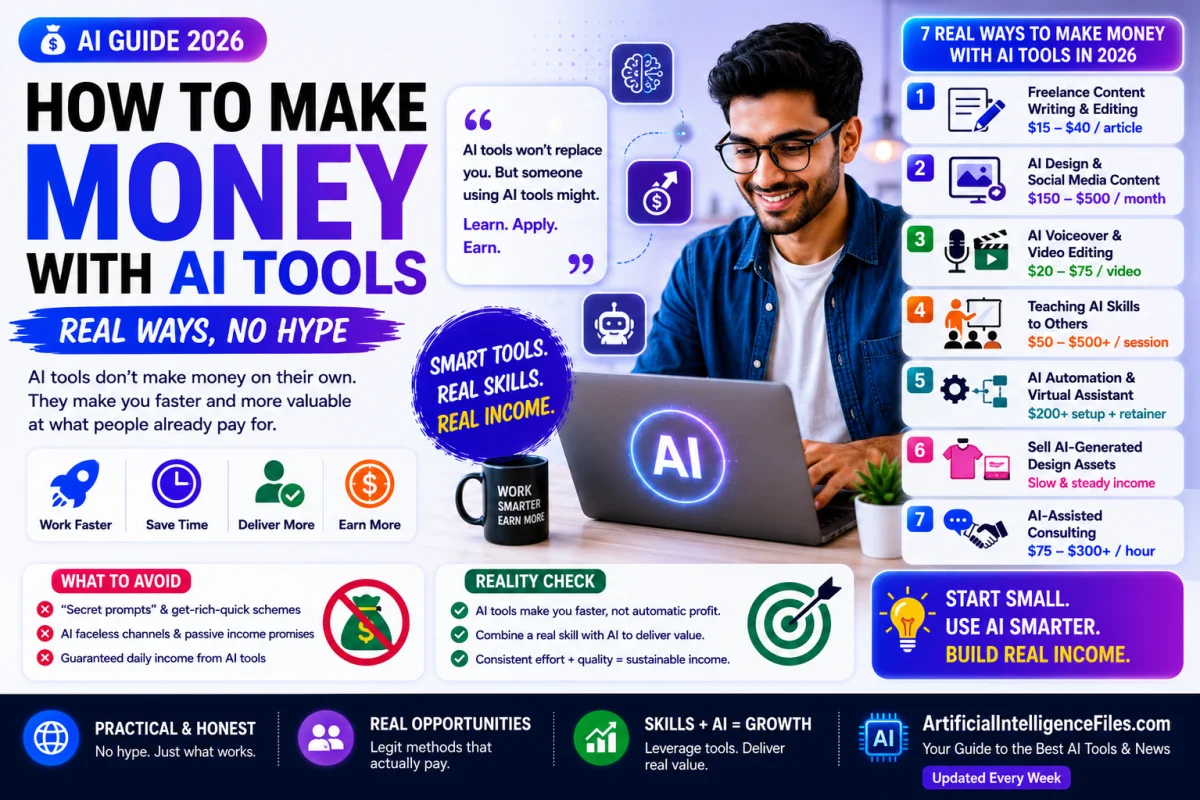
Here's the honest version instead. AI tools genuinely can help you earn money in 2026 — but the real path looks like offering a service faster and cheaper than before, not discovering some magic prompt. Below are methods that are actually working right now, what they realistically pay, and what skill or effort they require.
First — A Reality Check
AI tools don't make money on their own. They make you faster and more capable at doing something someone else is willing to pay for. That's the whole model.
If you already have a skill — writing, design, video editing, customer service, teaching — AI tools can help you take on more clients, deliver faster, or offer a service you couldn't easily offer before. If you have zero skills and zero effort to put in, no AI tool changes that. Keep that in mind as you go through this list, and be skeptical of anything promising passive income with no ongoing work.
1. Freelance Content Writing and Editing (with AI as Your Assistant)
Businesses still need blog posts, product descriptions, email newsletters, and social captions — and they need them faster than ever. Using AI tools like ChatGPT or Claude as a first-draft assistant lets you take on more clients without sacrificing quality, as long as you edit, fact-check, and add your own voice rather than copy-pasting raw output.
Where to start: freelance platforms like Upwork and Fiverr, or direct outreach to small businesses that don't have in-house content teams.
Realistic expectation: most beginners start around $15–40 per article and scale up with experience and a portfolio. This is a real skill-based income, not overnight money.
2. AI-Assisted Graphic Design and Social Media Content
Tools like Canva AI and Adobe Firefly let you produce social media graphics, ad creatives, and simple branding assets far faster than manual design work. Small businesses — especially local shops, restaurants, and service providers — are a strong market here because they often can't afford a full-time designer but still need a steady stream of content.
Where to start: offer a monthly content package (say, 15–20 social posts a month) to a handful of local businesses.
Realistic expectation: monthly retainers for small-business social content commonly range from $150–500 depending on your market and volume.
3. AI Voiceover and Video Editing Services
Tools like ElevenLabs for voice generation and CapCut for AI-assisted editing have made it realistic for one person to offer voiceover, dubbing, or short-form video editing as a service — work that used to require a full production team.
Where to start: offer voiceover or Reels/Shorts editing to content creators, course sellers, or small e-commerce brands who need product videos.
Realistic expectation: per-project pricing for short-form video editing typically starts in the $20–75 range per video and grows with speed and quality.
4. Teaching AI Skills to Others
As AI tools spread faster than most people can keep up with, there's real demand for people who can teach others how to actually use them — for a business, a job, or just personal productivity. This doesn't require being a world expert; it requires being a few steps ahead of the person you're teaching.
Where to start: short paid workshops for local business owners, one-on-one coaching, or a simple paid guide/course on a specific use case (e.g., "AI tools for real estate agents").
Realistic expectation: this scales with your reputation — early sessions might be low-cost or free to build testimonials, growing from there.
5. AI-Powered Virtual Assistant and Automation Services
Small businesses are increasingly interested in automating repetitive tasks — scheduling, email responses, basic customer support — but most don't know where to start. If you can set up simple automations using tools like Zapier combined with an AI chatbot, you're offering a genuinely valuable service.
Where to start: approach small businesses you already have some connection to, and offer to automate one specific pain point (like auto-responding to common customer questions).
Realistic expectation: setup fees plus a monthly maintenance retainer is a common structure, often starting in the low hundreds of dollars per client.
6. Selling AI-Generated Design Assets (Print-on-Demand, Templates, Stock Assets)
Using AI image tools to create designs for print-on-demand products (t-shirts, mugs, wall art) or design templates (Canva templates, social media kits) is a genuine, if slower-building, income stream. This is closer to a long-term side project than fast income — most sellers see gradual growth rather than instant sales.
Where to start: platforms like Etsy for print-on-demand, or template marketplaces for design assets.
Realistic expectation: this is volume and patience-dependent — expect a slow first few months while you build a catalog and any traction.
7. AI-Assisted Consulting for Small Businesses
If you understand a specific industry well (real estate, healthcare admin, retail, hospitality), pairing that knowledge with AI tools to solve a specific business problem is a strong, underused opportunity. Most small business owners don't have time to figure out which AI tools actually help them — that gap is where you get paid.
Where to start: your existing network, local business associations, or LinkedIn outreach targeting a specific industry.
Realistic expectation: consulting rates vary widely by industry and experience, but this tends to pay significantly more per hour than execution-based freelance work once you have a track record.
What to Avoid
A few honest warnings, since this space attracts a lot of noise:
"Prompt selling" as a business model rarely works at scale — most useful prompts are simple enough that buyers figure them out themselves after one purchase.
Fully automated "AI dropshipping" or "AI faceless channel" courses that promise passive income with zero ongoing work are almost always overselling the reality. Real income streams in this space still require consistent effort, especially in the first several months.
Any offer promising guaranteed daily income from an AI tool is a red flag. Legitimate AI-assisted work follows the same rules as any freelance or business income — inconsistent at first, more predictable as you build a reputation and client base.
Final Thoughts
The honest throughline across every method above: AI tools make you faster and more capable, not automatically profitable. The people actually earning money with AI in 2026 are combining a real skill or service with AI tools that speed up their delivery — not discovering a secret shortcut.
Start with one method that matches a skill or interest you already have, use AI tools to work faster within it, and build from there.
Want to explore the AI tools mentioned in this article? Browse our full AI Tools directory, or read more practical guides like this one on our AI Blogs page.
Want to stay updated on the latest AI tools, side hustle ideas, and news as they happen? Visit ArtificialIntelligenceFiles.com — your simple, honest guide to everything happening in AI right now, updated every week.
Frequently Asked Questions (FAQs)
Q1. Can you really make money with ChatGPT in 2026?
Yes, but not by ChatGPT doing the work alone. People make money by using ChatGPT to speed up a real service — writing, editing, research, customer support drafts — that someone is already willing to pay for. It's a productivity tool, not an automatic income source.
Q2. What's the fastest way to start earning with AI tools?
Freelance writing or social media content creation tend to have the lowest barrier to entry — you can start offering services on platforms like Upwork or Fiverr within days, using AI tools to speed up your drafts while you still edit and add your own judgment.
Q3. Do I need technical skills to make money with AI?
No. Most of the methods above — content writing, design, video editing, teaching, consulting — rely on a real-world skill you already have or can learn, with AI tools speeding up execution rather than requiring coding knowledge.
Q4. Is "AI side hustle" content on social media trustworthy?
Be skeptical of anything promising guaranteed daily income or fully passive earnings with no ongoing work. Legitimate AI-assisted income streams follow normal freelance and small-business rules — inconsistent at first, growing with reputation and effort over time.
Q5. How much can you realistically earn with AI tools as a beginner?
It depends heavily on the method and your existing skills, but most beginners should expect modest, gradually growing income in the first few months — similar to starting any freelance service — rather than significant earnings immediately.