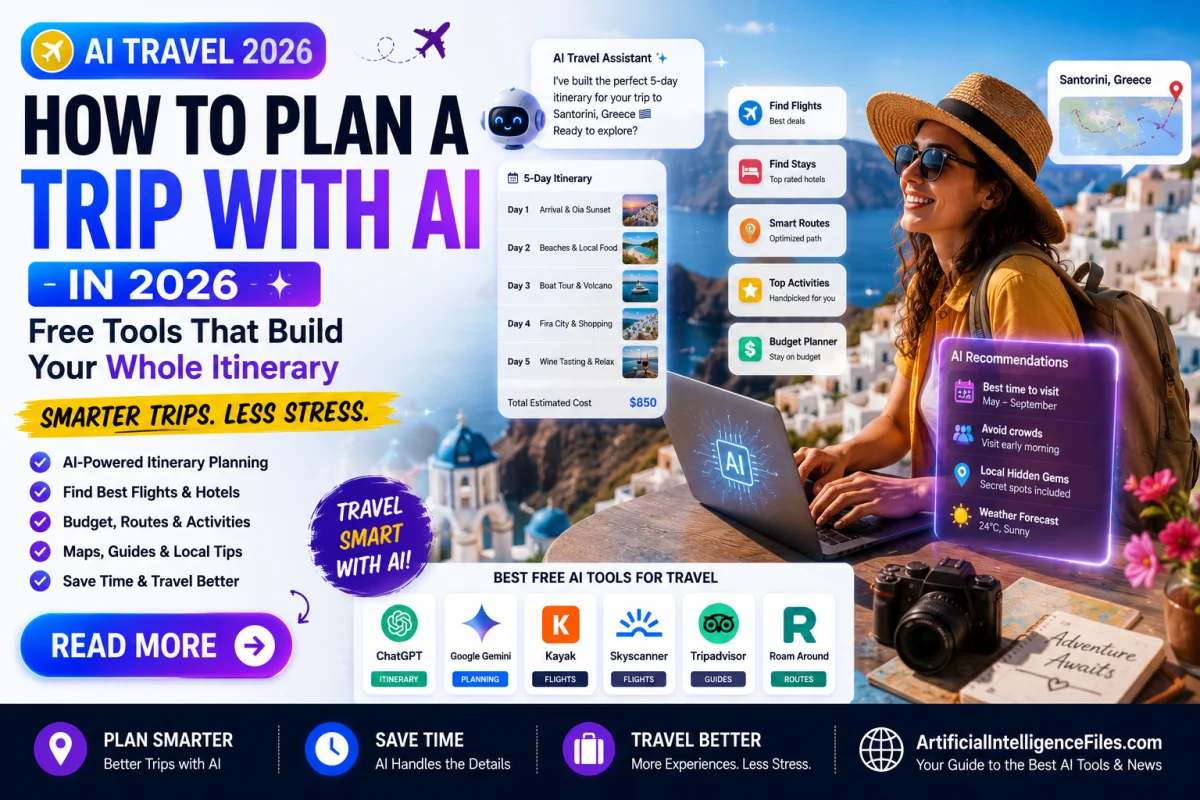
Twenty browser tabs. Three spreadsheets. A group chat that's still arguing about dates.
Planning a trip the old way takes hours you don't really have. In 2026, it doesn't have to. AI travel tools can take your destination, your dates, and your budget, and hand you a full day-by-day itinerary in under a minute — restaurants, sights, timing, and all.
Here's a simple look at the best free tools for this, and how to actually use them well.
Why AI Travel Planning Actually Works Now
A couple of years ago, "AI trip planner" was mostly a search box with a fancy name. That has changed. Roughly 4 in 10 travelers worldwide now use AI tools to plan trips, and among younger travelers that number is closer to 6 in 10. The tools have genuinely gotten smarter — they now think about things like grouping nearby sights together so you're not backtracking across a city, or leaving a lighter afternoon after an early flight.
1. ChatGPT
ChatGPT isn't built specifically for travel, but it's one of the most flexible options available. Describe your trip in detail — "10 days in Japan, love food and quiet temples, hate huge crowds, budget-friendly" — and it will build a real itinerary. The best part is the back-and-forth: you can immediately follow up with "add a rainy-day backup" or "what's the best way to get from Kyoto to Osaka," and it adjusts instantly.
Keep in mind: it can occasionally suggest a restaurant that's closed or a price that's outdated, so double-check anything time-sensitive before you rely on it.
2. Gemini AI
Gemini's advantage is that it searches the live web while answering, which makes it noticeably more reliable for fact-based questions — current visa rules, local transport options, or what the weather is actually like that time of year. Use it for the research-heavy parts of planning that ChatGPT sometimes gets wrong.
3. Mindtrip
Mindtrip is one of the few dedicated AI trip planners with no paywall at all — no message limits, no locked export button. Describe your trip and it builds a complete itinerary with map-based location cards, which makes it especially easy for a first-time AI planner or a family trip where everyone needs to see the plan at a glance.
4. Wanderlog
Wanderlog is best if you're a visual planner. It lays your whole trip out on a map with a drag-and-drop timeline, so you can literally see your days and reorder things if the route doesn't make sense. Great for road trips where geography matters more than anything else.
5. Layla
Layla is the most fun tool for the early "where should we even go" stage. It shows real short-form video from travelers at each destination, so you can see the actual vibe of a place before committing. It's not a full planning system though — no budget tools, no group editing — so use it for inspiration, then move to another tool to build the real plan.
6. Stippl
Stippl stands out because it doesn't stop at the itinerary. Once it's built your plan, you can track your budget automatically (even split by person if you're traveling as a group), manage a shared packing list, and share the whole trip live with everyone going. If you're planning with other people, this is the one tool on this list built specifically for that headache.
7. TripIt
TripIt isn't for building your itinerary — it's for managing it once you're actually traveling. Forward it your flight and hotel confirmation emails and it automatically organizes everything into one clean timeline, with instant alerts if a flight is delayed or a gate changes.
How to Get the Best Results from AI Trip Planning
The quality of what you get back depends heavily on what you put in. Instead of typing "plan a trip to Italy," try something closer to: "Plan a 7-day trip to Italy for a couple who loves food, wants to avoid tourist traps, and has a budget of about $150 a day." The more specific you are about pace, interests, and budget, the more useful the itinerary will be.
And one honest tip: AI is a fantastic starting point, not a final authority. Always double-check visa requirements, opening hours, and anything safety-related through an official source before you travel.
Final Thoughts
You don't need five different apps for one trip. A simple, reliable combo is: use ChatGPT or Gemini for the initial itinerary and research, Mindtrip or Wanderlog to organize it visually, and TripIt to keep everything on hand once you're actually traveling.
Want to explore more AI tools like these? Browse the full AI Tools directory, or check out 10 Best AI Tools for Small Businesses if you're planning a work trip instead of a vacation.
Frequently Asked Questions
What is the best free AI trip planner in 2026? It depends on what you need. ChatGPT is the most flexible for detailed, back-and-forth planning. Mindtrip is the best choice if you want a completely free tool with no locked features. Wanderlog is best if you want to see your trip visually on a map.
Can AI actually build a full travel itinerary for free? Yes. Most of the tools on this list generate a complete day-by-day itinerary at no cost, including destinations, timing, and recommendations. Some, like Layla, cap how many itineraries you can generate per month on the free plan, so check the limits before you commit to one tool.
Can AI replace a travel agent? For straightforward trips, yes — especially if you combine two or three of these tools. For complex trips, like multi-country travel with kids or accessibility needs, AI gives you a strong starting point, but you'll still want a human's judgment for the tricky details.
Is it safe to trust AI-generated travel information? Mostly, but always verify anything critical yourself. AI tools can occasionally get details wrong, like an outdated price or a restaurant that's since closed. Treat the itinerary as a strong first draft, not a final source of truth.
How do I use ChatGPT to plan a vacation step by step? Start by describing your trip in detail: destination, number of days, your travel style, and your budget. Once you get the first itinerary, keep refining it with follow-up questions like "add a rainy-day option" or "swap day 3 for something more relaxed." The more you go back and forth, the better the final plan gets.