What Are AI Agents? How Agentic AI Works With Tools and Takes Actions in 2026
You ask a chatbot a question. It writes an answer. You ask it to summarize a document. It summarizes it. But what if you tell an AI: "Find the best flight for my trip, compare the options, check my calendar, prepare an itinerary, and send me the details." Now the AI has to do much more than generate text. It needs to understand your objective, break the task into smaller steps, decide which tools it needs, retrieve information, perform actions, evaluate the results, and potentially change its approach if something goes wrong. That is the basic idea behind AI agents.
AI agents represent a shift from AI that primarily responds to AI that can act toward a goal. Instead of simply generating an answer, an agent can potentially interact with websites, databases, APIs, files, software applications, and other tools to complete a multi-step task. This distinction is becoming increasingly important in 2026 as businesses move from experimenting with generative AI chatbots toward AI systems designed to automate parts of real workflows.
But an AI agent is not simply "a smarter chatbot." Understanding what makes an agent different requires looking at how it reasons about tasks, uses tools, maintains context, and takes actions.
What Is an AI Agent?
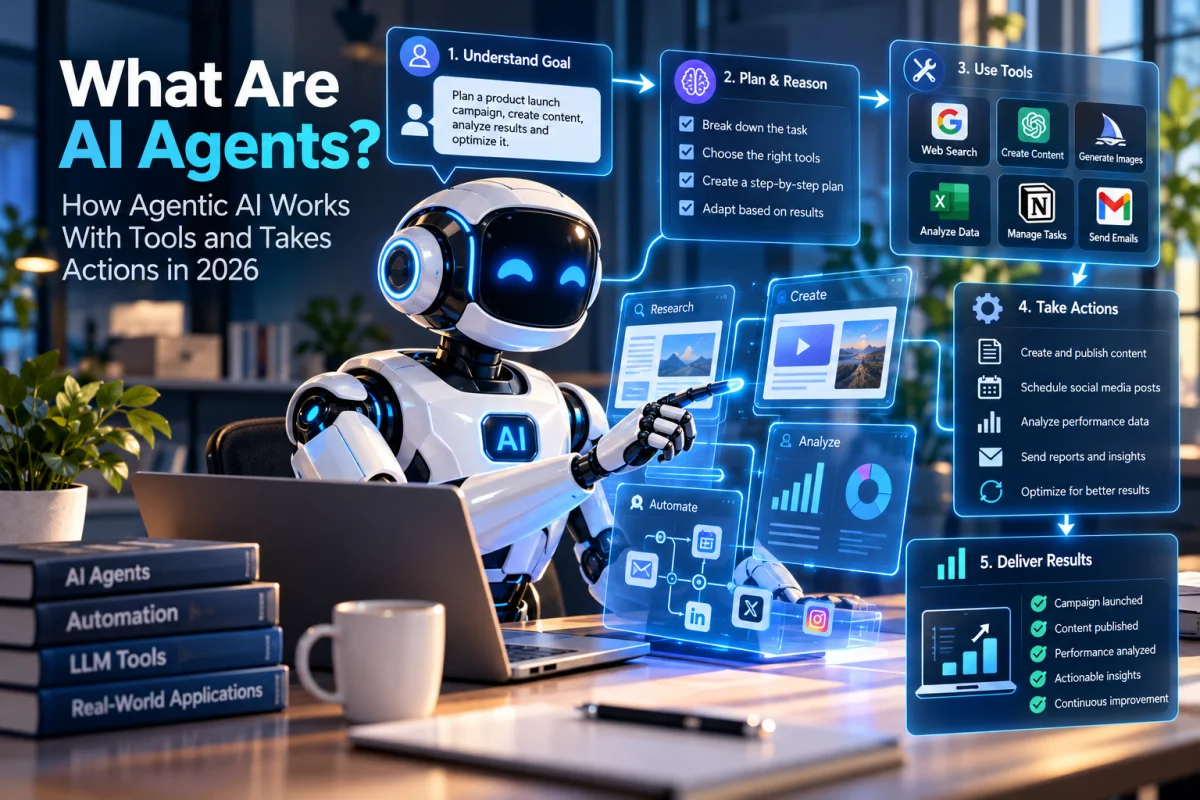
An AI agent is a software system that uses artificial intelligence to pursue a goal by perceiving information, making decisions, using available tools, and taking actions. A traditional chatbot generally follows a simple pattern: User → Prompt → AI → Response. An AI agent can follow a much more complex loop: Goal → Understand → Plan → Use Tools → Observe Results → Decide Next Step → Act → Evaluate.
For example, imagine asking an AI agent: "Research five competitors, compare their pricing, summarize their positioning, and create a report." A basic chatbot might explain how you could do this. An agentic system could potentially search for the competitors, visit their websites, extract relevant information, collect pricing data, compare the products, identify differences, organize the findings, generate a report, and save the report to a specified location.
The important difference is action. The AI is not simply producing text about the task. It is attempting to perform the task.
AI Agent vs AI Chatbot: What's the Difference?
The terms are often used interchangeably, but they describe different concepts. A traditional AI chatbot is primarily designed to answer questions, usually interacts conversationally, may have limited tool usage, generally performs minimal planning, has low autonomy, has limited ability to take external actions, and usually requires the user to direct the workflow manually. An AI agent is designed to achieve goals, can combine conversation with operational actions, uses tools as a core capability, can perform multi-step planning, may operate with greater autonomy, can interact with external systems, can react to results, and can automate parts of a workflow.
A chatbot can tell you how to perform a task. An agent is designed to potentially perform the task. However, the boundary is not always perfectly defined. Modern AI assistants increasingly combine conversational interfaces with tool use and agent-like capabilities. So "agent" should not be treated as a magical technical category. It is better understood as a system architecture centered around goal-directed action.
How Do AI Agents Work?
Most AI agents combine several components. A simplified architecture is User Goal → AI Model → Planning / Decision Making → Tools → Environment → Observation → Next Decision → Action. The AI model provides the intelligence needed to interpret the task and decide what to do next. The tools provide the ability to interact with the outside world. The environment is whatever system the agent is operating in, including websites, databases, software applications, APIs, files, or business systems.
- The Agent Receives a Goal
Everything starts with an objective. For example: "Find ten relevant AI tools for video generation and create a comparison." The agent first needs to understand what "relevant" means. It may need to identify the type of tools required, the number of tools, the comparison criteria, the desired output, available sources, and any constraints. The quality of the initial goal definition can significantly affect the final result.
- The Agent Breaks the Goal Into Steps
A complex objective often cannot be completed in one action. The agent may create a sequence such as Research → Collect → Verify → Compare → Analyze → Generate. For example, to create a competitor report, it may identify competitors, visit their websites, collect product information, research pricing, compare features, identify positioning, organize the findings, and produce the report. This ability to decompose a task is one of the important characteristics associated with agentic systems.
- AI Agents Use Tools
This is where agentic AI becomes particularly powerful. An AI model by itself mainly generates or processes information. A tool gives the system the ability to do something. Tools can include web search, browsers, APIs, databases, calculators, code execution, file systems, email systems, CRM platforms, project management software, spreadsheets, calendar systems, and business applications.
For example, an AI agent researching a company might use a sequence such as Search tool → Website → Database → Calculator → Spreadsheet → Report generator. The model decides when a tool is necessary and interprets the tool's result.
- The Agent Observes the Result
After using a tool, the agent receives information about what happened. For example, a search may return 20 results, an API request may fail, a website may require login, or a product price may be identified as $49 per month. The agent can then determine what to do next. This creates an important feedback loop: Action → Result → Interpretation → Next Action. That loop is one of the defining characteristics of agentic workflows.
- The Agent Takes the Next Action
Suppose an agent is trying to find the price of a software product. It searches the company's website, but the pricing page is unavailable. Instead of immediately stopping, the system might search for another official page, search documentation, check an API, look for another authoritative source, or report that pricing could not be verified if no reliable source exists. This ability to respond to intermediate results makes agentic systems different from simple one-shot generation.
- The Agent Evaluates Its Progress
A more sophisticated agent can evaluate whether it has actually completed the task. For example, if the goal is to find five AI video generators, the agent might check whether it has five tools, whether they are actually video-generation tools, whether the sources are current, whether the information was verified, whether pricing was included, and whether the final format is correct. This creates another loop: Goal → Action → Observation → Evaluation → Action.
What Makes an AI Agent "Autonomous"?
The word autonomous can be misleading. AI agents are not necessarily independent digital employees that can do anything without supervision. Autonomy usually refers to how much of the decision-making and execution process happens without requiring a human to manually direct every step.
Level 1 — AI Assistant: A human asks, "Search for AI video tools." The AI responds with options, and the human decides what happens next.
Level 2 — Tool-Using AI: A human asks, "Research AI video tools and compare their pricing." The AI searches the web, collects information, and produces the comparison.
Level 3 — More Autonomous Agent: A human asks, "Prepare a competitive analysis of the AI video market." The system may determine the research steps, gather information, analyze it, and create the requested deliverable within predefined permissions.
The greater the autonomy, the more important permissions, verification, monitoring, and human oversight become.
Real-World AI Agent Examples
AI agents are useful when a task involves multiple steps, changing information, tools, or decisions.
AI Customer Support Agent
A customer asks, "Where is my order?" An agent could potentially identify the customer, access the order system, retrieve the order number, check shipping status, look up the latest tracking information, and respond to the customer. If the order is delayed, it could potentially follow a different workflow.
AI Sales Agent
A sales agent could potentially identify leads, research companies, enrich contact information, classify prospects, personalize outreach, update CRM records, and schedule meetings. The important point is that these actions can form a connected workflow rather than isolated AI-generated responses.
AI Research Agent
A research agent could search multiple sources, extract relevant information, compare sources, identify conflicting information, organize findings, and produce a research report. This is particularly useful for repetitive research tasks. However, human verification remains important when accuracy matters.
AI Coding Agent
Coding agents can work with software repositories and development tools to perform multi-step programming tasks. A typical workflow might be Understand issue → Inspect code → Modify files → Run tests → Analyze errors → Fix code → Run tests again. This is significantly different from simply asking an AI to write a function because the agent interacts with a development environment and can iterate based on what happens.
AI Marketing Agent
A marketing workflow could potentially involve Research → Keyword analysis → Competitor analysis → Content creation → SEO optimization → Reporting. For example, an agent might be instructed to research a topic and prepare an SEO content brief. The human can then review and approve the output before publication.
What Are AI Agents Used For?
AI agents are particularly useful for workflows that are repetitive, multi-step, tool-dependent, data-heavy, rule-based, or time-consuming. Examples include customer support, lead qualification, research, data analysis, software development, document processing, scheduling, reporting, IT support, content workflows, sales operations, and business intelligence.
AI Agents and APIs: Why They Matter
APIs are one of the most important building blocks of agentic systems. An API allows one software system to communicate with another. For example, an AI agent could potentially use APIs to interact with CRM software, payment systems, databases, inventory systems, calendars, email platforms, analytics platforms, and project management tools.
Imagine an ecommerce support agent receiving the request, "Can I change the shipping address for my order?" The agent might access the order-management API, retrieve the order, check whether it has shipped, determine whether address modification is allowed, update the address if permitted, and confirm the change.
Without access to the relevant system, the AI can only provide instructions. With appropriate tools and permissions, it can potentially perform the workflow.
AI Agents Need Memory — But What Does That Mean?
"Memory" in AI systems can refer to several different things. Short-term context is information available during the current interaction, such as a user's request for a report in PDF format. Working memory is information the agent keeps while completing a task, such as knowing that Competitor A has been researched while Competitor B still needs verification. Long-term memory refers to information stored for future interactions when the system is designed to retain it.
The exact implementation varies between AI systems. Memory can make agents more useful, but it also creates important questions around privacy, security, retention, and data access.
What Are Multi-Agent Systems?
A single AI agent can perform many tasks, but some complex workflows can be divided among multiple specialized agents. This is known as a multi-agent system.
For example, a Research Agent can collect information, an Analysis Agent can analyze the information, a Writer Agent can create the report, and a Review Agent can check the report. The agents can potentially communicate with one another or pass outputs between stages.
A business workflow could therefore look like Research → Analysis → Writing → Quality Control → Final Output.
Multi-agent architectures can be useful, but adding more agents does not automatically make a system better. More components can also mean more complexity, higher cost, more failure points, more difficult debugging, and more opportunities for incorrect information to propagate. The architecture should therefore match the problem rather than simply maximizing the number of agents.
AI Agents vs RPA: What's the Difference?
AI agents are sometimes compared with Robotic Process Automation, or RPA. RPA traditionally automates structured workflows using predefined rules. For example, a traditional RPA workflow might open a spreadsheet, copy a value, open a website, enter the value, and save the result.
An AI agent can operate with more flexible instructions. For example: "Review these invoices, identify unusual entries, verify the relevant information, and prepare a report." Traditional RPA is generally strong for predictable, rule-based workflows, while AI agents can be more flexible when workflows involve unstructured information and model-driven decisions. In practice, the two technologies can also work together.
What Are AI Agent Frameworks?
Building an AI agent from scratch can involve many components. Agent frameworks provide developers with tools for constructing agentic applications. Depending on the framework, capabilities can include tool calling, workflow orchestration, memory, state management, agent coordination, evaluation, observability, retrieval, and model integration.
Popular frameworks and platforms in the agent ecosystem include LangChain, LangGraph, Microsoft AutoGen, CrewAI, and LlamaIndex. The ecosystem changes quickly, so developers should evaluate frameworks based on the specific application rather than choosing one solely because it is popular.
What Is Agentic AI?
Agentic AI is a broader term describing AI systems designed to pursue goals and take actions with some degree of autonomy. Generative AI primarily focuses on creating or transforming information. Agentic AI adds an operational layer: Understand → Plan → Act → Observe → Adapt.
This does not mean every agentic system operates fully autonomously. Agentic behavior exists on a spectrum. Some systems require approval before every important action, while others can execute multiple steps automatically within carefully defined boundaries.
Why AI Agents Are Becoming Important in 2026
The growth of AI agents is closely connected to the evolution of generative AI. Early generative AI applications were primarily about text generation, image generation, summarization, translation, and question answering. The next stage is increasingly about connecting those capabilities to tools and workflows.
Instead of asking an AI to "Write a sales email," the workflow can become "Identify qualified leads, research each company, draft personalized emails, and prepare them for approval." Instead of asking an AI to "Analyze this dataset," the workflow can become "Import the latest data, identify unusual trends, generate the analysis, and prepare the report." The AI becomes part of the workflow rather than simply producing an isolated response.
The Biggest Problems With AI Agents
- Hallucinations: An AI agent can still generate incorrect information. If an incorrect assumption enters a multi-step workflow, the error can potentially propagate through subsequent actions.
- Wrong Tool Usage: An agent may select an inappropriate tool or use a correct tool incorrectly. For example, it might retrieve the wrong database record or misunderstand an API response.
- Cascading Errors: A simple mistake early in a workflow can produce several incorrect downstream actions. For example: Wrong customer → Wrong order → Wrong decision → Wrong communication. This is why validation checkpoints matter.
- Security Risks: Agents can potentially access sensitive systems. If an agent has permission to read emails, access databases, modify records, send messages, or execute code, then a security failure can have real consequences. Agent permissions should therefore be limited to what the workflow actually requires.
- Prompt Injection: External content can contain instructions designed to manipulate an AI system. For example, an agent browsing a webpage might encounter hidden or visible text telling it to ignore its original task. This creates a major security consideration for browser-using and tool-using agents. Systems need safeguards to distinguish trusted instructions from untrusted content.
- Lack of Explainability: Sometimes an agent completes a task without providing a clear explanation of why it selected a particular action. For high-impact applications, organizations may need detailed logs showing what the agent saw, which tools it used, what actions it took, what information influenced the decision, and where human approval occurred.
Why Human Oversight Still Matters
AI agents may automate tasks, but automation does not eliminate responsibility. For low-risk activities, an agent might operate with relatively little supervision. For high-impact decisions, human review can be essential.
Examples include financial transactions, legal decisions, medical decisions, employment decisions, access control, account deletion, and sensitive communications.
A useful principle is: The greater the potential consequence of an incorrect action, the stronger the need for human oversight and controls.
The goal is not necessarily to remove humans from workflows. In many cases, the better approach is to let AI handle repetitive work while humans retain control over important decisions.
How to Build a Simple AI Agent
A basic agent can be conceptualized using five components: Model, Instructions, Tools, Memory / State, and Control Layer.
The AI model interprets instructions and generates decisions. Instructions define the agent's role, objectives, constraints, and rules. Tools provide capabilities such as search, APIs, databases, or code execution. Memory or state maintains the information required to continue the workflow. The control layer defines permissions, validation, approval requirements, monitoring, and failure handling.
A simple architecture could be understood as User → Agent → AI Model → Search / Database / API → Result → Agent evaluates → Next action → Final output.
A Simple AI Agent Example
Imagine an ecommerce business wants an agent to answer customer questions about orders.
The customer says, "Where is my order?" The workflow could involve identifying the customer, retrieving the relevant order, checking the order status, retrieving the latest shipping information, interpreting the status, and responding to the customer. If the shipment is delayed, another workflow might be triggered.
This is much more than generating text. The AI is interacting with a business system and using information from that system to complete a task.
How to Tell if an AI System Is Actually an Agent
Marketing language can make this confusing. A useful way to evaluate an "AI agent" is to ask: Can it pursue a goal through multiple steps? Can it use external tools? Can it observe the results of its actions? Can it decide what to do next? Can it recover or adapt when something changes? Can it complete a task without requiring a human to manually direct every step?
The more of these characteristics a system demonstrates, the more agentic its behavior generally is. Simply adding the word "agent" to an AI product does not automatically make it an autonomous agent.
The Future of AI Agents
AI agents are likely to become an important interface between people and software. Today, humans often have to learn how to use dozens of applications. In the future, a user may increasingly describe the desired outcome in natural language while an AI system handles parts of the underlying workflow.
Instead of Open CRM → Find customer → Open analytics → Export data → Open spreadsheet → Create report → Email team, the interaction could become: "Prepare today's customer performance report and send it to the sales team." The agent would potentially coordinate the underlying tools.
This does not mean traditional software interfaces will disappear. Instead, AI may become another layer through which people interact with existing software.
AI Agents Are Not Magic — They Are Systems
One of the biggest misconceptions about AI agents is that they are independent digital beings that can simply "figure everything out."
In reality, useful agents depend on carefully designed systems. They require capable models, reliable tools, good instructions, appropriate permissions, useful data, error handling, monitoring, security controls, evaluation, and human oversight where necessary.
The quality of an agent is therefore determined not only by the underlying AI model but also by the system built around it.
Final Thoughts
AI agents represent an important evolution in artificial intelligence. Traditional AI often answers questions. Generative AI creates content. Agentic AI goes one step further by connecting intelligence with tools, decisions, workflows, and actions.
The fundamental loop is simple: Goal → Plan → Act → Observe → Adapt.
That loop can power everything from customer support and research to software development, sales operations, data analysis, and business automation.
But greater autonomy also means greater responsibility. An agent with access to real systems can potentially make useful changes — and incorrect ones. That makes permissions, monitoring, security, testing, and human oversight essential.
The most useful way to think about AI agents in 2026 is not as replacements for humans, but as software systems capable of carrying out increasingly complex portions of a workflow.
The technology is still evolving rapidly. But the direction is clear: AI is moving from simply generating answers toward helping systems accomplish goals.
Want to understand the latest AI tools, technologies, companies, and trends? Visit Artificial Intelligence Files for practical AI guides, tool explainers, and the latest developments in artificial intelligence.
Frequently Asked Questions (FAQs)
Q1. What are AI agents? AI agents are AI-powered software systems designed to pursue goals by understanding instructions, planning steps, using tools, observing results, and taking actions. Unlike basic chatbots that primarily generate responses, agents can potentially interact with external systems and complete multi-step workflows.
Q2. What is the difference between AI agents and chatbots? A chatbot primarily responds to user prompts, while an AI agent is designed to accomplish a goal through multiple steps. An agent can potentially use tools such as web search, APIs, databases, software applications, and code execution to perform actions rather than simply describe them.
Q3. What is agentic AI? Agentic AI refers to AI systems designed to pursue objectives through planning, decision-making, tool use, and action. Agentic behavior can range from systems that require frequent human approval to systems that can autonomously execute multiple steps within predefined permissions.
Q4. What are examples of AI agents? Examples include customer-support agents, coding agents, research agents, sales agents, data-analysis agents, IT-support agents, and workflow automation agents. Their common characteristic is the ability to perform multiple connected actions toward a defined objective.
Q5. Can AI agents use tools? Yes. Tool use is a central capability of many AI agents. Depending on their configuration and permissions, agents can use web search, APIs, databases, calculators, code execution environments, file systems, calendars, CRMs, and other software tools.
Q6. Are AI agents fully autonomous? Not necessarily. Autonomy exists on a spectrum. Some agents require human approval before important actions, while others can complete multiple steps independently within predefined boundaries. The appropriate level of autonomy depends on the task, risk, permissions, and system design.
Q7. What are the risks of AI agents? Important risks include hallucinations, incorrect tool usage, cascading errors, security vulnerabilities, prompt injection, unauthorized actions, privacy issues, and insufficient explainability. Strong permissions, monitoring, testing, validation, and human oversight can reduce these risks.
Q8. Are AI agents going to replace humans? AI agents can automate portions of workflows, particularly repetitive and multi-step tasks, but that does not mean every human role will disappear. Their impact will vary by occupation and workflow. In high-impact situations, human judgment and oversight can remain particularly important.
Q9. What is a multi-agent system? A multi-agent system uses multiple specialized AI agents that collaborate or pass information between one another. For example, one agent could conduct research, another could analyze the results, and another could prepare the final report.
Q10. What is the future of AI agents? AI agents are likely to become increasingly integrated with business software, productivity tools, development environments, and online services. A major direction is the shift from AI that primarily generates content toward AI systems that can coordinate tools and execute parts of complete workflows.