You have probably heard the phrase "AI agents" everywhere lately — in tech news, on social media, and in conversations about the future of work. But what does it actually mean?
If you have ever used ChatGPT or Google Gemini, you already know what an AI chatbot is. An AI agent is the next step up — and it is a big one. Understanding the difference between the two is one of the most useful things you can learn about AI in 2026.
Let us break it all down from scratch, in plain simple language.
The Simplest Way to Understand AI Agents
Here is the easiest way to think about it.
A regular AI chatbot is like asking a colleague a question. They answer it, and then the conversation is over. You still have to go and do the actual work yourself.
An AI agent is like giving a colleague a project. You tell them the goal. They figure out the steps, do the research, make the decisions, take the actions, and come back to you with the finished result — without you having to guide every single step along the way.
That one difference changes everything.
So What Exactly Are AI Agents?
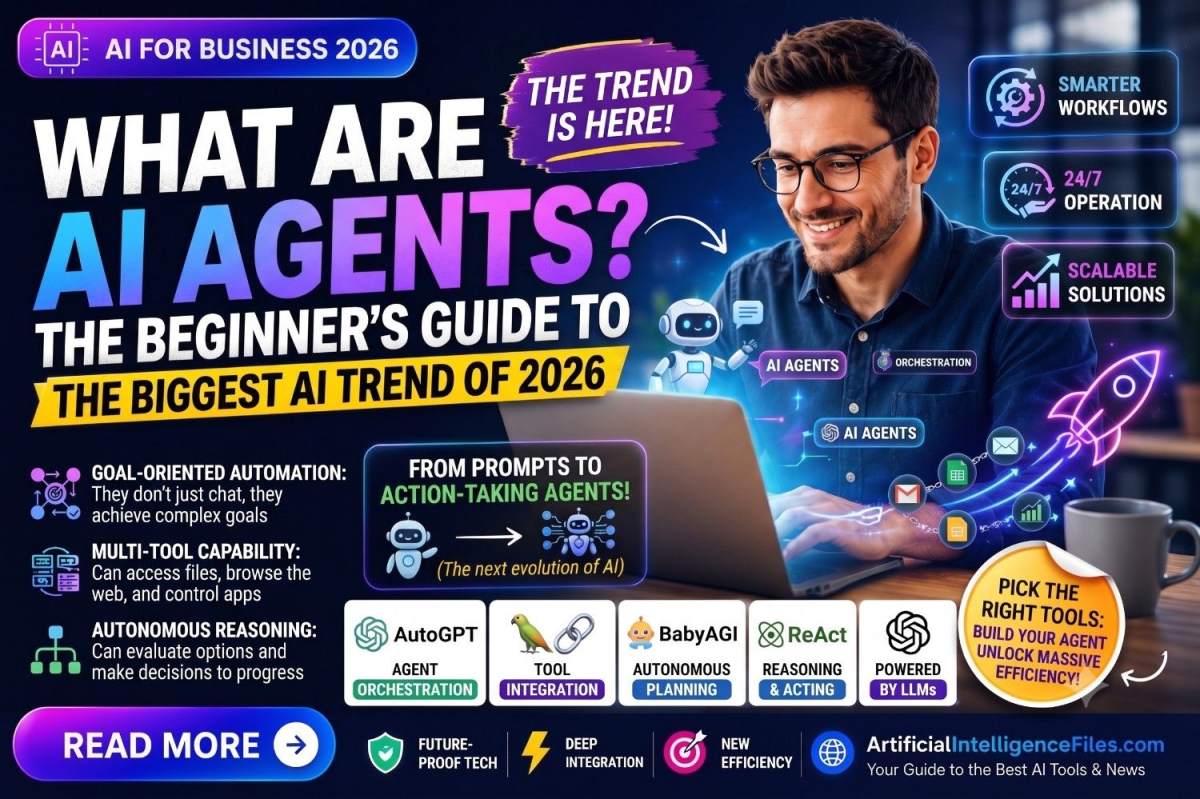
An AI agent is a software system that uses artificial intelligence to work towards a goal and complete tasks on its own. You give it an objective — not just a question — and it takes a series of actions by itself to achieve that objective.
An AI agent can browse the web, write emails, search through documents, book appointments, write and test code, and make decisions — all in one continuous flow, without you having to stay involved at every step.
Think of it like having a highly capable assistant who never sleeps, never forgets, and never needs to be told the same thing twice.
AI Agents vs Chatbots — What Is the Difference?
This is the question most people ask first, and it is a great one.
A chatbot answers one question at a time. Every time you send a message, it reads it, generates a response, and stops. It is a back-and-forth conversation — you do the work, the chatbot helps with individual steps.
An AI agent operates in a continuous loop. You give it a goal, and it keeps thinking and acting on its own until the task is completely finished. It uses tools, searches for information, makes decisions based on what it finds, and only comes back to you when it needs your approval or when the job is done.
A simple example makes this clear. If you ask a chatbot to plan a trip to Tokyo, it will describe some ideas. If you give the same goal to an AI agent, it will search for flights, check hotel prices, read reviews, compare options based on your budget, and come back to you with a full itinerary ready to book — without you having to ask 20 follow-up questions.
How Do AI Agents Work?
Every AI agent — no matter what it does — works through a simple loop that repeats until the task is finished.
First, it receives your goal. This is the instruction or objective you give it at the start.
Second, it makes a plan. It breaks the goal down into smaller steps and decides what needs to happen first, second, and third.
Third, it takes action. It uses tools to get things done — searching the web, opening apps, writing content, running calculations, sending messages, or whatever the task requires.
Fourth, it checks the result. It looks at what happened and decides whether the goal is closer to being achieved or whether it needs to take a different approach.
It keeps repeating this loop — plan, act, check — until the job is complete. This is what makes AI agents fundamentally different from everything that came before them in the world of AI.
Real-Life Examples of AI Agents in Action
The best way to understand AI agents is to see what they are already doing in the real world right now.
Microsoft Copilot Agents work inside Microsoft 365 apps. They can read your emails, draft replies, update spreadsheets with information from your inbox, and organise your calendar — all running automatically in the background while you focus on other work.
Salesforce Agentforce handles customer service for businesses around the clock. When a customer sends a question, the agent reads it, looks up the customer's history, finds the right answer from the company's knowledge base, and replies — all without a human being involved. It only escalates to a real person when the situation truly requires it.
Devin by Cognition AI is a software engineering agent. You give it a coding task. It sets up a development environment, writes the code, tests it, finds the bugs, fixes them, and submits the finished work — behaving like a junior developer who works through the night without needing breaks.
Customer support agents used by e-commerce companies can automatically process refunds, check order statuses, answer product questions, and resolve complaints — handling thousands of customers at the same time, 24 hours a day.
Research agents can be given a topic like "find the top five competitors for my business and summarise their pricing models." The agent searches the web, reads through websites, compares the information, and returns a clean written summary — a task that would take a human researcher several hours.
Best Free AI Agents You Can Try Right Now in 2026
You do not have to build anything or spend any money to experience AI agents for yourself. Here are the best free options available right now.
ChatGPT now includes agent-like features on the free plan. You can ask it to search the web, analyse files, write code, and chain together multi-step tasks in a single conversation. It is the easiest starting point for anyone new to AI agents.
Google Gemini is deeply integrated with Google's apps — Gmail, Docs, Drive, and Calendar. On the free plan, it can help you draft and send emails, organise your files, and summarise documents across your Google account, acting as a lightweight personal agent inside tools you already use every day.
Microsoft Copilot is free to use and built into Windows, Edge, and Microsoft 365. It can help you with multi-step tasks across Microsoft's apps and has agentic features that work directly in your browser.
Perplexity AI behaves like a research agent. Ask it a complex question and it searches multiple sources in real time, reasons through the information, and delivers a well-structured answer with sources — far beyond what a standard chatbot can do.
Claude by Anthropic is one of the most capable free AI tools for long, multi-step reasoning tasks. It excels at reading long documents, analysing complex problems, and working through detailed tasks step by step with a level of accuracy that stands out in 2026.
Why AI Agents Matter So Much in 2026
Google Cloud, IBM, and MIT Sloan all independently named AI agents as the single most important technology shift in 2026. Gartner reported a 1,445% increase in interest in AI agent systems between 2024 and 2025 — and that number has only kept rising.
The reason is simple. AI chatbots helped people get answers faster. AI agents help people get work done faster. That is a much bigger change — and it affects every industry, every job role, and every type of business on the planet.
The people and businesses that understand AI agents early are the ones who will save the most time, move the fastest, and get ahead while everyone else is still catching up.
Final Thoughts
AI agents are not science fiction. They are not complicated. And they are not something you need a computer science degree to understand or use.
They are simply AI systems that work towards goals rather than just answering questions — and in 2026, they are already being used by millions of people every single day to save hours of work each week.
Start with one of the free tools listed above. Give it a goal instead of a question. See what happens. That one experience will show you more clearly than any article what AI agents are capable of.
Want to stay updated on the latest AI agents, tools, and news as they happen? Visit ArtificialIntelligenceFiles.com — your simple guide to everything happening in AI right now.