Here is a problem that thousands of businesses discovered in 2026 — the hard way.
They built an AI-powered product. It worked brilliantly in testing. They launched it. Customers started using it. And then, silently, without any error messages or alarms, the AI started getting worse.
The responses became less relevant. The answers became less accurate. In some cases, the AI started giving confidently wrong information. Nobody noticed for weeks — because nobody was watching.
This is the problem that AI observability solves. And it is the reason AI observability just became the single fastest growing topic in the entire AI industry — trending at 9,300% growth on Exploding Topics in October 2026.
This guide explains what AI observability is, why it matters, and what the best free tools are — in the simplest language possible.
What is AI Observability?
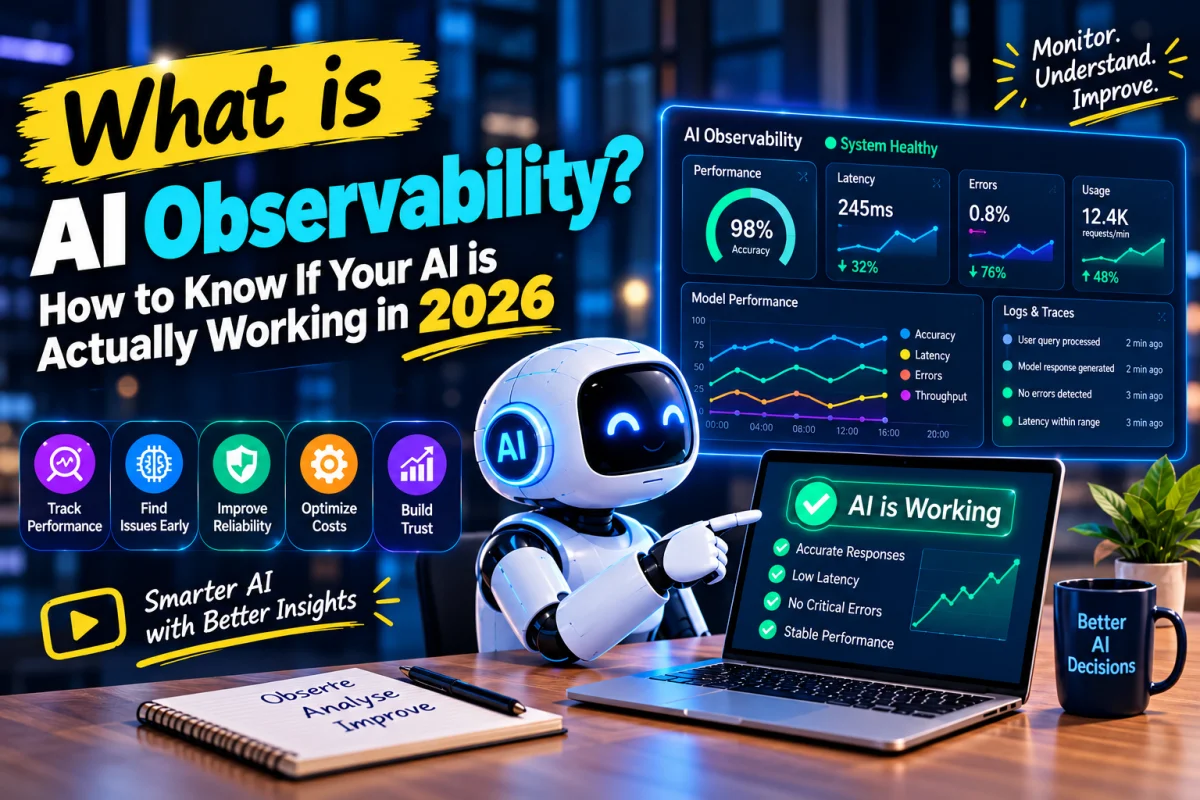
AI observability is the practice of continuously monitoring, analysing, and understanding how an AI system is actually behaving in the real world — so you can catch problems before they cause damage.
The simplest analogy is a car dashboard. Your car has a speedometer, a fuel gauge, an engine temperature indicator, and warning lights. These instruments give you constant visibility into what is happening inside the car so you can respond before something breaks. You do not wait until the engine seizes to find out there was no oil.
AI observability does the same thing for AI systems. It gives you a dashboard of indicators — accuracy, speed, cost, quality, safety — so you know what your AI is actually doing in production and can catch problems early.
What makes AI observability different from regular software monitoring is the nature of AI itself. Traditional software does the same thing every time you give it the same input. AI does not. AI is probabilistic — the same question can produce different answers at different times. Traditional monitoring tools can tell you if a website is up or down. They cannot tell you whether your AI's answers are drifting from accurate to inaccurate — or quietly becoming biased over time. That is exactly what AI observability is designed to catch.
Why AI Observability Matters — The Silent Failure Problem
The most dangerous way an AI system can fail is silently.
When a website crashes, you know immediately. When a traditional software bug occurs, it produces an error message. When an AI system starts producing worse answers — nothing alerts you. No error messages appear. No alarms sound. The system keeps running. Customers keep using it. But the quality degrades quietly, and without observability tools in place, you will only discover this through customer complaints or someone manually testing the system weeks later.
This silent failure mode has a specific technical name: model drift. It happens when the inputs coming into an AI system in production start to differ from the inputs it was trained on — and its performance quietly deteriorates as a result. The world changes. New topics appear. Language evolves. But the model stays fixed, and the gap grows wider.
AI systems can drift, degrade, or fail silently over time — and the most dangerous failures are not the ones that trigger threshold alerts but the ones that stay just within acceptable ranges while quietly getting worse.
What Does AI Observability Actually Watch?
AI observability systems monitor several distinct things simultaneously.
Accuracy and output quality — Is the AI giving correct, relevant, helpful answers? Are outputs getting better or worse over time? This requires comparing outputs against ground truth data or using automated evaluation tools that score outputs continuously.
Hallucinations — How often is the AI confidently stating something factually wrong or completely made up? Observability tools track hallucination rates and alert when they cross a threshold. In 2026, this has become one of the most important observability metrics for any AI handling factual questions.
Data drift — Are the inputs coming into the AI system changing significantly from what it was trained on? If your customer service AI was trained on questions from two years ago and customer behaviour has changed, drift detection catches this before performance degrades.
Latency and performance — How long does the AI take to respond? This matters for user experience and for cost, since most AI API pricing includes processing time components.
Token cost and usage — A single AI API call costs fractions of a cent. A million daily calls adds up fast. Observability tools track token usage across all calls — by model, user, session, and feature — and flag unusual spikes before they produce unexpected bills.
Safety and policy compliance — Are the AI's outputs staying within the boundaries set for it? Not producing harmful content, not violating its deployed scope, not making claims outside its authorised purpose.
AI Observability vs AI Monitoring — The Key Difference
People often use these terms interchangeably — but there is a meaningful distinction.
AI monitoring watches for known problems. You set a threshold — if accuracy drops below 85%, send an alert. Monitoring answers: is something wrong?
AI observability goes deeper. It gives you the tools to understand why something is wrong — including for failure modes you did not anticipate and did not set thresholds for. Observability answers: what is actually happening inside this system, and why is it producing this output?
The best analogy is medical. Monitoring is like a heart rate monitor that alerts when your heart rate is too high. Observability is like a full diagnostic workup that explains why your heart rate is elevated — so you can fix the underlying cause rather than just silence the alarm.
Good AI observability includes monitoring — but goes significantly further. In 2026, the tools best suited to this deeper observability are purpose-built for AI rather than adapted from traditional software monitoring.
The Four Pillars of AI Observability
Most frameworks organise AI observability around four core pillars.
Data observability monitors the quality and characteristics of data going into the AI. Are inputs representative of what the system was designed for? Data problems are often the root cause of AI performance issues — and catching them early is far cheaper than debugging them after they have affected output quality.
Model observability tracks the AI model's performance metrics over time — accuracy, confidence scores, hallucination rates. It answers: is this model performing as well as it was when deployed?
Infrastructure observability covers the computing environment — latency, throughput, error rates, and cost. This is closest to traditional software monitoring and the layer where tools like Datadog and New Relic have extended to cover AI.
Behaviour and safety observability monitors what the AI is actually saying — semantic correctness, policy compliance, and safety guardrail adherence across all outputs. This is the newest pillar and the one most specific to the age of generative AI.
Best Free AI Observability Tools in 2026
Here are the most widely used free options — organised by use case.
Langfuse — Best Free Open-Source Observability for LLM Applications
Free plan: Yes — free for small teams and individual developers Self-hostable: Yes — MIT licence Link: langfuse.com
Langfuse is the most widely used open-source AI observability tool in 2026. It provides detailed tracing of every prompt and response, session-level grouping for multi-turn conversations, token cost tracking, latency monitoring, and automated evaluation tools that score output quality.
The free cloud plan covers small teams and individual developers. The MIT licence means you can also self-host entirely on your own infrastructure at no cost — complete control over your data with unlimited scale. For developers building with ChatGPT, Claude, or Google Gemini APIs, Langfuse is the most practical free starting point in 2026.
Arize Phoenix — Best for Complex AI Pipelines
Free plan: Yes — open source Self-hostable: Yes — source-available licence Link: phoenix.arize.com
Arize Phoenix handles tracing, evaluation, and experimentation in a single tool. It is particularly strong for retrieval augmented generation systems where you need to track not just the model's outputs but the documents it retrieved to generate those outputs — essential for AI systems that answer questions by searching through knowledge bases.
Helicone — Best for Cost Monitoring With Minimal Setup
Free plan: Yes — up to 100,000 requests free per month Link: helicone.ai
Helicone sits between your application and the LLM API as a proxy, logging every request and response without any code changes required. Setup takes minutes. The free plan covers 100,000 monthly requests — enough for most individual developers and small teams. Its particular strength is cost monitoring — detailed breakdowns of token usage and API spend by user, session, and feature, which is exactly what you need to keep AI costs from spiralling as usage grows.
TruLens — Best for Automated Output Quality Evaluation
Free plan: Yes — completely free, open source Link: trulens.org
TruLens automatically scores AI responses for groundedness, answer relevance, and context relevance using AI-based assessment. For teams who want to move beyond human spot-checking to systematic automated quality evaluation, TruLens provides the most accessible free starting point.
A Simple Explanation for Non-Technical Readers
If you are a business owner or professional who uses AI tools but is not a developer — here is what AI observability means practically.
If your business uses an AI chatbot for customer service, AI observability means having a system that tells you whether that chatbot is giving correct and helpful answers over time — not just whether it is technically running. It catches problems like the chatbot giving outdated pricing, answering questions about products you no longer sell, or developing patterns of vague non-answers that frustrate customers.
If you use AI for content creation or marketing, observability means tracking whether outputs meet your quality standards systematically — not just reviewing individual pieces but measuring quality at scale over time.
You may not need to build observability infrastructure yourself. But understanding it exists — and asking AI vendors whether their products include it — is one of the most important questions any organisation deploying AI should be asking in 2026.
Why AI Observability is Trending at 9,300% in October 2026
The reason AI observability has exploded as a topic is not technical — it is organisational.
For the past two years, organisations deployed AI rapidly, building features and launching products. Most deployments had minimal monitoring infrastructure because the priority was speed.
Now the bills are arriving. AI systems that worked in 2024 are drifting in 2026. AI customer service tools are giving outdated answers. AI content tools produce lower quality than at launch. AI costs are higher than anticipated with no clear picture of where they are going.
The industry has collectively realised that deploying AI without observability is like building a skyscraper without structural monitoring — it works until it does not, and by the time you notice, the problem is expensive.
AI observability is the infrastructure organisations should have built from the start — and are now urgently adding to systems that have been running without it.
Final Thoughts
AI observability is not a complicated concept. It is simply the practice of watching what your AI is actually doing — closely enough and systematically enough that you catch problems before they become crises.
If you are a developer building with AI APIs, start with Langfuse — free, open source, and the most practical starting point for LLM tracing and evaluation in 2026. For cost monitoring with minimal setup, Helicone works in minutes with 100,000 free monthly requests.
If you are a business leader, the most important question to ask your AI vendor is: how do you monitor whether this system is giving accurate, appropriate, and consistent responses over time? Their answer will tell you a great deal about whether their approach to AI is trustworthy.
Want to stay updated on AI tools, AI safety, and everything happening in AI? Visit ArtificialIntelligenceFiles.com — your simple guide to everything in AI right now, updated every week.
Frequently Asked Questions (FAQs)
Q1. What is AI observability in simple words?
AI observability is the practice of continuously monitoring what an AI system is doing in real use — watching its outputs, accuracy, cost, speed, and safety — so you can catch problems before they cause damage. It is different from regular software monitoring because AI systems can fail silently, getting gradually worse over time without triggering any error messages or alarms. AI observability gives you the visibility to see this happening early, understand why it is happening, and fix it before users or customers are significantly affected.
Q2. Why is AI observability trending at 9,300% in October 2026?
Organisations that deployed AI rapidly over the past two years are now discovering that AI systems degrade silently over time — a problem called model drift. AI that worked correctly at launch has been giving gradually worse answers without anyone noticing, because nobody set up monitoring to catch it. The industry has collectively realised that deploying AI without observability is as risky as building critical infrastructure without any monitoring system. Organisations are now urgently adding observability to AI systems that have been running without it.
Q3. What is the difference between AI observability and AI monitoring?
AI monitoring watches for known problems — you set thresholds and get alerts when specific metrics breach those thresholds. It answers: is something wrong? AI observability gives you the tools to understand why something is wrong — including for failure modes you did not anticipate. It answers: what is actually happening inside this system, and why? Good AI observability includes monitoring but goes significantly further, giving you traceable insight into model behaviour, output quality, data drift, and safety compliance that standard monitoring tools cannot capture.
Q4. What are the best free AI observability tools in 2026?
The strongest free options in 2026 are Langfuse — free and open source, the most widely used LLM observability tool with detailed tracing, cost tracking, and evaluation capabilities; Arize Phoenix — open source, strong for complex AI pipelines and retrieval augmented generation systems; Helicone — free up to 100,000 requests per month, particularly good for cost monitoring with minimal setup; and TruLens — completely free open source evaluation framework for automatically scoring AI output quality.
Q5. Does my business need AI observability if we just use off-the-shelf AI tools?
If your business uses AI tools built by established vendors — like ChatGPT, Gemini, or Claude directly — those vendors handle infrastructure observability on your behalf. What you may still want to monitor is how those tools are being used within your organisation — what questions employees are asking, what quality outputs they accept, and whether the AI is being used appropriately. If your business has built custom AI features or integrated AI APIs into your own products, proper observability infrastructure is not optional — it is the difference between knowing your AI is working and just hoping it is.