AI voice cloning in 2026 is, in the words of one independent reviewer who tested eight tools this
year — scarily good.
From as little as ten seconds of audio, AI can now create a synthetic replica of a person's voice.
From as little as thirty seconds, it can capture the subtle breathing patterns, emotional range,
and natural pacing that make a voice feel genuinely human. And the best tools in this category
produce results that most listeners simply cannot distinguish from the real thing in controlled
tests.
For YouTubers, podcasters, educators, game developers, and audiobook creators — this is one
of the most genuinely useful developments in creative AI in years. For everyone else, it is also
one of the most important AI safety developments to understand.
This guide covers both sides. What AI voice cloning is, how it works, which free tools are
genuinely worth using in 2026, and what you need to know about the safety and ethical
questions that matter.
What is AI Voice Cloning?
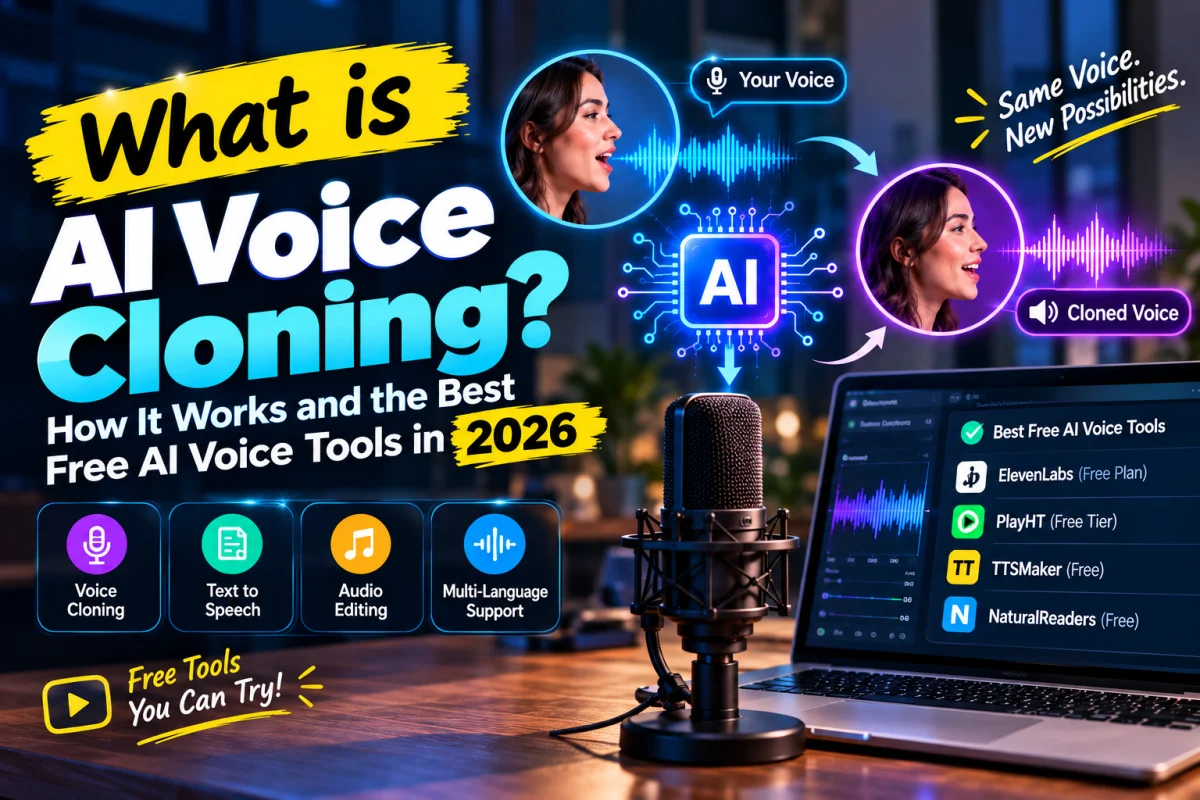
AI voice cloning is the process of creating a synthetic copy of a real human voice — one that
can then say anything you give it as text, in that person's voice, with natural-sounding delivery.
The result is a voice model — a digital representation of how a specific voice sounds, including
its tone, pitch, cadence, accent, and speaking patterns. Once created, that model can generate
new speech in the cloned voice from any text input. You type a sentence. The AI speaks it in the
cloned voice.
There are two main types of voice cloning in 2026.
Instant Voice Cloning works from a short audio sample — typically 10 to 60 seconds of clear
speech. The AI analyses the sample and builds a voice model quickly. The quality is good —
noticeably better than text-to-speech from a few years ago — but it misses some of the subtler
characteristics of a voice. Good for quick demos, personal projects, and situations where a
close approximation is enough.
Professional Voice Cloning uses 30 minutes or more of high-quality recorded audio. The AI
has much more material to work with and can capture the full range of a voice's characteristics
— emotional variation, speaking style, subtle patterns. The result is significantly more realistic
and is suitable for professional productions, audiobooks, and commercial applications.
How Does AI Voice Cloning Actually Work?
You do not need a computer science background to understand this — here is the simple
explanation.
When you provide an audio sample to an AI voice cloning tool, the system uses a type of AI
called a neural network to analyse what makes that voice distinctive. It listens to the pitch —
how high or low the voice generally sits. It tracks the cadence — the rhythm and speed of
speech, where the speaker naturally pauses, how they emphasise certain words. It captures the
timbre — the unique tonal quality that makes one voice sound different from another even at the
same pitch. And it models the emotional range — how the voice changes between calm speech
and excited speech, between formal delivery and casual conversation.
All of this gets encoded into a mathematical representation — a voice model. When you then
give the system new text to speak, it uses that model to generate audio that sounds like that
voice saying those words. It is not playing back a recording. It is generating entirely new
speech, moment by moment, that matches the patterns of the original voice.
The quality of modern AI voice synthesis has improved to the point where ElevenLabs — the
current industry leader — produces output where most listeners cannot reliably distinguish
cloned voices from originals in controlled listening tests, particularly with Professional Voice
Cloning.
The Best Free AI Voice Cloning and Text-to-Speech Tools
in 2026
Here is the honest breakdown — real free tier data, real quality assessment, real limitations.
ElevenLabs — Best Overall Voice Quality
Free plan: 10,000 characters per month — approximately 10 minutes of speech Voice cloning
on free plan: Limited instant cloning included Commercial use on free plan: Not permitted
Sign up required: Yes — free account with email Link: elevenlabs.io
ElevenLabs is consistently described as the gold standard for AI voice quality in 2026 — and
independent testing confirms this. Its voices capture subtle emotional nuances, natural
breathing patterns, and realistic pacing that make AI speech nearly indistinguishable from
human narration in quality tests.
The free plan gives you 10,000 characters per month — enough to produce short voiceovers,
test voice quality, and get a genuine sense of what the technology can do. The limitation to
know: commercial use is not permitted on the free plan. If you need to use your generated audio
in monetised YouTube videos, client work, or commercial products, you need the Starter plan at
$5 per month.
For educators, hobbyists, and anyone wanting to experience the best AI voice quality available
— the free tier is genuinely impressive. For professional and commercial use, the paid plans are
where the value lives.
Minimax — Best Completely Free Voice Cloning
Free plan: Voice cloning completely free — no credit card, no character limits within reason
Voice cloning on free plan: Yes — full voice cloning free Commercial use on free plan:
Check current terms Sign up required: Yes — free account Link: minimax.io
Minimax is the standout recommendation for anyone who wants genuine voice cloning — the
ability to clone a real voice from an audio sample — completely free in 2026. Unlike ElevenLabs
where voice cloning sits behind the paid tier, Minimax includes it on the free plan with no credit
card required and no character limits within normal usage.
Independent testing rates Minimax's voice cloning quality as close to ElevenLabs — not quite
matching it at the very top, but producing results that are genuinely impressive and suitable for
most creative projects. For creators who need real voice cloning capabilities without any cost,
Minimax is the most complete free option available.
TTSMaker — Best Free Tool With Commercial Rights
Free plan: Yes — unlimited with commercial rights included Voice cloning on free plan: No —
text to speech only Commercial use on free plan: Yes — commercial rights included free Sign
up required: No account required Link: ttsmaker.com
TTSMaker is the rare free text-to-speech tool that includes commercial rights on its free plan —
which makes it stand out significantly from most competitors that restrict commercial use to paid
tiers.
The quality is not as high as ElevenLabs — the voices are realistic but do not have the same
emotional depth and natural pacing of the premium tools. But for creators who need to generate
voiceovers they can actually use commercially in YouTube videos, podcasts, and marketing
content without paying anything — TTSMaker is the most practical completely free option
available.
No account required to start, which makes it the easiest tool on this list to try immediately.
TTS-Free — Best for Privacy and No Sign-Up Voice Cloning
Free plan: Completely free — no account, no limits Voice cloning on free plan: Yes —
browser-based, no server upload Commercial use on free plan: Check current terms Sign up
required: No account required at all Link: tts-free.com
TTS-Free is the most privacy-friendly voice cloning option in 2026 — it runs entirely in your
browser, your voice samples are never uploaded to any server, and no account is required at
any point.
For anyone who wants to experiment with voice cloning using their own voice but is
uncomfortable with their audio being processed on company servers — TTS-Free is the safest
option available. The quality is lower than ElevenLabs and Minimax, but for quick personal
projects and privacy-conscious users, it delivers genuine voice cloning capability at zero cost
with zero data exposure.
Fish Audio — Best for Community Voice Library
Free plan: Yes — free monthly generations Voice cloning on free plan: Yes — from 15
seconds of audio Voice library: Over 2,000,000 community voices Link: fish.audio
Fish Audio combines text-to-speech, speech-to-text, and a massive community library of over
two million voices — the largest open voice library of any tool on this list. If you need a specific
accent, speaking style, or voice type that you cannot create yourself, the Fish Audio community
library almost certainly has something that fits.
Voice cloning from 15 seconds of audio is included on the free plan — one of the lower
minimum thresholds of any tool tested. Quality is strong, though it does not match ElevenLabs
at the very top. For creators who need variety and flexibility rather than a single cloned voice,
Fish Audio's combination of tools and community library is unmatched at zero cost.
Microsoft Copilot — Best Free Realistic TTS for Everyday Use
Free plan: Yes — unlimited, no credit card Sign up required: Free Microsoft account (or no
account for basic use) Link: copilot.microsoft.com
Microsoft Copilot includes surprisingly capable text-to-speech as part of its free offering — and
for everyday voice generation without any cloning need, it is the most accessible option. Ask
Copilot to read something aloud, generate a spoken response, or convert text to audio and it
delivers natural-sounding output from a Microsoft account most people already have.
Not a voice cloning tool — but for quick, clean, realistic speech generation without setting up
any new accounts or tools, Copilot is the zero-friction starting point.
Who is Actually Using AI Voice Cloning in 2026?
Understanding how real creators use these tools helps you figure out whether they are relevant
to your work.
YouTubers and video creators use voice cloning to clone their own voice and produce
narration for videos without recording sessions — useful when you want consistent delivery at
scale, when you lose your voice, or when you want to produce in a language you do not speak
natively. ElevenLabs' dubbing feature can take an English video and produce realistic dubbed
versions in 29 languages in the original creator's cloned voice.
Podcasters use text-to-speech to generate ad reads, intros, and supplemental content — and
some use voice cloning to fill in sections of audio that need re-recording without setting up a full
recording session.
Educators and e-learning creators use realistic AI voices to produce course narration,
language learning audio, and accessibility content for students with reading difficulties — at a
fraction of the cost of professional voice actor recording.
Game developers and app creators use AI voice generation to give characters distinct voices
without hiring voice actors for every character in a game.
Audiobook creators use professional voice cloning with extended audio samples to produce
full-length audiobook narration.
The Safety Side — What Everyone Should Understand
Voice cloning is one of the most powerful and one of the most concerning AI technologies in
2026. Being honest about both matters.
The same technology that lets a YouTuber clone their own voice to scale content production is
also the technology behind AI voice scams — where criminals clone a family member's voice
from a social media clip and use it to call relatives pretending to be in an emergency. The FTC
received over 330,000 reports of AI voice fraud in 2025. This is not a theoretical risk. It is
happening regularly.
Every reputable AI voice cloning tool in 2026 includes consent requirements — you are
supposed to only clone voices with explicit permission from the person whose voice is being
cloned. ElevenLabs specifically includes speaker verification and consent enforcement. Fish
Audio and Minimax require users to agree that they have rights to the voice they are cloning.
In practice, these consent requirements are difficult to technically enforce — someone
determined to misuse the technology can circumvent them. What the tools can do is make
consent a required step, build in watermarking to help detect synthetic audio, and cooperate
with law enforcement on misuse cases.
From a practical safety perspective — the most important thing to know is the family code word
approach described in the dark side of AI blog: agree on a code word with your family members
that anyone can use to verify they are the real person in an emergency call. This single
precaution protects against AI voice scam calls regardless of how convincing the cloned voice
sounds.
How to Use AI Voice Cloning Responsibly
Using AI voice tools responsibly in 2026 comes down to three clear principles.
Only clone voices you have explicit permission to clone. Your own voice, or a voice where you
have written consent from the person. Using someone's voice without their permission is not just
ethically wrong — it is increasingly illegal under the right of publicity laws being passed across
multiple US states and the EU AI Act's transparency requirements.
Always disclose when audio was generated by AI. If you publish AI-generated voice content —
in podcasts, YouTube videos, marketing materials — disclose it clearly. The EU AI Act requires
this for content in the EU. Beyond legal requirements, it is the honest approach that builds long-
term trust with your audience.
Do not use cloned voices to deceive. The clearest ethical line is deception — using a cloned
voice to make someone believe they are hearing a real person when they are not. Creative uses
of AI voices, with disclosure, are legitimate. Deceptive uses are not — and are increasingly both
illegal and detectable.
Final Thoughts
AI voice cloning in 2026 has crossed from impressive technology to genuinely practical tool —
for YouTubers, podcasters, educators, developers, and creators of all kinds. The free tools
available right now — Minimax for free voice cloning, TTSMaker for commercial-rights-free TTS,
and ElevenLabs for the highest quality within the free character allowance — cover most
everyday creative needs without any cost.
The technology's power is real. The responsibility that comes with it is equally real. Used
ethically — with consent, with disclosure, and without deception — AI voice tools are one of the
most useful creative additions to any content creator's toolkit in 2026.
Want to stay updated on AI voice tools, AI safety, and everything happening in AI right
now? Visit ArtificialIntelligenceFiles.com — your simple, honest guide to everything in AI,
updated every week.
Frequently Asked Questions (FAQs)
Q1. What is AI voice cloning in simple words?
AI voice cloning is the process of creating a digital copy of a real human voice that can say
anything you give it as text. You provide an audio sample — as little as 10 to 30 seconds for
basic cloning, 30 or more minutes for professional quality — and the AI analyses what makes
that voice distinctive. It then generates new speech in that voice from any text input. The result
is audio that sounds like the original person speaking words they never actually said. The best
tools in 2026 produce clones that most listeners cannot distinguish from the real voice in
controlled tests.
Q2. What is the best free AI voice cloning tool in 2026?
For completely free voice cloning with no credit card required, Minimax is the strongest option
— offering genuine voice cloning from an audio sample with no character limits within normal
usage on the free plan. For the highest quality free text-to-speech without cloning, ElevenLabs'
free plan gives you 10,000 characters per month of industry-leading voice quality. For free text-
to-speech with commercial rights included, TTSMaker offers unlimited generation commercially
free with no account required. For private browser-based voice cloning with no data uploaded
anywhere, TTS-Free is the most privacy-protective option.
Q3. How does ElevenLabs work and is it really free?
ElevenLabs is free to start — you create a free account with your email and receive 10,000
characters of speech generation per month, which is approximately 10 minutes of audio. The
voice quality on the free plan is excellent — ElevenLabs consistently leads independent quality
evaluations for naturalness and emotional realism. The important limitation is that commercial
use is not permitted on the free plan, and voice cloning features have limits at the free tier. For
commercial content creation, the Starter plan at $5 per month adds commercial rights and
expanded voice cloning.
Q4. Is AI voice cloning safe and legal to use?
AI voice cloning is safe and legal when used responsibly — specifically, when you only clone
voices you have explicit permission to clone, disclose when content was AI-generated, and
never use cloned voices to deceive people. Using someone's voice without their consent is
ethically wrong and increasingly illegal under right of publicity laws in many jurisdictions and the
EU AI Act's transparency requirements. The most important safety consideration for everyday
users is protecting against AI voice scam calls — where criminals clone family members' voices.
Establishing a family code word that anyone can use to verify their identity in an emergency call
is the most effective practical protection.
Q5. Can I use AI-generated voices in my YouTube videos commercially?
It depends on the tool. TTSMaker explicitly includes commercial rights on its free plan, making it
the clearest free option for commercial YouTube use. ElevenLabs' free plan does not include
commercial rights — you need at least the Starter plan at $5 per month for commercial use.
Minimax's commercial terms should be checked on their current terms of service page.
Microsoft Copilot's voice output should be checked against Microsoft's current content licensing
terms. Always read the specific commercial licensing terms of any tool before publishing AI-
generated audio in monetised content.