Imagine applying for a job and never hearing back. No interview. No explanation. Just silence.
Now imagine the reason was not your skills or your experience. It was a pattern buried inside an AI system that quietly learned to prefer certain kinds of candidates over others, and nobody at the company even knew.
This is not a made-up scenario. Versions of it have happened. And it is exactly why ethical AI has become one of the most talked-about topics in technology in 2026.
AI is now involved in decisions about jobs, loans, medical care, school admissions, and even what news you see. When a tool that powerful makes mistakes, real people get hurt. Ethical AI is the effort to make sure that does not happen, or at least happens far less often.
This guide explains what ethical AI means in plain language, shows you real cases where AI went wrong, and covers what companies and governments are actually doing about it.
What is Ethical AI?
Ethical AI means building and using artificial intelligence in a way that is fair, transparent, accountable, and respectful of people's rights.
That sounds like a lot of big words, so here is the simple version. An ethical AI system is one that treats people fairly, can explain how it reached its decisions, has a real person responsible when something goes wrong, and protects your private information.
You will often hear a few other terms that mean almost the same thing. Responsible AI, trustworthy AI, and AI ethics are all used for the same basic idea: AI that helps people without harming them.
The easiest way to think about it is like safety rules for cars. Cars are incredibly useful, but nobody argues that they should be allowed to drive without brakes, seat belts, or traffic laws. Ethical AI is the same thing for AI. The goal is not to stop AI from being useful. The goal is to make sure it is safe to rely on.
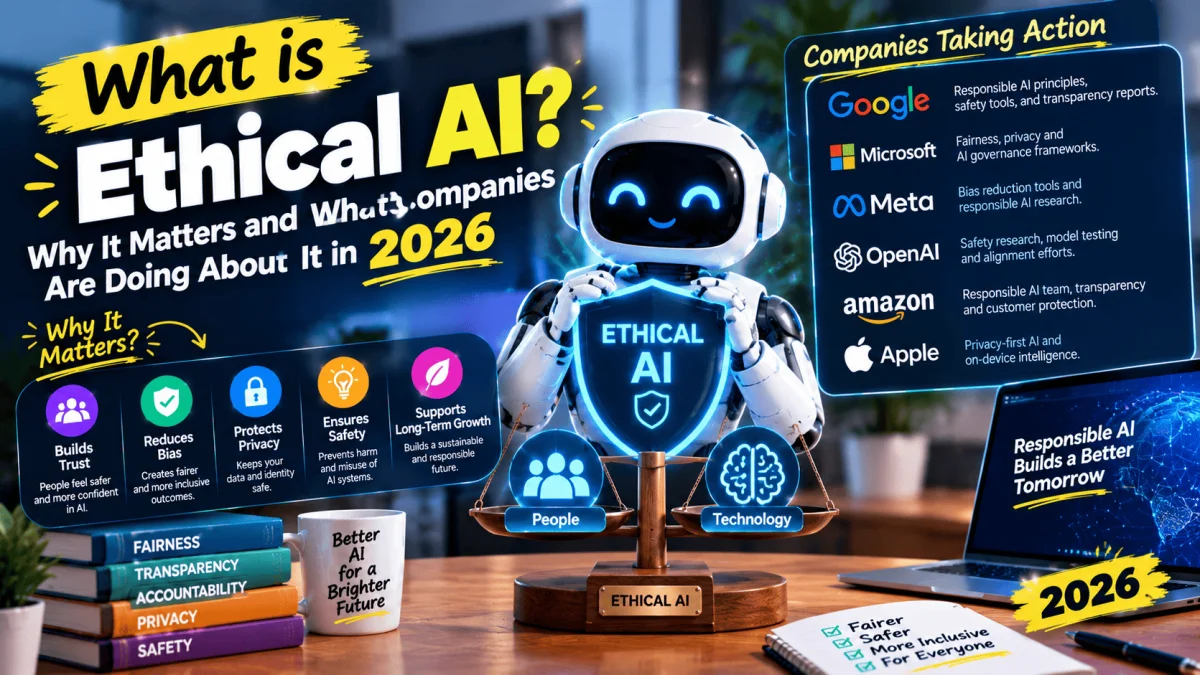
The Five Core Principles of Ethical AI
Almost every major framework for ethical AI, from IBM to Microsoft to Google to the OECD, comes back to the same handful of ideas. Here they are in simple terms.
Fairness. AI should not treat people worse because of their race, gender, age, disability, or background. In 2026, fairness is understood to be something you have to measure for each specific use, not just promise in general. A hiring tool and a medical tool need different kinds of fairness checks.
Transparency. People should be able to understand how an AI system works and why it made a particular decision. If a bank's AI turns down your loan, you should be able to find out the main reasons.
Accountability. When AI causes harm, a real person or organisation must be responsible. Saying "the algorithm did it" is not an acceptable answer.
Privacy. AI systems learn from huge amounts of data, and much of it is personal. Ethical AI protects that data, collects only what it needs, and does not use it in ways people never agreed to.
Safety and human oversight. AI systems should be tested properly before they are used, monitored while they run, and designed so a human can step in when something looks wrong, especially for decisions that affect people's lives.
Real Examples Where AI Went Wrong
Ethical AI is not just a theory. These are well-documented cases that show why it matters.
The Hiring Tool That Learned to Prefer Men
Around 2018, news reports revealed that Amazon had built an experimental AI recruiting tool and then scrapped it. The system had been trained on resumes submitted to the company over about ten years. Because most of those resumes came from men, the AI learned to treat male candidates as the better fit. It even marked down resumes that included the word "women's," as in "women's chess club captain."
Nobody programmed the AI to be sexist. It simply learned from patterns in historical data, and those patterns reflected an industry that had been dominated by men. This is the clearest example of how AI can pick up and repeat unfairness without anyone intending it.
The Court Tool That Treated Defendants Differently
In 2016, the investigative news organisation ProPublica analysed a widely used risk-scoring tool called COMPAS, which US courts used to estimate how likely a defendant was to commit another crime. Their analysis found that Black defendants who did not go on to reoffend were almost twice as likely as white defendants to be wrongly labelled as high risk. The company behind the tool disputed the analysis, and researchers have debated how to measure fairness in such systems ever since.
That debate is itself the lesson. Even experts disagree about what "fair" means mathematically. But the case showed why decisions that affect someone's freedom need transparency and human oversight, not blind trust in a score.
Facial Recognition That Worked Better for Some Faces Than Others
In 2018, researcher Joy Buolamwini and Timnit Gebru published a study called Gender Shades. They tested commercial facial analysis systems from major technology companies and found that error rates were far higher for darker-skinned women than for lighter-skinned men. In some systems, the gap was dramatic.
The cause was straightforward: the data used to train these systems did not include enough diverse faces. After the study, several companies improved their products. The case became a landmark example of why training data matters and why independent testing is so valuable. You can read more about this work at the Algorithmic Justice League.
The Healthcare Algorithm That Underestimated Who Needed Care
A 2019 study published in the journal Science examined an algorithm used across US hospitals to decide which patients should get extra medical support. The researchers found that it systematically underestimated how sick Black patients were. The reason was subtle: the system used past healthcare spending as a stand-in for medical need. Because less money had historically been spent on Black patients with the same level of illness, the algorithm concluded they needed less help.
This shows how even a sensible-sounding choice, like using cost as a measure, can quietly bake in unfairness.
Why Does AI Become Biased?
People are often surprised to learn that AI bias is usually not caused by anyone being deliberately unfair. It comes from a few common sources.
Biased training data. AI learns from examples. If the examples reflect a world with existing inequalities, the AI learns those inequalities as if they were facts.
Missing data. If a group of people is under-represented in the training data, the AI simply performs worse for them, as in the facial recognition case.
Poor choice of measurement. Like the healthcare example, using a shortcut measure that does not truly capture what matters can produce unfair outcomes.
Lack of testing. Many problems only appear when AI is tested on different groups of people. If nobody checks, nobody finds out.
Nobody watching afterwards. AI systems can drift and change over time. Without monitoring, a system that started fair can become unfair.
What Companies Are Doing About It in 2026
The good news is that ethical AI has moved from being a nice idea to being a normal business practice, partly because laws and customers now demand it. Here is what responsible organisations are doing.
Publishing AI principles. Major technology companies including Microsoft, Google, and IBM have published their AI principles. Microsoft's, for example, focus on fairness, reliability and safety, privacy, inclusiveness, transparency, and accountability. These documents matter most when they are backed by real processes, and critics rightly point out that principles alone are not enough.
Testing for bias before launch. Responsible teams test their AI on different groups of people and look for gaps in performance before the product goes live, then keep checking afterwards.
Using diverse and representative data. Teams now put real effort into making sure training data covers different groups, rather than assuming the data is neutral.
Keeping humans in the loop. For high-stakes decisions such as hiring, lending, or healthcare, organisations increasingly require a human to review AI recommendations rather than letting the AI decide alone.
Naming someone responsible. In 2026, good practice means every important AI system has a named owner who is accountable for its behaviour, a written risk assessment, and a plan for what to do when something goes wrong.
Following recognised frameworks. Three frameworks are now widely used: the NIST AI Risk Management Framework in the United States, the OECD AI Principles as an international baseline, and ISO 42001 as a management standard for organisations. Many large customers now ask suppliers to show evidence of bias and safety testing before they sign contracts.
What Governments Are Doing
Ethics used to be voluntary. Increasingly it is becoming law.
The most important example is the EU AI Act, the world's first comprehensive AI law. It bans certain harmful uses of AI outright, places strict requirements on AI used in sensitive areas like hiring, education, and healthcare, and requires transparency, for example telling people when they are talking to an AI. Its transparency rules began applying in August 2026, while some of the strictest high-risk requirements are being phased in later. If you want the full breakdown, our guide to the EU AI Act explains it in plain language.
Outside Europe, approaches differ. The United States relies more on sector-specific rules and voluntary frameworks like NIST's, while many other countries are developing their own laws. The direction of travel is the same everywhere: less "trust us" and more "show us."
What Can You Do as an Everyday AI User?
You do not need to be an engineer to practise ethical AI. Here are simple habits that make a difference.
Check AI output before you rely on it. Tools like ChatGPT, Claude, and Google Gemini can reflect biases from their training data and can be confidently wrong. Treat their answers as a strong first draft, not a final verdict.
Be careful what you share. Avoid typing passwords, financial details, medical records, or confidential work information into AI tools, and check the privacy settings of the tools you use.
Be honest about using AI. If you use AI to create something that others will read, watch, or rely on, say so where it matters. Transparency builds trust, and in many places it is becoming a legal requirement.
Ask questions when AI affects you. If an automated system makes a decision about your job application, loan, or insurance, you can often ask how the decision was made and request a human review. In the EU, these rights are getting stronger.
Do not use AI to deceive or harm. Using AI to create fake content that is meant to mislead people, or to copy someone's voice or face without permission, is both unethical and increasingly illegal.
The Honest Limits of Ethical AI
It would not be fair to pretend this problem is solved. A few challenges are still very real in 2026.
Fairness is not one thing. Researchers have shown that different definitions of fairness can contradict each other. A system cannot always satisfy all of them at once, which means choices have to be made, and those choices involve values, not just maths.
Principles are easier than practice. Plenty of organisations publish impressive ethics statements. Fewer turn them into measurable, auditable processes. Be a little sceptical of any company that talks about ethics without showing evidence.
Rules differ around the world. What counts as acceptable AI use varies by country and culture, which makes global standards hard.
AI keeps changing. New abilities, like AI agents that take actions on their own, raise new questions faster than rules can be written.
None of this means ethical AI is pointless. It means it is ongoing work, and the more people understand it, the better the outcomes are likely to be.
Final Thoughts
Ethical AI comes down to a simple idea: powerful technology should be fair, understandable, and answerable to the people it affects.
The cases in this guide, from biased hiring tools to unequal healthcare algorithms, were not caused by evil intentions. They were caused by blind spots, and blind spots can be found, measured, and fixed. That is what ethical AI practice is for.
As an everyday user, your role is not to solve this alone. It is to stay curious, ask questions, check what AI tells you, and expect the companies and tools you use to be open about how they work.
Want to stay updated on AI ethics, AI safety, and everything happening in AI right now? Visit ArtificialIntelligenceFiles.com — your simple guide to everything in AI, updated every week.
Frequently Asked Questions (FAQs)
Q1. What is ethical AI in simple words?
Ethical AI means building and using artificial intelligence in a way that is fair, transparent, accountable, and respectful of people's privacy and rights. In practice, it means AI should not treat people unfairly, should be able to explain its decisions, should have a real person or organisation responsible for it, and should protect personal data. You may also hear it called responsible AI or trustworthy AI. They all describe the same goal: AI that helps people without harming them.
Q2. What are some real examples of AI bias?
Several well-documented cases exist. Amazon scrapped an experimental hiring tool around 2018 after it learned to favour male candidates from historical resume data. A 2016 ProPublica analysis of the COMPAS court risk-scoring tool found that Black defendants who did not reoffend were more often wrongly labelled high risk, though the tool's makers disputed the findings. The 2018 Gender Shades study found facial recognition systems made far more errors on darker-skinned women. And a 2019 study in Science found a US healthcare algorithm underestimated how sick Black patients were because it used past spending as a stand-in for medical need.
Q3. Why does AI become biased if nobody programs it to be?
AI learns patterns from data, and data reflects the real world, including its inequalities. If training data over-represents some groups or contains historical unfairness, the AI learns those patterns as if they were facts. Bias can also come from missing data about certain groups, from using a poor shortcut measure for what really matters, from a lack of testing across different groups, and from nobody monitoring the system after launch. This is why responsible teams test for bias before and after deployment.
Q4. How do companies make AI ethical and fair?
Responsible organisations publish clear AI principles, test their systems for bias across different groups before launch, use diverse and representative training data, keep humans involved in high-stakes decisions, assign a named person accountable for each important AI system, and follow recognised frameworks such as the NIST AI Risk Management Framework, the OECD AI Principles, and ISO 42001. Many also run regular audits and have an incident response process. Principles alone are not enough, so it is worth looking for evidence that a company actually tests and monitors its AI.
Q5. Is ethical AI required by law in 2026?
Increasingly, yes. The EU AI Act is the world's first comprehensive AI law. It bans certain harmful AI uses, sets strict requirements for AI in sensitive areas like hiring and healthcare, and requires transparency such as telling people when they are interacting with an AI. Its transparency rules began applying in August 2026, with some stricter requirements being phased in later. Other countries are developing their own rules, and in the United States there is no single national AI law, so frameworks like NIST's and sector-specific rules play a bigger role. Whether or not a law applies to you, many customers and partners now expect evidence of ethical AI practices.