Have you ever wondered — who actually invented Artificial Intelligence? Was it one person? A team? A secret government lab?
The truth is more interesting than you think. AI was not invented overnight. It was born from the ideas of a few brilliant people who dared to ask one big question: "Can a machine think like a human?"
Let's go back in time and meet the founding fathers of AI — the people whose work made ChatGPT, Siri, and every other AI tool possible today.
When Did AI Start?
The history of artificial intelligence did not begin with ChatGPT or even with the internet. It started way back in the 1930s when a British mathematician sat down and imagined a machine that could think.
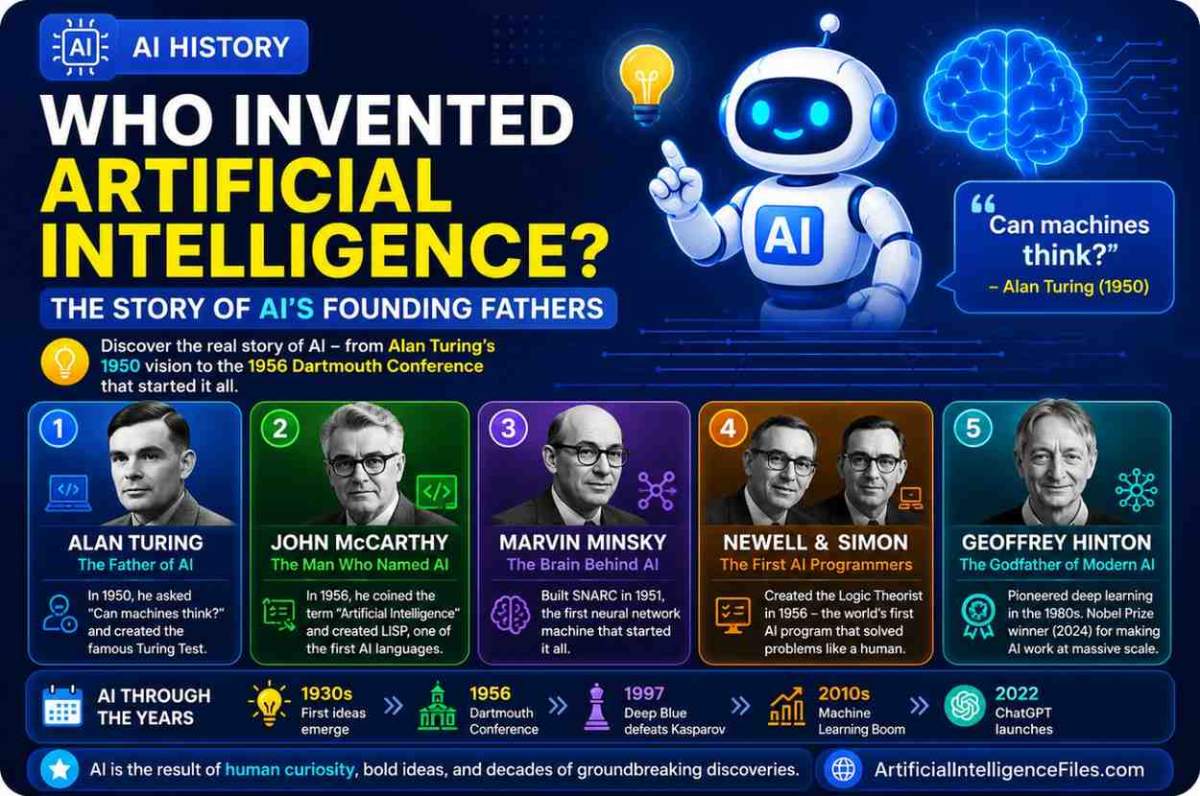
By 1950, the first big ideas about machine intelligence were published. In 1956, a small group of scientists gathered at Dartmouth College in the USA and officially gave this new field a name — Artificial Intelligence. Through the 1960s and 1980s, the first real AI programs were built and tested. Then came the "AI Winter" — a long period when funding dried up and progress slowed.
Things picked up again in the 1990s. In 1997, IBM's Deep Blue defeated world chess champion Garry Kasparov — a huge milestone. By the 2010s, machine learning exploded. And in 2022, ChatGPT launched and AI finally became something everyone in the world started talking about.
Now let's meet the people who made all of this possible.
1. Alan Turing — The Father of AI (1912–1954)
If you ask anyone "who is the father of AI?", the answer is almost always Alan Turing.
Turing was a British mathematician and scientist who, in 1950, published a groundbreaking paper called "Computing Machinery and Intelligence." In it, he asked a simple but powerful question: "Can machines think?"
He also created the famous Turing Test — a challenge where a machine tries to have a conversation so human-like that you cannot tell the difference between it and a real person. This idea is still discussed and used as a benchmark in AI research today.
Turing's ideas were 50 years ahead of his time. Sadly, he was never fully recognized during his lifetime. But today, the entire world of AI stands on the foundation he built.
🔗 Learn more: Alan Turing at Britannica
2. John McCarthy — The Man Who Named AI (1927–2011)
If Alan Turing asked the question, John McCarthy gave it a name.
In 1956, McCarthy organized a summer workshop at Dartmouth College in the USA. It was at this historic event — now known as the Dartmouth Conference — that the term "Artificial Intelligence" was officially used for the very first time. McCarthy defined AI as "the science and engineering of making intelligent machines."
He did not stop there. McCarthy also created LISP, one of the earliest programming languages built specifically for AI research. His work laid the foundation for how computers process logic and language — something every AI tool still depends on today.
🔗 Learn more: John McCarthy on Wikipedia
3. Marvin Minsky — The Brain Behind AI Thinking (1927–2016)
Marvin Minsky was a co-founder of MIT's AI laboratory and one of the sharpest thinkers in the history of artificial intelligence.
He believed that human intelligence could be broken down into smaller, simpler steps — and that machines could learn to replicate those steps. Minsky built some of the first AI programs that could solve math problems and play strategy games.
In 1951, he also built SNARC — widely considered the world's first artificial neural network machine. Neural networks are the exact same technology that powers modern AI tools like ChatGPT and AI image generators today. Minsky planted the seed that the whole world is now harvesting.
🔗 Learn more: Marvin Minsky at MIT
4. Allen Newell & Herbert Simon — The First AI Programmers (1950s)
While Turing and McCarthy were thinking big, Allen Newell and Herbert Simon were actually building things.
In 1956, they created the Logic Theorist — considered the world's first true AI program. It could solve complex mathematical problems by mimicking the way a human reasons through a problem step by step. They later built the General Problem Solver, a program designed to work through any logical challenge a human could throw at it.
Herbert Simon even boldly predicted in 1965 that machines would one day be capable of doing any work a human can do. That prediction feels very real today.
🔗 Learn more: Herbert Simon on the Nobel Prize site
5. Geoffrey Hinton — The Godfather of Modern AI (1947–Present)
Fast-forward to today. Geoffrey Hinton is the man most responsible for the AI boom we are all living through right now.
Starting in the 1980s, Hinton championed a technology called deep learning — a method of teaching computers to learn from massive amounts of data, much like how the human brain learns from experience. For decades, most scientists ignored his ideas. Then in 2012, his team's AI model destroyed the competition in a global image-recognition contest and the world finally paid attention.
In 2024, Hinton was awarded the Nobel Prize in Physics for his contributions to AI. He also made headlines for leaving Google to speak freely about the potential dangers of AI — proving that even the people who built this technology think carefully about where it is going.
🔗 Learn more: Geoffrey Hinton's Nobel Prize profile
So, Who Really Invented AI?
There is no single inventor. AI was created by many brilliant people working across different decades and different countries. Alan Turing asked if machines could think. John McCarthy gave the field its name. Marvin Minsky built the first learning machines. Newell and Simon wrote the first working AI programs. And Geoffrey Hinton made modern AI actually work at scale.
Together, their discoveries built the technology that today powers everything from Google Search to self-driving cars to the AI tools you use every day.
Final Thoughts
The story of AI is really the story of human curiosity — a small group of people who refused to believe that thinking was something only humans could do.
Next time you use ChatGPT, an AI study tool, or even a smart recommendation on YouTube, remember the names above. They are the reason it all exists.
Curious to learn more about AI history, tools, and the latest news? Visit ArtificialIntelligenceFiles.com for everything AI — from its past to its exciting future.