
Executive research summary
AutoGPT is best understood as several related generations of autonomous-agent technology rather than a single unchanging application. The original 2023 Auto-GPT project explored goal-directed, tool-using language-model loops. The later AutoGPT Platform introduced a visual, block-based approach to reusable automation. By September 2026, AutoGPT had launched its AI Experts experience, positioning Otto as a coordinator of specialist workers such as Maria for marketing, Max for sales and Frankie for operations. The official product blog identifies a production launch on 19 September 2026, at version 0.8.0, with an initial roster of 18 Experts. [1] [2] [3]
This research finds an important evidence gap. Official sources offer specific, accessible workflow descriptions across customer service, SEO, meeting preparation, lead research, video production, newsletters and web research. The AutoGPT marketplace publicly displays execution counts. Yet those counts do not reveal unique organizations, completion quality, customer satisfaction, business revenue or financial ROI. The examined sources did not establish a named external paying customer with independently corroborated, pre/post financial outcomes. That conclusion reflects the public material reviewed; it is not proof that AutoGPT has no commercial users. [4] [5]
The strongest identifiable external technical example in this selection is Auto-GPT–Notion, an open-source integration by developer doutv. Its README specifies Auto-GPT v0.3.0 and links to a Notion database demonstration showing web research archived into Notion. Other directly documented community extensions connect Classic with IFTTT, Discord and Google Analytics. These are real public code projects, but public code does not establish production deployment, organizational procurement or savings. [6] [7] [8] [9]
For practical business readers, the useful story is therefore what AutoGPT workflows are designed to accomplish, which components are supported by primary documentation, and what proof a buyer must collect in their own pilot. A controlled trial should benchmark real task accuracy, human edit time, completion rates, total tool/model cost and the quality of downstream results. The publication maintains a strict boundary between developer demonstrations, vendor-described workflow examples and measured commercial outcomes.
What is AutoGPT?
AutoGPT is an ecosystem for building and using AI agents: systems that interpret a goal, decide or follow steps, use tools, interact with information sources and return work for human review. The 2023 Classic codebase is historically associated with Python, language-model-driven reasoning, memory, web access and file operations. It was experimental and often required technical setup. The current AutoGPT repository still separates its Classic materials from the newer platform. The repository describes Classic as MIT-licensed and the autogpt_platform/ component as Polyform Shield-licensed; calling the entire contemporary product unrestricted MIT open source would therefore be inaccurate. [1]
The managed platform offers hosted execution, integrations and orchestration. Its visual builder lets users assemble workflow blocks, while self-hosting moves infrastructure, credentials and ongoing maintenance to the operator. The Experts layer simplifies interaction through named roles and conversational delegation. A current marketing page cannot be used to infer how an earlier Classic project worked. [1] [2] [10]
Three product generations, three different evidence requirements
| Generation | Period/context | Typical architecture | Deployment and evidence warning |
|---|---|---|---|
| AutoGPT Classic | Began 2023 | Python agent loop, LLM reasoning, memory and tool access | Often self-hosted and experimental; old code or demos may no longer work on the hosted platform. |
| Visual AutoGPT Platform | Later platform era | Agent Blocks, visual builder, triggers, scheduling, marketplace workflows, APIs | Public workflow listing proves software availability, not external customer adoption. |
| Otto and AI Experts | Production release reported 19 Sep 2026 | Otto delegates to task-focused Experts, with connected accounts, routines and spending controls | Official demonstrations show product operation, not audited customer ROI. |
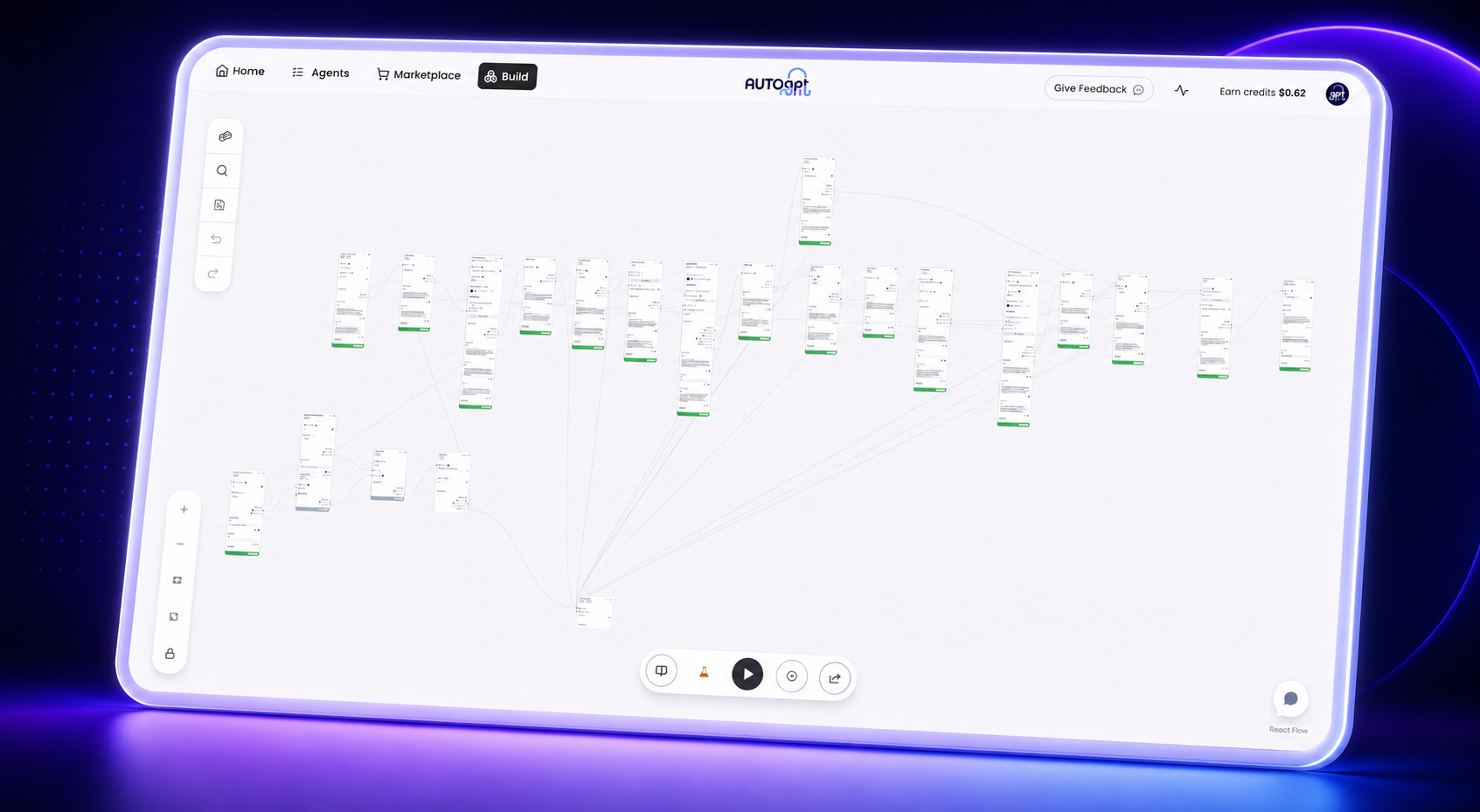
Historical note: AutoGPT's November 2024 Agent Blocks announcement explains modularity and specialist collaboration, but its architectural vision should not be confused with proof of a production customer deployment. [11]
How these case studies were verified
The research applied six evidence levels. A requires a named actual customer, a specific workflow and credible source-backed observed results. B requires an identifiable implementation with sufficiently detailed public evidence, though quantitative results may be absent. C covers authentic code projects with a clear AutoGPT dependency, code or documentation; runtime success is additionally identified as demonstrated, asserted or untested. D covers official platform workflows, marketplace templates and product demos. E covers user testimony without a complete implementation record. F covers hypothetical examples. These types are never combined into a total of verified commercial customers.
Primary-source review prioritized AutoGPT's official homepage, how-it-works, Experts, integrations and marketplace pages; the Significant-Gravitas GitHub repository; named community repositories; and original competitor documentation. Statements not supported by those materials are labeled Not publicly documented. The date displayed with public marketplace run counts is the observation date, not necessarily the underlying run date. Pages may change after the 29 October 2026 research cutoff.
Verified external customer directory: what the evidence permits
Named external customers with independently corroborated business ROI found in the reviewed sources: none. No customer-specific pre-implementation baseline, documented expenditure and measured financial benefit was available to calculate a verified ROI. This does not rule out private deployments or unnamed users. It prevents publishing fictional customer stories. No 500–800-word customer narrative is manufactured to fill the gap.
A separate developer evidence directory follows. These entries are not sales customer testimonials, and the external makers are not asserted to be paying clients of the current hosted offering.
| Project | Creator | Version / deployment | What public material establishes | Evidence |
|---|---|---|---|---|
| Auto-GPT–Notion | doutv |
Classic v0.3.0; developer-side plugin | Repository includes Notion read/create/update functions and a link to a demonstration database; commercial results absent. | C — code + author-linked demo [6] |
| AutoGPT–IFTTT | AntonioCiolino | Classic-era plugin; local configuration | Public webhook bridge, example data-handling logic, installation/testing guidance; successful independent deployment not verified. | C — code/documentation [7] |
| AutoGPT–Discord | gravelBridge | Classic-era plugin | Public source and README describing control of an AutoGPT instance from Discord; enterprise use and task outcomes absent. | C — code/documentation [8] |
| Auto-GPT Google Analytics Plugin | isaiahbjork | Classic-era plugin | Public source and setup for requesting website analytics through Auto-GPT; measured marketing improvement not documented. | C — code/documentation [9] |
Developer deep dive: Auto-GPT–Notion
Organization / author: doutv (GitHub author; country not publicly verified). Industry: developer productivity and knowledge organization. Product generation: Classic. Deployment: self-configured Classic plugin, not the present Otto hosted service. Implementation period: Classic v0.3.0 era; exact production dates not verified. Public evidence: README, code and author-linked demonstration. [6]
Problem and context. Public documentation describes a desire to let Auto-GPT interact with a Notion workspace, turning web research into structured notes. No documented commercial procurement problem, team size or manual baseline is supplied. Consequently, the project is evaluated as a technically documented integration and demonstration, not an enterprise adoption story.
Implementation. The README describes installing Auto-GPT v0.3.0 with plugin support, preparing Python dependencies, configuring the Notion integration token and database identifier, and allowing the AutoGPTNotion plugin. The described agent goal is to use a Google search command to research Auto-GPT and save the result into a Notion page. The repository describes reading, creating and updating Notion databases and pages and links to a database purportedly managed by Auto-GPT. These are concrete steps, unlike an abstract suggestion that agents might write notes someday. [6]
Observed results. Existence of a repository and linked public demo is evidence of developer work. The available evidence does not establish repeated production success, independence of evaluation, output accuracy, sustained maintenance, saved work hours, customer acquisition or subscription revenue. Measured business impact: not publicly documented. A team reusing the idea should inspect the Classic version constraint and compatibility before attempting installation.
Technical and security lessons. A narrow API integration makes an agent more useful than unconstrained reasoning alone. Tokens must be scoped, search material should be treated as untrusted, created pages should be checked for source accuracy, and write actions should initially require review. Replicability depends on the historical plugin API and third-party service versions. The project illustrates developer extensibility; it does not establish that the current AI Experts use the same architecture.
Other publicly documented developer projects
AutoGPT–IFTTT: AntonioCiolino's project explains passing Auto-GPT output to IFTTT via named webhooks and filtering a JSON payload before an email action. It documents setup and a test procedure, not a published before/after business study. Security considerations include webhook secrets, unintended sends and outdated Classic configuration. [7]
AutoGPT–Discord: gravelBridge's repository provides a Classic-era interface for controlling an AutoGPT instance through Discord. This can support remote interaction and agent visibility, but a repository title or README does not prove unattended production operation, successful issue resolution or permission safety. [8]
Google Analytics plugin: isaiahbjork's repository provides a bridge from Classic to Google Analytics data. It demonstrates a plausible way for an agent to request site information and prepare analysis. There are no credible numeric improvements in traffic, acquisition cost or return on ad spend attributable to this repository. [9]
The official Auto-GPT-Plugins repository is a useful historical technical reference, but it was archived in June 2024. Its README explicitly warns that plugins can execute Python code and may expose API keys. It is not evidence that every listed third-party project remains secure or compatible today. [12]
Official workflow examples: what is actually documented
The following seven items are published marketplace examples rather than customer success stories. Their design descriptions support the workflow summaries; actual customer-level performance needs separate proof. [4] [5]
1. Automated SEO Blog Writer — marketing and publishing
The marketplace lists an SEO content workflow intended to expand keyword-driven blog production. The relevant business workflow is an input brief, research or idea generation, draft creation and an editorial approval step before publication. The public listing establishes the existence of the agent; it does not verify live search-volume provider use, permanent WordPress publishing permissions, search-ranking improvements or measured articles-per-hour. For a pilot, measure correctly cited research, accepted drafts, editorial rework and published-page performance. Evidence: D; customer ROI not publicly documented. [4]
2. Lead Finder — prospecting from place data
AutoGPT's official description says this workflow searches Google Maps through an official API, accepts location and business-category prompts, and returns business names, websites, ratings, reviews, telephone numbers and addresses. It advertises export into CRM, sheet or outreach workflows. The listing also makes a 90% prospecting-time-saving claim, but gives no external customer's baseline or study method. That percentage is promotional, not verified performance. Google Maps data can be incomplete or stale; a lead needs deduplication, permission checks and human qualification before outreach. Evidence: D; advertised time savings unverified. [5]
3. Automated Support Agent — help-desk triage
AutoGPT says its support example reads incoming email, consults internal knowledge sources, drafts or sends a response when confident, and escalates uncertainty to a human. The listing describes automation of the easy 80% of support requests. This is an advertising proposition, not an audited handling rate. An enterprise test must log escalation decisions, identity verification, source relevance, wrong-answer incidents, reopen rates and customer satisfaction. Refunds, credential resets and other sensitive actions should have approval checkpoints. Evidence: D; real resolution rate not publicly documented. [5]
4. Smart Meeting Prep — recurring executive assistance
The marketplace offers a meeting-preparation workflow. It is designed to reduce repetitive work before scheduled meetings, potentially combining calendar context and research into a briefing. Without a verified block-level snapshot, exact mail access, attendee enrichment, scheduling cadence and every output field must not be assumed. Evaluate data permissions, factual completeness, whether the brief is useful and actual review minutes per meeting. The marketplace displays executions, not validated minutes saved. Evidence: D; business results not publicly documented. [4]
5. AI Video Generator — creative production
The creator page provides unusually specific details: a topic or headline starts research; Claude composes a short script; GPT-4o prepares a title and hashtags; Revid.ai renders a vertical MP4. The description refers to one output per run, with defaults for aspect ratio and video settings that users can alter. Rendering belongs to the external video provider; AutoGPT coordinates the stages. No third-party customer campaign engagement, production-cost comparison or approval rate is published with the listing. Evidence: D; disclosed workflow design, not independent results. [5]
6. Personal Newsletter — editorial monitoring
The listing describes selecting topics, choosing a tone, setting a daily or weekly cadence, and receiving a curated digest of several stories. It is a useful model for turning repeated browsing into a standardized review. Its source selection and editorial verification remain important: summaries can omit context, repeat outdated claims or include poor-quality material. No subscriber open-rate or revenue lift is independently substantiated. Evidence: D; outcome not measured publicly. [5]
7. Research Scraper — developer quick-start
Published by the marketplace account toran, this 1.0 example describes a minimal research agent that searches, scrapes and summarizes online content. The available page identifies it as a learning template and gives a public run count. It is not a verified customer research department. A robust production variant should preserve source URLs, detect duplicates, respect access restrictions, handle extraction errors and label uncertain claims. Evidence: D; public workflow listing, no independent accuracy benchmark. [13]
Otto and AI Experts: a separate generation
In the contemporary product, Otto acts as a Head of AI, helping a user select, brief and coordinate specialists. Maria supports SEO briefs and drafts. Max supports prospect research and outreach preparation. Frankie supports meeting preparation and operations. Nadia appears in an illustrative competitor monitoring scenario. AutoGPT describes choices over connected-account access, work review, repeat scheduling and spending thresholds. These are current platform design claims, not evidence of any 2023 Classic feature. [2] [3]
The official homepage offers sample article, prospect and meeting outputs. Its prospect list explicitly says the organizations are fictional. The how-it-works page similarly identifies the Northstar/Relay competitor comparison as fictional. Those names must not appear in an external customer directory. AutoGPT also publishes a sped-up demonstration of a real coordinated run; a vendor-recorded run is stronger product evidence than a static mockup, but is still not proof of an external customer's ROI. [2] [3]
A cautious implementation pattern is business brief → Otto or a nominated Expert → constrained research and app actions → draft or structured output → human approval → scheduled repeat. Connected app permissions should follow the narrowest access needed. What an individual buyer can automate depends on the current plan, tools and approvals.
Technical architecture and integrations
At a conceptual level, an agent workflow contains six stages: user goal → instructions and plan → tools or agent blocks → execution and data exchange → output → review and monitoring. Classic's open-ended Python control loop differs from the visual platform's defined blocks and the Experts experience's conversational delegation. The visual platform can include execution schedules, connectors, stored state and credential management, while Classic installations require local configuration and maintenance. [1] [10] [11]
Conceptual diagram created for this report. Exact blocks and control points depend on product generation and workflow configuration.
| Component | Role | Source-backed detail |
|---|---|---|
| LLM reasoning | Interpret instructions and generate text or decisions | AutoGPT supports external AI model providers; AutoGPT does not own OpenAI, Claude or other models. [10] |
| Agent blocks / workflows | Break jobs into reusable actions | Discussed in official Agent Blocks announcement and platform repository. [11] |
| Search and extraction | Gather external material | Research Scraper documentation describes search, scrape, summarize; exact providers vary by version. [13] |
| Business tools | Read/write authorized apps | Official integrations include Gmail, Calendar, Sheets, WordPress, Notion, Slack, GitHub and other services. [10] |
| Media renderer | Produce assets | AI Video Generator explicitly identifies Revid.ai as the render provider. [5] |
| Human oversight | Review work and approve consequential actions | Official how-it-works documentation emphasizes review, account access and spending controls. [2] |
| Deployment | Hosted infrastructure or self-hosted operation | GitHub documentation distinguishes managed platform and self-hosting requirements. [1] |
The October 2026 integrations page lists 128 apps/services and 616 ready-made blocks when checked. Treat these as vendor-displayed catalog counts, not evidence that all of them are active in a given agent, included in every plan or independently benchmarked. [10]
Industry-wise practical applications
Marketing: keyword research, content drafts and monitored publication pipelines; evaluate citations, accuracy and search results after publication. Sales: geographic lead lists and company research; evaluate lead validity and lawful outreach, not just spreadsheet row counts. Customer support: ticket classification, knowledge lookup and suggested replies; monitor wrong answers and escalations. Operations: calendar briefs, recurring summaries and internal status updates; compare preparation effort and factual completeness. Media: coordinated scripts, metadata and external video rendering; track full production cost, approved outputs and engagement. Development: integrations with GitHub or APIs and experimentation with custom agent functions; review code changes and permissions. Research: monitored information sources, structured briefs and newsletter curation; preserve provenance and detect stale claims. E-commerce and finance: possible integrations and automation patterns should remain proposals unless an actual documented AutoGPT deployment is identified. Product-specific business improvement in those sectors is not publicly documented in this review.
Performance, productivity and ROI: what can be measured
No reviewed named customer provided the combination of baseline, post-implementation results, implementation expenditure and recurring usage costs necessary for a reliable financial calculation. The appropriate research results table therefore records unavailable metrics instead of fabricated percentage changes.
| Evidence group | Before | After | Improvement | Finding |
|---|---|---|---|---|
| Named external customer financial ROI | Not publicly documented | Not publicly documented | Cannot calculate | No verified case found in reviewed sources |
| Developer plugins | Not publicly documented | Public code and some demonstrations | Not measured | Implementation artifact, not business KPI |
| Marketplace workflow runs | Not an outcome baseline | Published run totals | Not an outcome measure | Activity indicator only |
| AutoGPT SEO/support marketing claims | No measured customer baseline | Promotional narrative | Unverified | Must not be reported as observed ROI |
ROI (%) = [(verified financial benefits − total verified costs) ÷ total verified costs] × 100. Total cost should include subscriptions or credit usage, model/API charges where relevant, cloud resources, setup, security review, integration maintenance, human checking and remediation. Value should come from actual approved outputs or measurable business improvements—not drafts, run counts or model-generated promises.
A sound trial compares like-for-like tasks over a defined period, tracks failed runs separately, and records manual corrections. For an SEO workflow, track accepted articles and validated traffic rather than generated drafts. For lead research, track qualified contacts and sourced revenue rather than rows exported. For support, track verified ticket resolution, escalation quality and customer feedback rather than emails sent.
Marketplace activity observed 29 October 2026
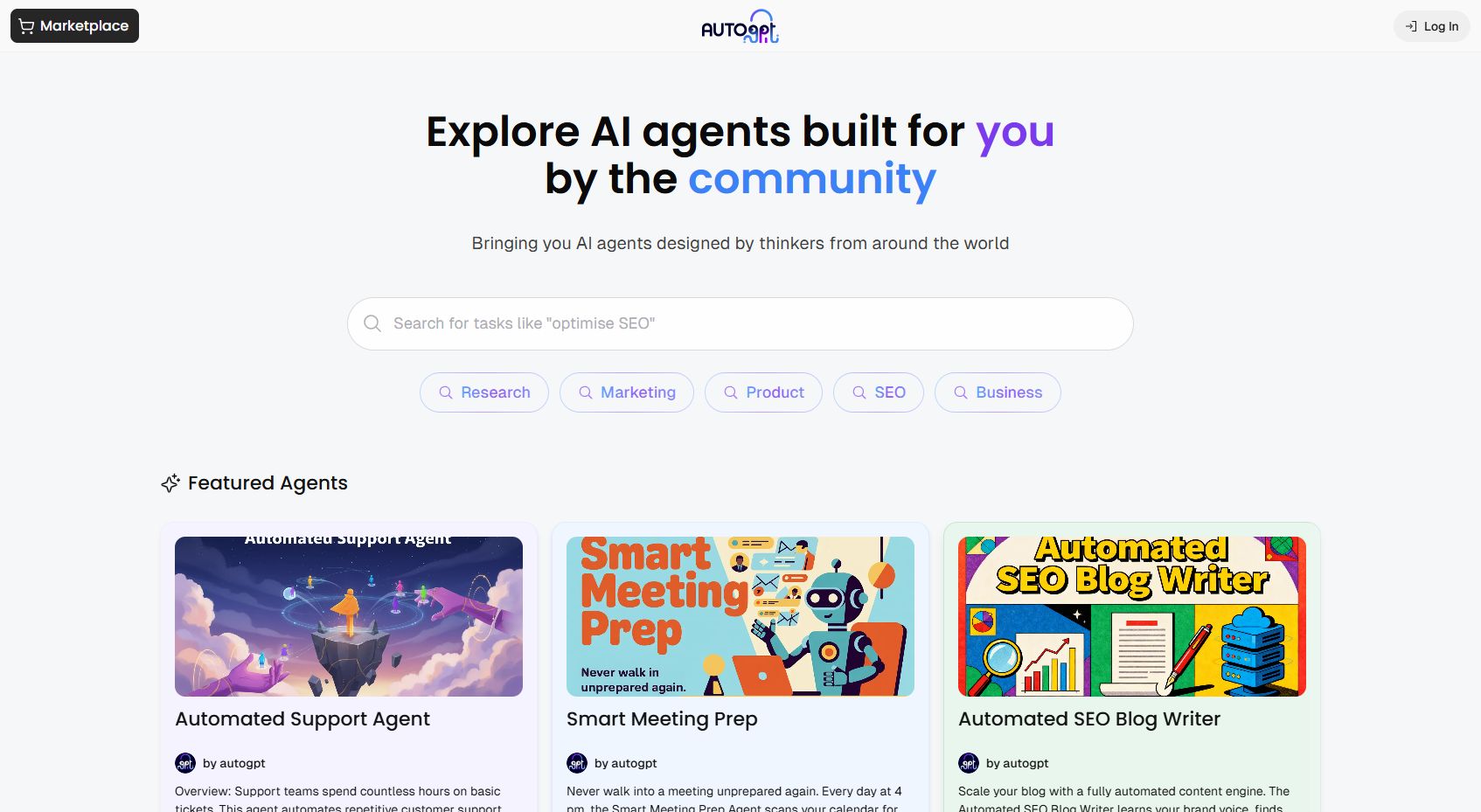
The public marketplace index displayed the following run counts when checked. Run counts may change, may include repeated executions by the same person and do not establish task success, distinct customers, subscriptions or ROI. [4]
| Workflow | Creator | Category | Published runs | Evidence |
|---|---|---|---|---|
| Smart Meeting Prep | autogpt | Operations | 51,648 | Official marketplace index [4] |
| Personal Newsletter | autogpt | Research / communication | 50,138 | Official marketplace index [4] |
| Automated SEO Blog Writer | autogpt | Marketing / SEO | 27,720 | Official marketplace index [4] |
| AI Video Generator | autogpt | Media | 26,556 | Official marketplace index [4] |
| Research Scraper – Agentic Quick-Start | toran | Research | 15,708 | Official workflow page [13] |
| Lead Finder | autogpt | Sales | 8,568 | Official marketplace index [4] |
| Automated Support Agent | autogpt | Support | 5,527 | Official marketplace index [4] |
The separate Flux AI Image Generator listing also had a prominent public run count; it is excluded here because this article focuses on the seven named research tracks and not every available marketplace product.
Security, reliability and responsible use
Autonomous systems can combine untrusted information with access to sensitive apps. The risks differ by task: prompt injection in research pages, incorrect customer email replies, unintended publishing, compromised plugins, leaked API credentials, unapproved CRM changes and runaway usage expenses. Historical Classic plugin documentation explicitly warns that plugins can execute arbitrary Python code and may expose keys. Contemporary AutoGPT materials advertise configurable access and spending thresholds, but those controls do not guarantee the accuracy or safety of every future agent action. [12] [2]
Operational guardrails should include narrowly scoped credentials; test or sandbox accounts; allowlisted actions and domains where feasible; human approval before publishing, payment, deletion or external communication; budgets and alerts; retention and access reviews; traceable source references; quality checks for every business-critical output; and a clear rollback or disable procedure. Lead-generation workflows must respect privacy and outreach regulations. Support workflows should avoid exposing personal account information without identification and authorization. Finance agents should prepare proposals for authorized human review, not autonomously transfer funds.
Practical lessons for businesses
- Start with a narrow, reversible job. A read-only research brief is easier to validate than an autonomous support or billing agent.
- Choose the right AutoGPT generation. A 2023 Classic plugin tutorial is not an Otto instruction manual; verify product version and deployment requirements.
- Separate content production from approved outcomes. Drafts, scraped records and model responses still require review.
- Measure the entire workflow. Include failed attempts, API expenses, human corrections and downstream performance.
- Protect the connections. Permission scope, approval thresholds and secret handling matter as much as the prompt.
- Require source and change tracking. Market research and recurring reports should distinguish facts, interpretation and dates.
- Do not over-read marketplace numbers. Public executions and vendor showcases are discovery evidence, not evidence of actual savings.
AutoGPT compared with alternative AI automation platforms
| Platform | Primary emphasis | Overlap with AutoGPT | Important distinction |
|---|---|---|---|
| n8n | Visual integrations, workflow automation and AI steps | Triggers, API connectors, self-hosted workflows | Workflow-centered environment; n8n also announced natural-language AI workflow creation in 2026. [14] |
| Make | Scenario automation with newer AI Agents | Multi-step process logic, app connections, AI actions | Scenario-oriented automation and reusable AI agents; the newer Make AI Agent product was documented as beta in 2026. [15] |
| Zapier | App connectivity, automation, AI agents | Connected tools, workflow triggers, agent actions | Broad no-code automation ecosystem; current Agents documentation describes a migration to AI by Zapier. [16] |
| CrewAI | Developer-oriented agent crews and flows | Specialist agents, delegation and multi-agent logic | Code-oriented framework and orchestration concepts rather than identical hosted AutoGPT UI. [17] |
| LangGraph | Stateful orchestration and controlled execution | Agent planning, tool use, human approvals | Lower-level graph runtime built for developer control, persistence and complex execution paths. [18] |
These are qualitative product-positioning differences, not controlled performance benchmarks. Prices and license terms are plan- and version-dependent; verify current contracts directly rather than infer universal price advantages.
SEO strategy and publication metadata
SEO title: AutoGPT AI Case Studies: Agents & Automation in 2026
Meta description: Explore AutoGPT AI case studies, real developer implementations, official agent workflows, business uses and verified evidence in 2026.
Suggested slug: autogpt-ai-case-studies
Search intent: Informational, technical research and business tool evaluation. The keyword set includes AutoGPT AI case studies, AutoGPT business automation, AutoGPT real-world examples, AutoGPT Otto use cases, AutoGPT lead generation automation, AutoGPT open-source projects and autonomous AI workflows. A content gap worth addressing is the frequent conflation of product demos, historical testimonials and customer case studies. No third-party keyword-volume or difficulty dataset was verified, so numerical search-volume estimates are intentionally omitted.
Suggested internal linking: Link to the live Artificial Intelligence Files homepage or relevant existing AI Case Studies, AI Tools and AI Company Profiles pages after confirming their actual paths in the content management system. Do not invent unavailable page URLs. The homepage is https://artificialintelligencefiles.com/.
Frequently asked questions
1. What is AutoGPT?
AutoGPT is an AI agent ecosystem spanning an original Python-based Classic project and newer platforms for creating and coordinating automated work. [1]
2. What are AutoGPT AI case studies?
They are evidence-backed descriptions of who used a specific AutoGPT product, for what task, with what implementation and verified outcome. A product listing alone is not a customer case study.
3. Are real businesses using AutoGPT?
The platform is offered commercially, but a named external business with independently corroborated ROI was not identified in the reviewed public sources. Private adoption may exist.
4. How does AutoGPT Classic differ from the current platform?
5. How can AutoGPT support business automation?
Agents can research, create drafts, use connected apps and run repeatable tasks, subject to their permissions, model quality and human oversight. [2]
6. Can AutoGPT help with SEO content?
7. Can AutoGPT generate leads?
Its Lead Finder listing describes Google Maps API-based business research, but exported entries are not automatically qualified prospects. [5]
8. Can AutoGPT automate customer support?
The official support example describes knowledge lookup, confidence-based replies and human escalation. Its advertising rate is not a verified customer benchmark. [5]
9. How are visual workflows built?
10. What is an AI Expert?
An AutoGPT specialist with a role, instructions, capabilities and permitted connected accounts. [3]
11. What does Otto do?
Otto helps users brief and coordinate experts, presenting work for user review. [2]
12. Can AutoGPT make videos?
Its listed video workflow coordinates research, scripts and metadata, then invokes Revid.ai for rendering. [5]
13. Can it prepare meetings?
The marketplace offers Smart Meeting Prep; exact access and output depend on the configured workflow. [4]
14. Can AutoGPT monitor competitors?
The how-it-works page demonstrates Otto and Nadia planning a competitor brief, but explicitly marks the sample company findings as fictional. [2]
15. What is the AutoGPT Marketplace?
A collection of workflows and agent capabilities provided by official and community creators. [4]
16. Do marketplace runs prove business results?
No. Run totals do not validate unique users, output quality, task completion, revenue or ROI.
17. Can developers build custom agents?
Yes. AutoGPT maintains public source repositories, technical documentation and extensibility approaches. [1]
18. Is AutoGPT open source?
Parts of the repository are open source, but licenses differ across components: Classic is MIT, while the platform directory uses Polyform Shield according to the repository. [1]
19. Can AutoGPT be self-hosted?
The platform repository documents self-hosting, with responsibility for infrastructure, credentials, upgrades and model costs falling to the operator. [1]
20. What does running AutoGPT cost?
21. How does AutoGPT compare with n8n?
22. What are autonomous-agent limitations?
Incorrect tool choices, hallucinations, prompt injection, permissions errors, cost spikes and missing data can reduce reliability.
23. How should a business measure ROI?
Measure verified financial value against all implementation, tool, usage and review costs, using a consistent task baseline.
24. Is AutoGPT suitable for smaller businesses?
Potentially, especially for narrow research, drafting and coordination tasks. Fit depends on data sensitivity, cost, maintenance and ability to verify output.
25. What safeguards should teams prioritize?
Least-privilege connections, approvals, logs, source attribution, spending caps, error monitoring, backups and periodic quality checks.
Conclusion and final fact check
AutoGPT's documented evolution—from Classic to visual workflows and Otto-led AI Experts—is real and source-supported. The reviewed public repositories support several named developer extension stories, and the marketplace offers concrete workflow examples across common business tasks. What remains weak in public material is independently measured customer impact. It would be misleading to convert advertised support automation percentages, lead-research time savings, marketplace runs or historical endorsements into financial results. For an authoritative case-study directory, the most useful conclusion is disciplined: real evidence first, practical technology second, no fabricated results.
Final verification status: Named external customer with independently verified financial ROI: not publicly documented in reviewed sources. Developer demonstration: Auto-GPT–Notion, author-linked demo. Additional public code projects: IFTTT, Discord and Google Analytics plugins (runtime performance not independently validated). Official workflow descriptions: seven analyzed. Historical testimonials: not counted as modern paid customers. Promotional percentages: excluded from measured outcomes. Fictional company samples: excluded. Financial ROI: not calculated. Screenshot descriptions: identified as vendor-owned product images, not third-party customer evidence.
Research references
- [S1] Significant-Gravitas, AutoGPT repository, undated/live repository; accessed 29 Oct 2026. https://github.com/Significant-Gravitas/AutoGPT — product generations, self-hosting and component licenses. Primary technical source.
- [S2] AutoGPT, How AutoGPT Works, live page; accessed 29 Oct 2026. https://agpt.co/how-it-works/ — Otto workflow, fictional competitor example, approvals, routines and spending controls. Official vendor documentation.
- [S3] John Ababseh / AutoGPT, A rock in your work life, 3 Oct 2026. https://agpt.co/blog/designing-otto-and-ai-experts-clay-and-rock/ — Experts production release timing, product roles. Official product blog.
- [S4] AutoGPT, Marketplace, dynamic live index; observed 29 Oct 2026. https://platform.agpt.co/marketplace — public workflow names and run counts; activity only.
- [S5] AutoGPT, Official creator storefront, dynamic live page; accessed 29 Oct 2026. https://platform.agpt.co/marketplace/creator/autogpt — workflow descriptions, vendor claims and external video services.
- [S6] doutv, Auto-GPT–Notion, GitHub repository, Classic v0.3.0-era source, accessed 29 Oct 2026. https://github.com/doutv/Auto-GPT-Notion — code and author-linked demonstration.
- [S7] AntonioCiolino, AutoGPT–IFTTT, GitHub repository, accessed 29 Oct 2026. https://github.com/AntonioCiolino/AutoGPT-IFTTT — classic webhook plugin, test instructions.
- [S8] gravelBridge, AutoGPT–Discord, GitHub repository, accessed 29 Oct 2026. https://github.com/gravelBridge/AutoGPT-Discord — classic remote-control plugin.
- [S9] isaiahbjork, Auto-GPT-Google-Analytics-Plugin, GitHub repository, accessed 29 Oct 2026. https://github.com/isaiahbjork/Auto-GPT-Google-Analytics-Plugin — analytics integration code/docs.
- [S10] AutoGPT, Integrations, live catalog accessed 29 Oct 2026. https://agpt.co/integrations/ — connector catalog; not proof of customer deployment.
- [S11] Toran Bruce Richards / AutoGPT, Introducing Agent Blocks, 22 Nov 2024. https://agpt.co/blog/introducing-agent-blocks/ — modular architecture rationale.
- [S12] Significant-Gravitas, Auto-GPT-Plugins, GitHub, archived 9 Jun 2024; accessed 29 Oct 2026. https://github.com/Significant-Gravitas/Auto-GPT-Plugins — legacy plugin system, security warning.
- [S13]
toran, Research Scraper – Agentic Quick-Start, AutoGPT Marketplace v1.0, accessed 29 Oct 2026. https://platform.agpt.co/marketplace/agent/toran/research-scraper-agentic-quick-start — official example; no customer ROI. - [S14] n8n, Hosting documentation, accessed 29 Oct 2026. https://docs.n8n.io/hosting/ — self-hosted workflow platform; compare July 2026 AI Assistant statement at https://community.n8n.io/t/introducing-the-ai-assistant-the-workflow-building-agent-inside-n8n/302667.
- [S15] Make, Introduction to Make AI Agent (New), documentation accessed 29 Oct 2026. https://help.make.com/introduction-to-make-ai-agent-new — scenario-based AI agent design.
- [S16] Zapier, Build an agent in Zapier Agents, updated 1 Oct 2026. https://help.zapier.com/hc/en-us/articles/24393442652557-Build-an-agent-in-Zapier-Agents — app-connected agent configuration.
- [S17] CrewAI, Introduction, live documentation accessed 29 Oct 2026. https://docs.crewai.com/en/introduction — agents, crews and flows.
- [S18] LangChain, LangGraph Overview, live documentation accessed 29 Oct 2026. https://docs.langchain.com/oss/python/langgraph/overview — stateful graph-oriented orchestration.