
PhotoRoom
Company profile: the founders, business, AI technology, funding and customers behind the ecommerce visual-production platform.
PhotoRoom at a Glance
Photoroom is a venture-backed French AI visual-production business serving individual sellers, ecommerce brands, retailers, marketplaces and developers. It began with automated background removal and expanded into generated product scenes, catalog-wide editing, fashion images, product videos, quality checks and enterprise APIs. [1] [4] [14]
300M people
Cumulative people who have used the product; not monthly active users.
7B images / year
Annual processing volume as reported by the company.
$64M raised
Cumulative announced fundraising through the February 2024 Series B.
Adoption statistics are PhotoRoom-reported and not independently audited. Figures describe different measures and should not be compared as if equivalent. [4] [6]
About PhotoRoom
Short company description (55 words): Photoroom develops AI-powered image and video tools for online selling. Its software removes photo backgrounds, generates product scenes and edits catalog visuals in batches. Sellers can use its mobile and web apps, while larger businesses can integrate image automation through APIs. Its main focus is making product photography faster, more consistent and easier to manage.
The company addresses a practical bottleneck: a seller may have a good product but limited time, budget or photo-editing expertise. Photoroom helps turn existing photos into consistent listing and campaign assets; it is not a guarantee of sales performance. [1] [4]
Company Overview
Photoroom is best understood as an AI product-visual platform with three overlapping markets: consumer-friendly editing software, business catalog-production tools, and API-driven image infrastructure. Its 2026 launch of Visual Agents extends that model to managed generate-check-fix workflows. [29]
For a solo reseller, this means removing a distracting background. For a retailer, it can mean standardizing thousands of SKUs. For a marketplace, an API can process seller-uploaded photos inside the listing pipeline.
Key Company Facts
| Field | Evidence-led finding |
|---|---|
| Brand / primary product | Photoroom (historically styled PhotoRoom) |
| Legal operating entity | Photoroom, French société par actions simplifiée (SAS); RCS Paris 853 059 384 [2] [22] |
| Founded | 2019; Balderton specifies late 2019 [5] |
| Co-founders | Matthieu (Matt) Rouif; Eliot Andres [3] [4] |
| Head office / registered address | 229 rue Saint-Honoré, 75001 Paris, France. LinkedIn also lists a New York location; operational HQ designation is not uniform across sources. [2] [38] |
| Ownership | Privately held, venture-backed. Majority shareholder / cap table not publicly disclosed. |
| Parent company / acquisitions | No publicly verified parent; Photoroom acquired GenerateBanners in May 2025, its first announced acquisition. Transaction price and resulting legal subsidiary structure not disclosed. [43] |
| CEO | Matthieu Rouif [4] |
| CTO | Eliot Andres (co-founder; described as CTO in verified 2024 coverage). Latest formal 2026 job-title reaffirmation not independently verified. [7] |
| Main platforms | Web, iOS, Android, Shopify app and developer API [8] [14] |
| Main markets | Ecommerce, retail, resale, marketplaces, fashion, food delivery, product marketing |
| Latest confirmed funding round | Series B, $43M, 27 February 2024 [6] |
| Cumulative announced funding | $64M through that round [6] |
| Latest public valuation reference | $500M, February 2024; CEO-confirmed to TechCrunch. Not a verified current valuation. [7] |
| Revenue / ARR | Not publicly disclosed in company financial statements; $65M ARR in 2024 reported by third party, not company-confirmed [30] |
| Employees | ~50 in Feb 2024; reliable current 2026 count not independently verified [7] |
| Users | 300M cumulative people used, company-reported in June 2026 [4] |
| Images processed | 7B per year, company-reported as of June 2026 [4] |
| Pricing | Free (personal only); Pro / Max / Ultra subscriptions; Enterprise and usage-priced API [8] [9] [36] |
| Support | help@photoroom.com in legal notice; in-app Help Center chat recommended [2] |
| Privacy contact | privacy@photoroom.com [22] |
| Website | www.photoroom.com |
| Verified social presence | LinkedIn; other platform profile URLs omitted rather than guessed. |
Who Founded PhotoRoom?
Matthieu Rouif and Eliot Andres founded Photoroom in 2019. Rouif described the spark as a cumbersome manual lasso-editing task while working at GoPro; he joined with Andres, an engineer with computer-vision experience, to automate the process. [1] [3] [4]
| Founder | Role / background | Contribution | Evidence |
|---|---|---|---|
| Matthieu “Matt” Rouif | Co-founder and CEO; former GoPro product manager; previously worked on Replay video editor; Y Combinator bio lists École Polytechnique and Stanford. | Product vision, seller-focused positioning and company leadership. | [3] [4] |
| Eliot Andres | Co-founder; engineering and computer vision / deep-learning background; described as CTO in 2024 reporting. | AI implementation, early product engineering and image processing. | [3] [7] |
Founding story: The first problem was not how to generate synthetic pictures but how to remove a background without spending hours tracing objects. Ecommerce sellers then provided a particularly strong use case because listings need clear, repeatable product imagery. [1] [5]
Leadership Team
| Person | Evidence-backed leadership status | Notes |
|---|---|---|
| Matthieu Rouif | Co-founder & CEO (confirmed in 2026) | Current public-facing executive and author of the 2026 brand-positioning statement. [4] |
| Eliot Andres | Co-founder; CTO in 2024 coverage | 2026 position not independently reconfirmed from a current management roster. [7] |
| Ben Lefaudeux | Head of machine learning, cited in company’s technical material | Historical cited role; current 2026 tenure not independently confirmed. [13] |
| Thibaut Patel | Founder, GenerateBanners (acquired May 2025) | Joined Photoroom in connection with acquisition; cited as head of API shortly afterward. Current 2026 title could not be independently verified. [43] [45] |
| COO, CFO, CPO and other executives | Not publicly disclosed / could not be independently verified | No names inserted without reliable, dated source. |
The available public sources do not establish a comprehensive, current executive directory. The list intentionally avoids making outdated role claims.
PhotoRoom History
| Date | Milestone | Why it mattered |
|---|---|---|
| Late 2019 | Founding by Rouif and Andres | Opened a mobile-first route to AI-assisted image cutouts. [5] |
| 2020 | Early marketplace seller traction; Y Combinator backer | Validated a repeatable need for product-image cleanup. [3] [30] |
| Nov 2022 | $19M Series A; more than 40M app downloads then | Funding to expand beyond early mobile growth. [5] |
| Feb 2024 | $43M Series B; valuation reported at $500M | Expanded funding for in-house AI research and business tools. [6] [7] |
| May 2025 | GenerateBanners acquisition; Visual Ads Automation launch | First announced acquisition; introduced precise text-layout composition and high-volume branded ad variants to the API. [43] |
| Sep 2025 | Announcement of open-source text-to-image model development | Shift toward a visible, publishable model-research program. [33] |
| Feb–May 2026 | Product Fixer, Shopify workflows, AI video, batch AI tools | Emphasis on commerce catalog quality and scale. [14] [37] |
| Jun 2026 | New brand identity; 300M cumulative users reported | Sharper ecommerce-first positioning. [4] |
| Jul 2026 | PRX Pixel research published under Apache 2.0 | Open-source pixel-space model research. [11] |
| Aug 2026 | Visual Agents for enterprise catalogs | Generate, check and fix workflow assembled for enterprise use. [29] |
| Sep 2026 | New fashion presets and fidelity checking API updates | More control over consistency and catalog QA. [15] |
| 13 Oct 2026 | Vestiaire Collective test results published | Recent marketplace validation; a reported randomized test. [19] |
Ownership & Corporate Structure
Operating entity: Photoroom SAS, a French company registered in Paris. The company’s public documents describe it as the service provider. Investor-backed is not equivalent to investor-controlled: a complete cap table, voting rights and ultimate beneficial-ownership breakdown were not established from the reviewed sources. [2] [21] [22]
Photoroom SAS
French SAS and registered website operator.
Privately held
Venture investors are documented, but their ownership percentages are not.
GenerateBanners · 2025
Integrated its automated ad-text layout into Photoroom APIs; purchase price and formal subsidiary details not disclosed. [43]
What Does PhotoRoom Do?
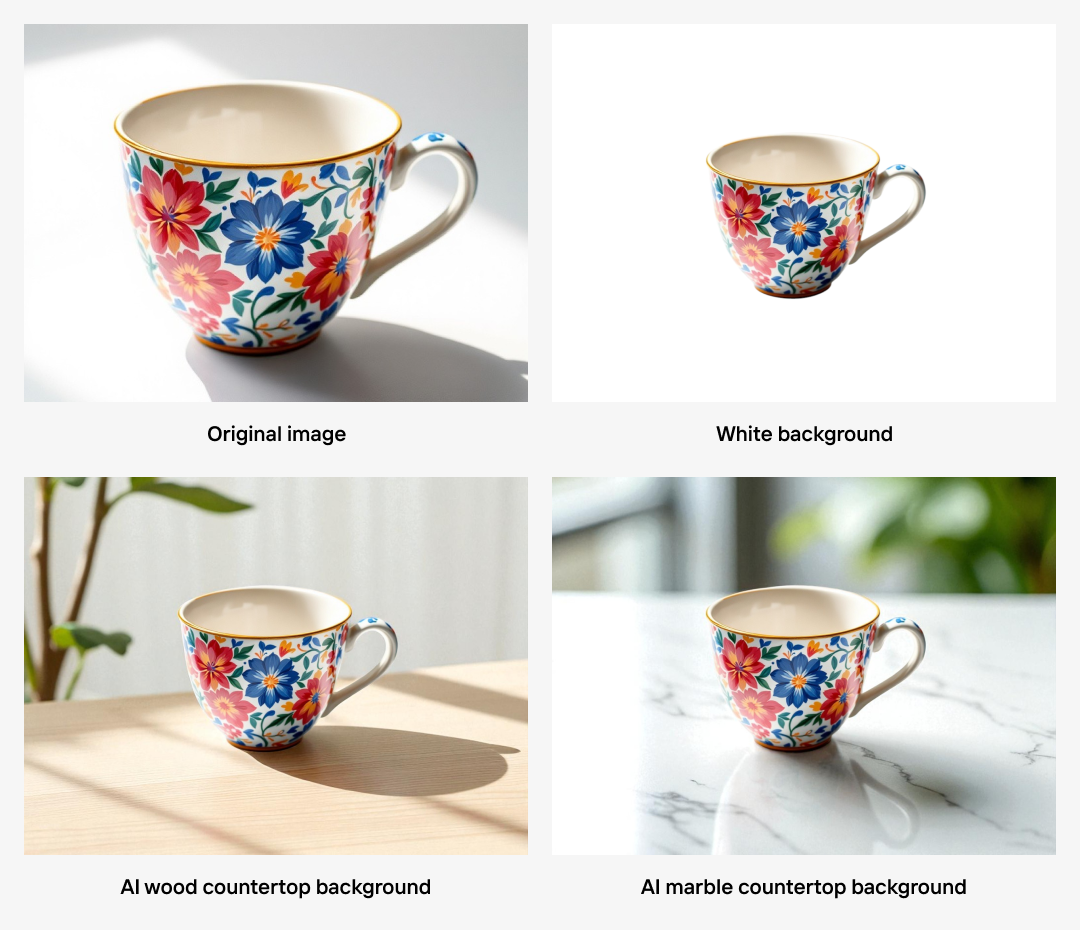
It combines straightforward photo editing and more generative workflows: keep the original product, remove or replace its surroundings, build product lifestyle scenes, enhance fashion presentations, generate supporting marketing visuals and automatically format catalogs. Enterprise capabilities add API orchestration, quality assurance and review rules. [8] [10] [26] [29]
Background removal
Isolate product silhouettes, create white backgrounds or transparent cutouts.
AI scenes and fashion
Create contextual lifestyle images, virtual fashion scenes, shadows and product videos.
Catalog & API tools
Batch-edit sets of photos, publish with Shopify and integrate editing in software pipelines.
PhotoRoom Products & AI Tools
| Current tool / area | Input → output | Primary users / notes |
|---|---|---|
| Background Remover | Photo → transparent/white/color background | Core image segmentation; web, mobile and API. [26] [35] |
| AI Backgrounds / Product Staging | Photo + preset/prompt → contextual product scene | Generative backgrounds; credit-based tools; exact platforms and model tiers vary. [12] [26] |
| AI Shadows / Relight | Photo → product with adjusted shadows or lighting | Core or advanced variants by plan; API functionality available. [8] [10] |
| Retouch / Remove Object / Product Fixer | Photo + target edit → cleaned/corrected image | Product Fixer compares against the reference and helps repair generative errors. [14] |
| AI Expand / Resize / Image Enhancer | Photo → re-framed or enhanced output | Uses generative and conventional edits depending on operation. [8] [26] |
| AI Fashion Models / Virtual Model | Clothing images → styled virtual model imagery | Fashion teams; 4-item outfit capability reported in H1 2026. [14] |
| Ghost Mannequin / Flat Lay / Ironing / Recolor | Apparel photo → alternate merchandising view | Catalog merchandising, not evidence of the actual product being changed. [26] |
| Product Photography / AI Images | Prompt → wholly generated product-style image | A separate synthetic-image workflow; must not be mistaken for proof of a real SKU. [39] |
| Video Generator | Product reference images → templated video | 2026 rollout; Max and Ultra have video limits. [8] [14] |
| Batch Mode / Brand Kit / Shopify | Multiple photos, brand rules or catalog → standardized exports | High-volume processing and commerce publishing. [8] [14] |
| Visual Ads Automation (GenerateBanners) | Image/catalog + brand guidelines, text, templates → large-scale campaign variants | Added May 2025 following its first acquisition; available through Image Editing API for enterprise. [43] |
| Image Editing API / Background API | HTTP image + parameters → processed image | Developer and enterprise automation. [9] [10] |
| Visual Agents / Visual QA / Enterprise Guarantee | Catalog + agreed criteria → generated and checked assets | Enterprise services, qualifying terms and contracts apply. [8] [29] |
Historical status: Older help articles refer to legacy model labels and pricing tiers. This table reflects the product families visible in current 2026 documentation; it is not a guarantee that every tool is available on every device or plan.
Product Photography in Practice
Photoroom’s product workflows range from ordinary background cleanup to generated scenes and merchandising visuals. The example below is a company-published demonstration of a hat moving through different background and creative treatments. It is illustrative, not an audited accuracy benchmark. [10]
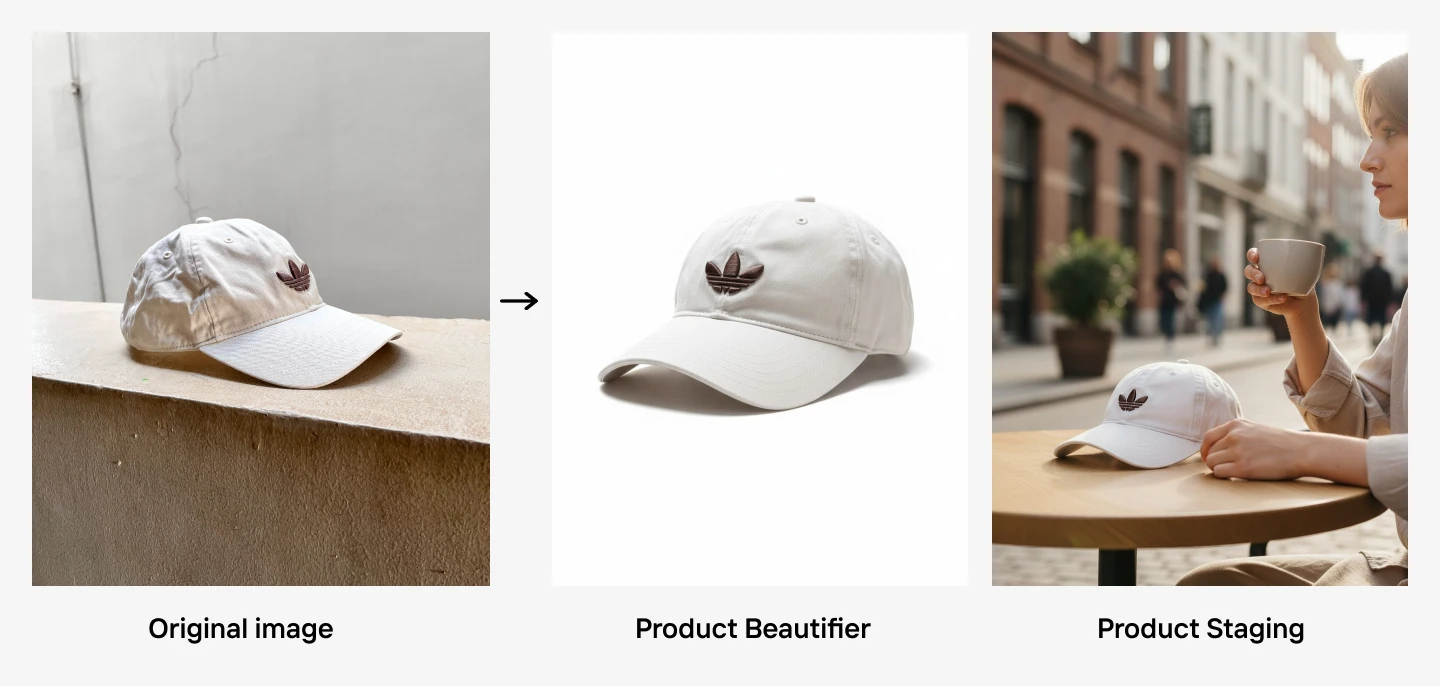 Illustrative company-supplied product photography image.
How PhotoRoom Works
Background removal
Upload a photo → AI segments the foreground → choose transparent or white background → export. The Basic API is specifically designed not to alter the remaining product pixels, except optional operations such as despill. [35]
AI product photography
Upload a real product photograph → isolate product → generate suitable setting → edit shadows or lighting → inspect details → export. Generative operations may need manual correction. [14]
Catalog & developer API
Photo source or PIM → programmatic API request with x-api-key → background/edit processing → QA check → DAM, storefront or marketplace listing. [10]
Important distinction: A real-product edit starts from a photograph of a specific item. Text-only Product Photography can generate a synthetic item from a prompt. Sellers should not use a synthetic output as a factual photograph of a SKU without checking its exact identity and details. [39] [40]
PhotoRoom AI Technology
Confirmed PhotoRoom technology. The company publicly documents foreground segmentation, background removal, generative backgrounds, image editing APIs, AI shadow generation, fashion generation, and visual QA using a proprietary fidelity model. It also documents proprietary/open research in pixel-space and latent diffusion. [10] [11] [29]
General technical explanation — not a claim about its proprietary architecture: Segmentation models predict which pixels belong to an object; matting can estimate semi-transparent edges. A generative model can synthesize background pixels around a subject. A separate image-comparison or fidelity system can detect when product labels, shapes or colors drift from a reference. Some workloads run on servers; availability of individual models on mobile does not by itself prove on-device inference.
Photoroom says its 2026 enterprise benchmark covered 4,250 generated images across 850 products: its own pipeline increased a strict product-fidelity pass rate from 29% to 38.2%. This is Photoroom-run testing, not an independently replicated benchmark, and 38.2% is not a general product-accuracy guarantee. [29]
AI Models & Research
| Model / research | Documented role | Ownership / status | Evidence |
|---|---|---|---|
| Photoroom Instant Diffusion (ID) | Product-photo-focused in-house diffusion model initiative | Proprietary research disclosed by company; deployment mapping not fully public. | [13] |
| AI Backgrounds Studio HD / Studio / v3 / v2 | Selectable AI background-generation models; documented speed/resolution trade-offs | Official product model labels; detailed model weights/providers not specified. | [12] |
| PRX / PRX latent variants | Open text-to-image research lineage; 256px–1024px variants | Photoroom research/open releases; not evidence every variant powers commercial tools. | [11] [33] |
| PRX Pixel | ~7B-parameter pixel-space text-to-image research model; no VAE, Qwen3-VL text encoder | Photoroom open-sourced under Apache 2.0 in July 2026; company describes as research, not live product editor. | [11] [40] |
| Visual Agents fidelity scoring | Checks images against product fidelity criteria | Photoroom proprietary fidelity model / enterprise service; model weights undisclosed. | [29] |
| Third-party model suppliers | Sub-processors include OpenAI, Black Forest Labs, Google and others | DPA establishes listed processor roles, not which model powers each PhotoRoom feature. | [22] |
Relevant engineering resources: official PRX GitHub, PRX Pixel weights, and published model-data research notes. These are research artifacts, not proof of the full production-model inventory. [11]
Main Use Cases
| User / industry | Problem | Capability → outcome |
|---|---|---|
| Small online seller | Distracting photographed background | Background Remover → clean listing shot. |
| Shopify brand | Inconsistent product and campaign visuals | Brand Kit, batch, Shopify app → more uniform assets. |
| Fashion retailer | Need on-model, ghost and flat-lay views | AI Fashion Models, Flat Lay → merchandising imagery. |
| Resale marketplace | Variable seller photo quality | Remove Background API → standardized seller listing flow. |
| Restaurant / delivery marketplace | Menus with inconsistent images | API and web edits → consistent visual presentation. |
| Automotive and home retail | Contextual imagery at scale | Scene generation and catalog transforms, subject to category suitability. |
| Advertising team | Many placements, sizes and formats | Resize, scenes, product videos → campaign variations. |
| Developer / SaaS team | Need repeated edits without a person opening the editor | API → automated images returned to software pipeline. |
Industry positioning documented on PhotoRoom’s pricing/product pages includes fashion, marketplaces, beauty, home, food, and technology; no unsupported partnership with Amazon, TikTok or other channel is implied simply because export sizes may be compatible. [8] [10]
Who Uses PhotoRoom?
Its audiences span solo resellers and creators, growing ecommerce businesses, brand marketing teams, product/catalog operations, resale and delivery platforms, software developers, and enterprises. The two most economically distinct workflows are self-service subscriptions and API/enterprise processing. [4] [9] [17]
Officially documented businesses include Decathlon, Wolt, Depop and Vestiaire Collective; their relationships and reported impacts are detailed below rather than inferred from customer-logo strips. [16] [17] [18] [19]
Industries Served
- Retail and ecommerce, including sporting goods and consumer products.
- Resale and peer-to-peer marketplaces, including fashion and luxury resale.
- Food and grocery delivery, with platform-wide catalog editing.
- Fashion and apparel merchandising, including on-model and garment workflows.
- Beauty/skincare, home/furniture and general product imagery (official industry positioning).
- SaaS and software products using the API for image automation.
The industries above are drawn from official product positioning and documented customers; this is not a claim of enterprise penetration in every vertical. [8] [16] [17] [19]
Platform Availability & Integrations
| Surface / integration | Current evidence | Scope |
|---|---|---|
| Web app | Confirmed | Editing, export, batch, business workflows. [8] |
| iOS / iPadOS | Confirmed | Photo editing, catalog features; availability differs by tool. [8] |
| Android | Confirmed | Photo editing and other AI tools; version availability differs. [8] |
| REST API | Confirmed | Background removal and image-edit operations. [10] |
| Photoroom for Shopify | Confirmed native integration | Manage and publish Shopify catalog and listing imagery; Max/Ultra in pricing comparison. [8] [14] |
| MCP for Claude | Confirmed workflow integration | Tool calling through a Claude connector; not a generic desktop app. [14] |
| Capture One 16.8 | Confirmed native Actions-framework integration | Background removal, AI backgrounds, shadows and expand directly in photo-capture workflow. [44] |
| Standalone Windows/macOS editor or browser extension | Could not be independently verified | Web access is not the same thing as a standalone desktop client. |
| Amazon/eBay exports | Compatible image workflows | Do not treat marketplace image-size support as a certified native integration. [8] |
PhotoRoom Pricing
Pricing checked: 16 October 2026. The amounts below are US-dollar prices displayed on the official web pricing page with annual billing selected; not month-to-month rates. Taxes, local markets, mobile app stores and promotions can differ. [8]
| Plan | Displayed price | Credits and exports | Positioning |
|---|---|---|---|
| Free | Free | Limited non-commercial personal use; low AI limits | Personal experimentation only. [36] |
| Pro | $7.50/month, billed yearly | 8,000 AI credits + 1,000 exports per month | Sellers, basic catalog creation. |
| Max | $20.99/month, billed yearly | 25,000 AI credits + 3,000 exports per month | Growing brands, video and Shopify access. |
| Ultra | $82.50/month, billed yearly | 75,000 AI credits + 10,000 exports per month | Higher output volume and 4K features. |
| Enterprise | Custom quotation | Contract-specific balance, QA/SLA and negotiated operations | Large catalogs, managed workflows, APIs. |
The official pricing page states that AI operations and exports are different allowances. Core tools such as background removal and retouch are included on paid plans subject to fair use; credit-intensive tools consume from a shared pool. Monthly pricing and payment platform differences must be checked at checkout. [8]
PhotoRoom API & Developer Platform
PhotoRoom sells two published API levels: Basic (Remove Background) and Plus (Image Editing). Developers authenticate HTTP calls with the x-api-key request header. Successful calls consume an image allowance, with distinct limits for the two tiers. [9] [10] [32]
| API capability | Input → output | Use case | Current access |
|---|---|---|---|
| Remove Background / Basic | Image file → cutout/white/color output | Seller image cleanup | Basic; listed at $0.02 per image. [9] [35] |
| Image Editing / Plus | Image + parameters → edited image | Staging, crop, shadow, lighting, expand and more | Plus; listed at $0.10 per image. [9] [10] |
| Generate Background | Product photo + settings → contextual background | Lifestyle photos at scale | Within Image Editing API. [42] |
| Enterprise APIs / Visual QA | Large catalog → automated edited and checked assets | High-volume brand workflows | Contact sales; enterprise API offering. [9] [29] |
Developer details. Plus accepts PNG, JPEG, WEBP and AVIF; the published limit is 30 MB with a maximum 5,000-pixel longest side after resizing. Basic accepts PNG/JPEG/WEBP/HEIC inputs, up to 50 MB and 6,000 pixels on its longest side. Official guidance lists a 1,000-calls/month watermarked editing sandbox and 10 clean free Basic production calls for new accounts; verify account entitlements before implementation. [9] [10]
API pricing is based on image processing, not identical to mobile subscriptions. The current pricing FAQ describes Basic and Plus cross-charges at $0.02/$0.10 respectively; enterprise eligibility and rate limits vary by contract. Public universal latency or SDK availability must not be assumed. [9] [32]
API business strategy: an image-processing endpoint lets marketplaces, retail platforms, DAM/PIM workflows and SaaS products standardize images without making sellers edit every file manually. PhotoRoom confirms this business line; the API’s share of total revenue is not publicly disclosed. The May 2025 GenerateBanners acquisition added automated copy layout and branded ad composition. [10] [17] [43]
Business Model
| Revenue stream | Status | Evidence |
|---|---|---|
| Pro / Max / Ultra subscription payments | Confirmed | Published subscription plan prices and credits. [8] |
| Basic / Plus API subscriptions and usage | Confirmed | Published per-image rate tiers and monthly allowances. [9] [32] |
| Enterprise annual commitments / custom QA | Confirmed | Negotiated contracts, export/operation metering and Visual Agents. [8] |
| Advertising revenue, third-party data sales | Not publicly disclosed | No reliable source in this review established such revenue streams. |
PhotoRoom competes through software recurring revenue, usage-based API access and enterprise service contracts. No public breakdown establishes which line is the largest or most profitable.
Funding & Investors
| Date | Round | Amount | Confirmed participants | Valuation / detail |
|---|---|---|---|---|
| 2020 | Seed / early financing | Amount not separately confirmed here | Y Combinator and early backers reported; do not assign unsupported round-specific amounts. [3] [7] | Not publicly disclosed |
| 7 Nov 2022 | Series A | $19M | Balderton Capital (lead), Adjacent and angels connected with Meta/Facebook, Hugging Face and Disney+. [5] | Not publicly disclosed |
| 27 Feb 2024 | Series B | $43M | Balderton Capital (lead), Aglaé and Y Combinator. [6] | Reported $500M valuation [7] |
Total disclosed funding: $64M through February 2024, per PhotoRoom’s investor announcement. A new post-2024 round was not established in the sources checked; this does not prove that no undisclosed financing occurred. [6]
Investor ownership and board seats: Shareholding percentages, any controlling investor, and a complete director roster were not publicly disclosed by the cited announcements.
Valuation & Financial Information
Latest date-specific public valuation: approximately $500 million in February 2024, reported by TechCrunch based on its confirmation with CEO Matthieu Rouif. This is a historical round valuation, not a 2026 current-market appraisal. [7]
Revenue/ARR: PhotoRoom does not publish audited annual revenue statements in the reviewed sources. Sacra reports approximately $65M ARR in March 2024; label this third-party estimate; not company-confirmed. API-only revenue, profitability, cash flow and 2026 ARR: not publicly disclosed. [30]
Headcount: TechCrunch described around 50 staff in February 2024. A current October 2026 employee count could not be independently verified; historic employee counts should not be republished as current. [7]
Users & Market Traction
| Metric | Value | Date / source | Evidence class |
|---|---|---|---|
| Cumulative people who have used Photoroom | 300M | Jun 2026 [4] | PhotoRoom-reported; not independently verified |
| Images processed per year | 7B | Jun 2026 [4] | PhotoRoom-reported; not independently verified |
| Businesses / brands using Photoroom | More than 1M | 2026 company About page [1] | PhotoRoom-reported; not independently verified |
| App downloads | 40M+ | Nov 2022 [5] | Investor-reported historic milestone |
| App downloads | 150M+ | Feb 2024 [6] | Investor-reported historic milestone |
| Monthly active users | Not publicly disclosed | As of Oct 2026 | No independently verified number |
| Paying subscribers / API customers | Not publicly disclosed | As of Oct 2026 | No independently verified number |
| Employee count | ~50 | Feb 2024 [7] | Historical independent reporting |
Cumulative users, downloads, active users and paying customers measure different things. The 2026 “300M users” figure should never be presented as monthly active users or subscribers.
Customers & Case Studies
All examples below appear in named PhotoRoom customer stories or company statements. Business outcomes are attributed to those sources, not independently audited. [34]
| Customer | Documented workflow | Reported result | Evidence |
|---|---|---|---|
| Decathlon | API and batch standardization of product catalog visuals | 35,000 images processed in a three-month rollout; 99% lower cost per image and 1,000 images edited in 20 minutes. | Official case study + named customer quotes. [16] |
| Wolt | API and web editor for food/grocery product images across markets | Standardized visuals for 140,000+ merchants in 27 countries; tens of thousands of images in batches. | Official case study + named customer quotes. [17] |
| Depop | Remove Background API integrated into resale listing flows | Company reports more than 1M listings handled in case narrative; methodology and attribution should be read in full case. | Official customer story. [18] |
| Vestiaire Collective | Randomized test: PhotoRoom clipping vs platform’s earlier in-house clipping tool | PhotoRoom group had 5% higher reported listing liquidity and 3–7% more unique product-page views. | Company-published comparison dated 13 Oct 2026. [19] |
Interpretation: These outcomes are from specific customer workflows and cannot be generalized to every merchant. The Vestiaire test is more methodologically informative than an ordinary testimonial, but access to the full independent dataset and audit was not established.
Partnerships & Integrations
| Relationship | Type | Why it matters |
|---|---|---|
| Shopify | Product integration | Store catalog management and publishing within PhotoRoom; current pricing lists access. [8] [14] |
| Capture One 16.8 | Native Actions framework integration | Photoroom background, scene, shadow and expand capabilities embedded in 2026 release. [44] |
| Wolt, Depop, Decathlon, Vestiaire Collective | Named customer relationships | Evidence of usage, not automatically joint-venture/strategic partnerships. [16] [17] [18] [19] |
| Y Combinator, Balderton Capital, Aglaé | Investor relationships | Financial backers; not evidence of product integration. [5] [6] |
| Listed processors / model providers | Supplier / sub-processor list | Data processing agreement enumerates firms, but does not map every live model to a public feature. [22] |
Privacy & Data Handling
App image training: PhotoRoom states that by default user images/designs in its app may be used to improve and train its models. Users can disable Improve model for everyone on their accounts; the privacy policy says that opting out is not retroactive. [20] [23]
API images: PhotoRoom says API image inputs are not used for model training by default. Its security page says API images are discarded after calls, and enterprise terms include stronger consent requirements. Distinguish this from saved designs and content in the consumer app. [23] [25] [41]
GDPR and processors: The company publishes a Data Processing Agreement and a sub-processor list including cloud providers and model vendors. The DPA describes client-controller / PhotoRoom-processor roles for applicable professional processing and gives privacy@photoroom.com for data inquiries. [22]
Precise retention periods differ by data type and must be checked against the live policy. Neither “all app images are never stored” nor “all uploaded images are always used for training” would be accurate.
Content Ownership & Commercial Use
The July 2026 terms state that customers own their submitted content as between customer and PhotoRoom, subject to the permissions/licences necessary to operate the service. They also permit PhotoRoom to process user content and set responsibilities for legal rights in uploads and outputs. [21]
Commercial-use restriction: Free accounts are licensed for personal, non-commercial use. PhotoRoom’s help center states that paid subscribers can use applicable templates and AI-generated assets commercially, but they must still comply with intellectual-property and third-party licensing rules. [24] [36]
Synthetic assets may contain design features or marks resembling protected material; commercial permission from an editing tool does not automatically settle copyright, trademark or marketplace advertising compliance. This section is practical guidance, not legal advice.
Security & Responsible AI
PhotoRoom publishes a security portal and states it has a SOC 2 Type 2 report scoped to its API (report dated April 2026). This should not be rewritten as proof that every product and entity is SOC 2 certified. Its enterprise offering also mentions SSO and SLAs. [25] [8]
The Data Processing Agreement identifies technical and organizational safeguards, third-party processors and enterprise responsibilities; the detailed trust reports may require access to its Trust Center. An ISO 27001 certificate was not independently verified in this review. [22] [25]
Responsible AI risks particularly relevant for sellers are incorrect labels, logos, fabric details, colors and fabricated product features. PhotoRoom’s Product Fixer, enterprise fidelity checks and contractual guarantee aim to address this; because no generative pipeline is error-free, human QA remains essential for regulated, branded or specification-heavy goods. [14] [29] [40]
Reviews & User Sentiment
PhotoRoom receives positive user discussion for speed, easy background removal and seller-oriented workflows. Some Reddit users with extensive reselling experience say it saves meaningful editing time. These reports are individual opinions, not controlled performance data. [27]
Repeated complaints include changes to credits and batch limits, pricing, occasional cutout errors, crashes and AI-generated artifacts. The cited posts are not representative customer surveys and may reflect different app versions and subscription terms. [28]
Quick cutouts
Accessible to users without professional compositing expertise.
Seller-first flow
Useful white backgrounds, repeatable layouts and mobile access.
Fidelity & limits
Generated scenes and credit allowances require checking before purchase or publishing.
PhotoRoom Strengths
- Focused positioning around ecommerce and product-visual workflows rather than general design alone. [4]
- Proven breadth across mobile, web, Shopify and two API product tiers. [8] [9]
- Documented enterprise examples at marketplace and retail catalog scale. [16] [17]
- Visible company-led research output: Instant Diffusion, PRX and PRX Pixel. [11] [13]
- Product-fidelity remediation and QA are a strategic priority rather than an ignored failure mode. [29]
PhotoRoom Limitations
- Generative edits may change important product details; fidelity checks reduce but do not eliminate the need for review. [29] [40]
- PhotoRoom is not a full substitute for advanced manual pixel-level editing, compositing and VFX workflows.
- Paid plans have distinct export/AI limits, and the free plan is non-commercial. [8] [36]
- Prices vary by region, subscription platform and billing interval. [8]
- Specific account and enterprise API latency/capacity should be verified against current service agreements.
- Current cap table, revenue split, staff size and user engagement metrics remain undisclosed or unverified.
Pros & Cons
| Pros | Cons |
|---|---|
| Fast seller-oriented background removal and easy image cleanup | Errors at object boundaries or AI-generated details require visual QA. |
| Catalog, batch and Shopify workflows | Caps and credits can complicate high-volume budgeting. |
| API plus enterprise offering | Higher-scale operations introduce usage and contract complexity. |
| Open technical research and product-fidelity focus | Underlying production model-to-feature mapping not fully public. |
PhotoRoom Competitors
The nearest competition depends on workflow. Remove.bg competes strongly in segmentation and API cleanup; Pixelcut overlaps in seller-facing AI product photography; Canva and Adobe Express are broader marketing-design environments; Photoshop provides deeper manual editing. Feature availability can change and individual plan access is not identical.
| Platform | Primary focus | Background removal | AI product scenes | Batch / automation | API positioning |
|---|---|---|---|---|---|
| PhotoRoom | Ecommerce product imagery | Yes | Yes | Yes | Dedicated image APIs |
| Canva | Design, social content and brand layouts | Yes (plan dependent) | AI image tools; less catalog-specific | Bulk creative tools | Different developer ecosystem |
| Pixelcut | AI product image editor | Yes | Yes | Available, plan dependent | Verify current endpoint and plan |
| Remove.bg | Background removal and compositing | Yes | Limited relative to full scene suite | Bulk / API | Dedicated remover API |
| Adobe Express / Photoshop | Broad design / professional imaging | Yes | Generative fill and images | Automation depends on product | Adobe enterprise/developer offerings |
This is a qualitative workflow comparison, not a scored benchmark. Check each provider’s current plan matrix before choosing an API.
PhotoRoom vs Canva
Choose PhotoRoom for repeatable product cutouts, ecommerce catalog styling and a dedicated image-processing API. Choose Canva for presentations, broader brand collateral, multi-format social media graphics and accessible collaborative layouts. Many marketing teams use both: PhotoRoom to prepare product assets, Canva to place them in campaign designs. Neither is categorically superior.
PhotoRoom vs Pixelcut
Both target ecommerce sellers who need backgrounds, generative scenes and polished listing photos. Compare actual batch allowances, image quality on your product category, AI model fidelity, and API contract features rather than assuming a universal winner. PhotoRoom’s API and enterprise QA are more fully documented in the sources reviewed here.
PhotoRoom vs Remove.bg
Remove.bg is a specialist option when the job is predominantly removing backgrounds at scale. PhotoRoom combines that with styled product photography, fashion transformations, video and catalog workflows. For a single automated cutout, compare segmentation edge quality, operating cost, and throughput; for full creative operations, compare the surrounding tooling.
PhotoRoom vs Adobe
Adobe Photoshop offers much greater pixel-level control for experienced retouchers; Adobe Express offers broad template-first marketing design. PhotoRoom is simpler for repeatable seller-focused visuals and offers dedicated API flows for product catalogs. High-end photoshoots, complicated compositing and demanding product-accuracy workflows may still require professional photography or advanced manual tools.
Who Should Use PhotoRoom?
Ecommerce sellers
Resellers, store owners and small brands preparing product photos frequently.
Marketplaces and catalog teams
Large quantities of seller images needing standardization, formatting and QA.
Developers
Applications and PIM/DAM pipelines that need automated image transformations.
Professional compositors
Complex masking, sophisticated VFX, color grading and intensive manual retouching.
Strict-fidelity merchandise
Packaged goods, luxury items, textiles and regulated products where changed details are unacceptable.
Very tight budgets
Users needing commercial rights and high image export volume with minimal recurring spend.
Frequently Asked Questions
What is PhotoRoom?
An AI visual platform for ecommerce images, editing, product photography and developer image APIs. [1] [10]
Who owns PhotoRoom?
It is a privately held venture-backed company; precise current shareholdings are not publicly disclosed. [2] [6]
Where is PhotoRoom based?
Its registered French operator lists 229 rue Saint-Honoré, Paris. Its LinkedIn company profile also lists New York; sources differ on the headquarters label. [2] [38]
What problem does PhotoRoom solve?
It makes product-image editing and visual production faster and more repeatable, especially for online sellers and catalog teams. [1]
Does PhotoRoom use generative AI?
Yes, for generated backgrounds, fashion imagery and other creative transformations. [14] [26]
How does PhotoRoom remove backgrounds?
It uses machine-learning segmentation to isolate subjects; specific production architecture is not fully public. [35]
Which AI models does PhotoRoom use?
The app identifies Studio HD, Studio, v3 and v2 for AI Backgrounds; PhotoRoom also publishes PRX Pixel research. It does not publicly map every production feature to a specific provider/model. [11] [12]
Is PhotoRoom free?
A free tier is available for personal, non-commercial use only. [36]
How much is PhotoRoom Pro?
The US web pricing page displayed $7.50/month billed yearly on 16 October 2026; regional and mobile pricing can differ. [8]
Does PhotoRoom have an API?
Yes, including Basic Remove Background and Plus Image Editing endpoints. [9] [10]
How much does PhotoRoom API cost?
The site lists $0.02 per Basic background-removal image and $0.10 per Plus image-editing image, subject to plan terms. [9]
How much funding has PhotoRoom raised?
$64 million in publicly announced funding through its $43 million Series B in February 2024. [6]
Who invested in PhotoRoom?
Confirmed major investors include Balderton Capital, Aglaé, Y Combinator and Adjacent across different rounds. [5] [6]
What is PhotoRoom’s valuation?
Approximately $500 million was reported for February 2024; its current 2026 valuation is not publicly disclosed. [7]
How many users does PhotoRoom have?
The company said 300 million people had used it as of June 2026. This is cumulative company-reported usage, not monthly active users. [4]
Which companies use PhotoRoom?
Documented examples include Decathlon, Wolt, Depop and Vestiaire Collective. [16] [17] [18] [19]
Does PhotoRoom use uploaded photos to train AI?
For app uploads, model improvement is on by default with an account-level opt-out; API photos are excluded by default under the published policy. [20] [23]
Can businesses use PhotoRoom images commercially?
Paid subscriptions permit applicable commercial uses, subject to content rights and the terms; free accounts are personal-use only. [21] [24]
Is PhotoRoom SOC 2 certified?
PhotoRoom says its API has a SOC 2 Type 2 report, published April 2026. This is a scope-specific claim. [25]
Does PhotoRoom support batch editing?
Yes; 2026 documentation describes batch processing across web and mobile, with limits by feature and plan. [14]
Can PhotoRoom preserve product logos and labels exactly?
Simple background removal is designed to preserve foreground pixels, but generative edits can distort fine details; review outputs against original product photos. [35] [29]
Is PhotoRoom better than Canva?
It depends: PhotoRoom is more product-photo and catalog focused; Canva is broader marketing design software.
Is there a dedicated desktop app?
A standalone Windows/macOS product was not independently verified; the browser-based editor is available. [8]
SEO & Publishing Details
Recommended SEO title: PhotoRoom Company Profile 2026: Founders, Funding & AI Products
Suggested URL path: /companies/photoroom/ — this is a proposed slug, not a claim that the page is already live.
Meta description: PhotoRoom company profile: founders, history, $64M funding, AI models, 2026 pricing, APIs, customers, privacy, valuation and ecommerce competitors.
| Alternative SEO title | Search intent |
|---|---|
| PhotoRoom: Company Profile, Founders, Funding & AI Technology | Full company research |
| PhotoRoom Company 2026: History, Ownership, Products & Customers | History and company identity |
| PhotoRoom AI Product Photography: Pricing, Models & API | Product and developer research |
| Who Owns PhotoRoom? Founders, Investors & 2024 Valuation | Founders and finance |
| PhotoRoom Company Profile: AI Tools, Customers & Competitors | Business ecosystem and market position |
Internal linking: consider linking to PhotoRoom Tool Profile, PhotoRoom Case Studies, AI Product Photography Tools, Canva, Adobe and Pixelcut only after confirming the destination pages exist on your website. No invented live internal URLs have been inserted.
Sources & References
References are grouped by evidence type. Publication dates are taken from page metadata or visible publication dates; “live” entries are undated pages accessed on 16 October 2026. Inline source numbers throughout this profile link to the relevant item below.
Official company
Founder & leadership
Funding & investor
Independent business
Official product
Official technical
Customer evidence
Official privacy
Official security
Community sentiment
Official research
Official terms
Research Notes
| Audit field | Status / qualification |
|---|---|
| Research and pricing check | 16 October 2026. |
| Latest product update checked | August 2026 product release, published 1 September 2026. [15] |
| Latest company/customer announcement checked | Vestiaire Collective results, 13 October 2026. [19] |
| Latest confirmed round | Series B, $43 million, February 2024. [6] |
| Latest public valuation | ~$500 million dated February 2024; not current. [7] |
| User and image-count assurance | Company-reported, not independently verified. [4] |
| Revenue, paying users, current staff | No company-confirmed current totals found; external ARR estimates explicitly labelled. [30] |
| AI model scope | PRX Pixel is research; product model-to-feature map and all vendor relationships are not fully disclosed. [11] [22] |
| Legal / data protection | 2026 terms and current privacy, DPA and security pages reviewed; check jurisdiction-specific terms. [20] [21] [22] [25] |
| Customer evidence | Official customer stories, not independently audited ROI; Vestiaire reports a randomized comparison. [16] [17] [18] [19] |
| Company address discrepancies | Paris legal registration vs New York presence on LinkedIn; exact global executive headquarters not definitively resolved. [2] [38] |
| Missing / historical evidence | The confirmed 2025 GenerateBanners acquisition is included. No further transactions, IPO, patents, new financing or current employee totals are invented. [43] |
Editorial policy: Verified facts and company-reported claims are differentiated. References remain clickable, and claims requiring a live contract or account dashboard should be checked again before publication.