Artificial Intelligence Files · Evidence-based research · 9 October 2026
VEED AI Case Studies: Real-World Examples & Results
12 documented customer and creator implementations, five detailed investigations, and a clear distinction between AI outcomes and ordinary editing success.
Product VEED AI / VEED.IOCategory AI video creation and editingOfficialveed.io ↗
Published as independent editorial analysis; customer quotations and outcomes are attributed to the original source.
Original editorial illustration of a video editing workflow — not a screenshot of the VEED interface.
Part 1 · Research overview
What real businesses use VEED for
VEED is a browser-based video creation and editing platform founded by Sabba Keynejad and Tim Mamedov. The current service combines conventional editing, subtitles and collaboration with AI-assisted tools for translation, audio cleanup, gaze correction, avatar video and generation. For this research, the relevant question is not which features VEED advertises, but which ones named customers actually used. Independent background on the company confirms its founders; Stripe’s story is not counted as an example of a customer using VEED.
This report reviewed VEED’s newsroom stories, long-form customer interviews, current official feature pages and selected independent context. Twelve named customer or creator accounts supplied an identifiable user, practical video workflow and a published source. The detailed cases come from Oktopost, GEDI, Whirlpool Canada, CurrentBody and Gronda; additional examples cover higher education, SaaS marketing, professional education, personal brands, podcasting and entertainment. These customer accounts do not establish that every company-wide productivity or commercial improvement resulted from artificial intelligence alone.
Strongest numerical claims include Whirlpool’s self-reported eightfold increase in weekly training-video production, Gronda’s twofold increase in “winning” ad creatives in tests, GEDI’s 100–200% increase in social shares for some brands, and CurrentBody’s estimate that translation accuracy moved from approximately 70% to 95–98%. The first three lack disclosed measurement denominators or external analytics; the accuracy figures have no published audit methodology. None should be read as independently verified ROI. In contrast, Oktopost describes clearly identifiable generative and auto-caption workflows without quantified growth.
Editorial boundary: a customer named in a VEED interview qualifies as a documented user, but VEED’s own reporting remains vendor-published evidence. We mark AI-only versus hybrid use separately, preserve dates only when supported, and identify unavailable data rather than creating tidy but unsupported case narratives.
12Named documented implementations
5Detailed customer research cases
8×Whirlpool training output (reported)
12CurrentBody target languages (reported)
How to read the metrics: Customer-reported and VEED-published statistics are evidence of a claim, not an independent audit. Social shares, video volume, caption accuracy and revenue are different outcomes and are never combined into one ROI score.
Part 2 · Verified directory
12 documented VEED customer and creator stories
“Level A” here means a named customer with documented usage and a direct publisher source. All twelve primary sources are VEED-published interviews or customer stories; they are not independent, audited performance evaluations. Implementation dates are given only when visible.
Each account describes a known user, concrete production process, specific software functions and actual evidence gaps. Workflow statements are limited to information directly presented by the source.
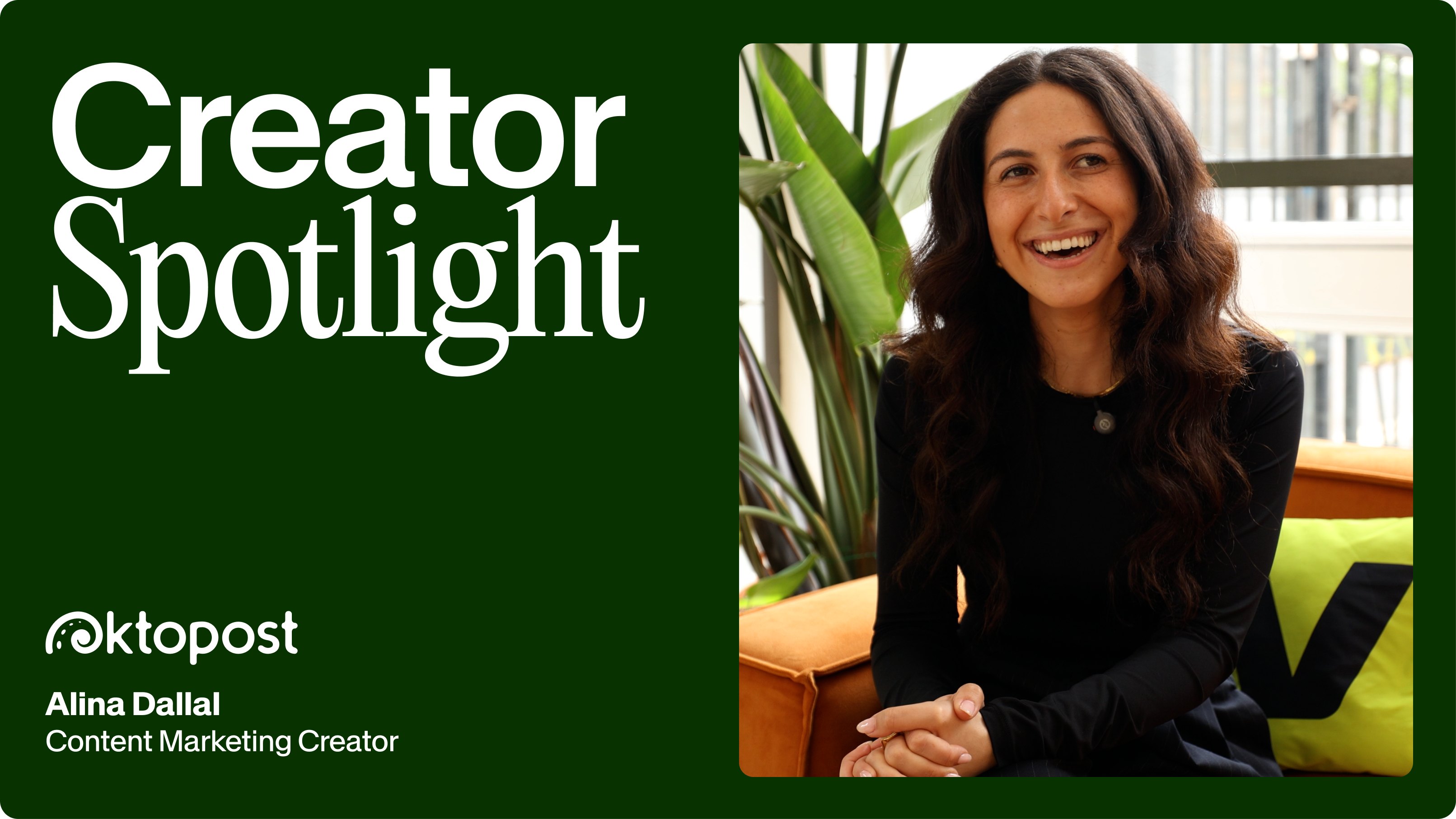
Customer contactAlina Dallal, former content marketing managerWorkflow typeHybrid: generative AI + automated captions + editorTimelinePublication date not displayedEvidenceVendor-published customer story; direct source [S01] Source ↗
Background
Oktopost provides B2B social-media management software and operates its own content, employee-advocacy, influencer, webinar and podcast programs. Video was becoming an expected part of nearly every activity. That presented an operational challenge: a social team could identify more opportunities to publish than its recording-and-editing setup could comfortably handle. VEED's published account describes the challenge through the marketer's actual process rather than a generic promise to “make more video.”
Problem before VEED
Editing, subtitling, occasional generation and sharing lived in different tools. Staff emailed files back and forth, then repeated edits after receiving feedback. Color palettes, logos and subtitle styling had to be checked repeatedly, and content depended on whoever was available to film or edit. The published story does not disclose a previous total tool spend, average turnaround time, monthly video count or a side-by-side production log.
Why VEED
VEED offered a single place for editing, automatic subtitles, shared assets and collaboration. That mattered because Oktopost wanted more team members, including employee advocates, to make on-brand videos. Importantly, the customer story explicitly says the team also used prompt-based generative video for moments when filming was not practical. It is therefore a genuine hybrid workflow involving both AI generation and routine editing.
Implementation and human + AI workflow
The clearest documented workflow is the Behind the Post podcast: take source media, add background music and a call-to-action slide, apply automatic subtitles, add a guest logo and prepare the result for publication. For live webinars the team extracted shorter clips and prepared subtitle-led assets or audiograms, including a guest portrait and animated waveform for Instagram. A separate generative process turned text prompts into additional videos. VEED describes a central brand kit and shared workspace that were available across the team. Human scripting, approvals and distribution remain the team's responsibility; the account does not establish that AI generated every clip.
Content produced
Branded podcast excerpts, webinar highlights, audiograms, social assets and selected text-prompt-generated videos. The real-face and generated-video mix is one of the most useful details: it demonstrates that a brand need not treat synthetic content as a complete replacement for interviews or subject-matter experts.
Results and business impact
Alina Dallal, identified as Oktopost's former content marketing manager, described making substantially more content and meeting social-media demand without always appearing on camera. VEED documents improved process coherence and brand consistency, but it publishes no numeric video increase, cost reduction, paid campaign lift, or attributable conversion figures. The safe conclusion is a customer-reported increase in content-production capacity—not a measured marketing ROI.
Evidence limitations and causality
No publicly stated implementation date, sample size, baseline production count, software expense or platform analytics. We cannot confirm whether the VEED workflow alone caused an increase in post reach. Generated-video model and prompt specifications were also not disclosed.
Practical lessons
Treat captions, collaboration and approvals as one workflow, not disconnected finishing tasks.
Keep branding reusable before expanding creation access to employee advocates.
Use AI-generated clips selectively alongside recorded people.
Measure video output and review cycles locally; the public story does not supply numeric baselines.
Primary evidence:[S01] Source ↗ · Publisher: VEED · Publication date not displayed · Evidence Level A (named user/customer; vendor-reported results). No independent audit located.
02
Customer story · News/media publishing
GEDI: Third-party editing bottlenecks slowed news publishing and cross-team collaboration
Customer contactGEDI team; individual not specifiedWorkflow typeHybrid: automated captions/translation + platform editingTimelinePublication date not displayedEvidenceVendor-published customer story; direct source [S02] Source ↗
Background
GEDI is an Italian publishing group whose newspaper, radio and digital brands need to publish quickly as events develop. VEED describes the company as reaching more than 35 million people across its properties. That audience-size figure is company background—not the number of people who viewed a VEED-made video. Its newsroom case addresses a real structural challenge: producing video fast enough for modern mobile and social consumption.
Problem before VEED
Teams were dependent on outside specialists for video preparation. Even routine requests accumulated long email chains, while subtitling, translation and dubbing contributed manual work. Because breaking news quickly becomes old news, each handoff could erode the value of a timely clip. There is no disclosed quantitative record of pre-VEED hours per video, number of freelancers, or daily output by brand.
Why VEED
GEDI's story emphasizes reducing third-party bottlenecks, giving multiple teams access to one production environment, and preserving a reusable archive. VEED's available combination of editor, subtitle/translation functions and shared workspace addressed those needs. Subtitles and language processing are AI-supported capabilities; editing, archives and publishing organization are broader platform features. The story does not show that GEDI used generative prompt-to-video, virtual presenters, or voice cloning.
Implementation and human + AI workflow
The documented change was organizational: the newsroom moved video preparation in-house and gave teams direct access to edit and caption material in one shared workspace. Content and media assets could be stored for reuse rather than fetched repeatedly by email. Editors could prepare, translate and publish content with fewer cross-team handoffs. VEED does not publish a per-clip tutorial showing each screen, the degree of manual translation checking, or a formal newsroom approval pipeline, so this is a verified workflow outline rather than a speculative SOP.
Content produced
Newsroom video clips and social-publishing content across GEDI properties. The case reports improvements across some brands but does not identify which individual brands generated the reported share change or supply before-and-after counts.
Results and business impact
VEED's GEDI case study reports that social shares increased by 100–200% across some brands, alongside increased content production and reduced turnaround time. The publication does not provide the brands, measurement period, underlying denominator, external analytics report, control group or independent confirmation. The relative increase is therefore a vendor-published customer outcome associated with a broader shift to in-house, centralized production. It would be misleading to describe the entire improvement as solely an “AI subtitle result.”
Evidence limitations and causality
Causality is partial or unknown: editorial choices, content volume and changing social platforms can affect shares. Video counts, hours saved, cost of previous outsourcing and absolute engagement totals are not public.
Practical lessons
Design a self-service newsroom process around speed and approval responsibility.
Separate AI language tools from the wider effect of replacing an outsourced workflow.
Build a shared archive when the same source footage may be repurposed.
Report social increases with baseline counts and timeframes; neither is disclosed in this case.
Primary evidence:[S02] Source ↗ · Publisher: VEED · Publication date not displayed · Evidence Level A (named user/customer; vendor-reported results). No independent audit located.
03
Customer story · Appliances / retail product training
Whirlpool Canada: One video editor could not scale bilingual training for retail sales associates
Customer contactYvonne Gettins, training content designerWorkflow typeHybrid: AI subtitles/translation + conventional editingTimelinePublication date not displayedEvidenceVendor-published customer story; direct source [S03] Source ↗
Background
Whirlpool Canada's training content team creates appliance product education for sales associates at retail partners. The employees being trained are not exclusively Whirlpool staff: Yvonne Gettins says the audience includes sales teams at retailers carrying Whirlpool products. Video helps demonstrate appliances that may not be on display at every shop. With many product types and a dispersed retail audience, learning material must be produced frequently and available in both English and French.
Problem before VEED
Video creation relied heavily on one specialist using Adobe Premiere Pro. Field trainers who understood the products were not necessarily confident using a sophisticated editor. Canadian bilingual needs created a separate bottleneck: translating and subtitling English-language content into French took time and involved paid outside services. These are two distinct problems—authoring capacity and language localization—which VEED addressed through different product functions.
Why VEED
Gettins said simplicity persuaded the trainers, while automatic subtitle translation was the main selling point for the training designer. Instead of requiring a specialist to assemble every piece, more trainers could make shorter videos themselves. VEED also offered simple stickers, arrows and on-screen presenter recording to make product demonstrations easier to follow. Translation is AI-assisted; those editing features are conventional.
Implementation and human + AI workflow
Product trainers contribute knowledge and film or assemble product-training material. The team uses VEED's accessible editor for visuals and recording, adds screen or camera appearances when useful, and brings in graphics to emphasize appliance details. Existing English videos can be uploaded and given French subtitles through automated translation, then reviewed and deployed in smart learning courses for retail associates. The story does not state exactly which learning platform delivers the finished course, and it does not confirm that every generated subtitle was manually reviewed.
Content produced
Bilingual appliance training videos, demonstrations and related learning material for retail associates. VEED's account says trainers can make their own clips; it does not list a total video library size or an exact number of learners who completed a course.
Results and business impact
The interview gives a relative productivity baseline: Gettins previously made one or two videos per week mostly by herself; after adoption, several trainers could each contribute around two per week. She calls the resulting output roughly eight times the previous level. VEED also reports that the team avoided hundreds of dollars each month in translation-service expenses. The number of active trainers, precise weekly counts, software-subscription offset and accounting records were not provided. This is a self-reported operational improvement, not an audited company-wide ROI figure.
Evidence limitations and causality
The 8× figure is a customer-reported comparison without a complete denominator, and the French-language legal context should not be interpreted as a blanket legal conclusion about all Whirlpool materials. Subtitle accuracy and student comprehension were not independently tested.
Practical lessons
Combine domain-expert trainers with low-friction editing instead of centralizing all production in one specialist.
Distinguish time saved in production from money saved on translation vendors.
Use a human review step for technical terms and bilingual training content.
Measure total modules delivered and completion—not only videos created—to assess learning impact.
Primary evidence:[S03] Source ↗ · Publisher: VEED · Publication date not displayed · Evidence Level A (named user/customer; vendor-reported results). No independent audit located.
04
Customer story · Beauty / international e-commerce
CurrentBody: Product videos needed 12 languages; translations and approvals took weeks
Customer contactAndy Hargraves, videographerWorkflow typeHybrid: AI subtitles/translation + team collaborationTimelinePublication date not displayedEvidenceVendor-published customer story; direct source [S04] Source ↗
Background
CurrentBody sells beauty technology and needs clear product-explainer and use-case video for international audiences. Videographer Andy Hargraves describes a localization operation spanning 12 languages. The story also refers to a global community across roughly 90 countries, but that geographic background is not proof that each localized video performed in all those markets. The key operational pressure was producing many versions of the same core asset without sacrificing quality or approval speed.
Problem before VEED
The organization worked with Adobe Premiere Pro and internal translation stakeholders. Localization took weeks because every language required separate adaptation, approval and coordination across offices. Hargraves estimated the earlier subtitle-translation accuracy at around 70%. This is a customer comparison, not a published language-by-language evaluation using a disclosed test set.
Why VEED
VEED brought automated translation and subtitles into a collaborative workflow. Editing teams could generate language variants and collect feedback rather than moving each version through a long series of manual tasks. CurrentBody is a particularly relevant AI-specific case because AI-powered language processing is explicitly described, unlike cases that only feature cutting and cropping videos.
Implementation and human + AI workflow
The source material begins as product explainers or use-case footage. Teams upload it to VEED, prepare subtitles and translation for target markets, review versions with regional stakeholders and finalize the localized output. VEED credits automatic language generation and a centralized review setup. The case does not name all twelve target languages, specify voice dubbing or voice cloning, or show that translations went out without human validation. It mentions regional feedback particularly from French, Spanish and German teams.
Content produced
Multiple language versions of video marketing and product education material, maintained through a shared production process. The published customer interview offers no representative file samples or a public inventory of localized video count.
Results and business impact
VEED summarizes the before-and-after turnaround as weeks becoming hours or a few days. Hargraves describes translations as around 95–98% accurate with VEED, versus about 70% with the previous method. The article elsewhere calls that “25–28% higher accuracy”; mathematically the comparison is a change of approximately 25–28 percentage points, not an independently confirmed relative-percent uplift. As no reference translations, sample sizes, evaluation method or language-specific breakdown are available, report the customer's estimates only and avoid characterizing 98% as independently verified accuracy.
Evidence limitations and causality
We cannot compute reliable hours saved, cost saved, or sales lift without data on number of videos, review time, wages and marketing impact. The workflow is hybrid: collaboration and approvals matter alongside AI-generated translations.
Practical lessons
Map localization by language and stakeholder, not simply by number of videos.
Treat machine subtitle output as a first pass that still benefits from regional review.
Avoid presenting customer-estimated translation accuracy as an audited technical benchmark.
Track per-language turnaround, revision count and post-release corrections.
Primary evidence:[S04] Source ↗ · Publisher: VEED · Publication date not displayed · Evidence Level A (named user/customer; vendor-reported results). No independent audit located.
05
Customer story · Culinary media / creator marketing
Gronda: Loud kitchens, inconsistent on-camera delivery, slow UGC ad editing
Customer contactSebastian Schürgers, head of growth marketingWorkflow typeAI-specific correction/noise tools + subtitles + editingTimelinePublication date not displayedEvidenceVendor-published customer story; direct source [S05] Source ↗
Background
Gronda is an online food and chef community. Its growth team works with user-generated chef testimonials for ads and professionally produced culinary masterclasses. Kitchen recordings often contain equipment noise, and a persuasive on-camera chef does not always look straight at the lens. Sebastian Schürgers, head of growth marketing, described these everyday production frictions in a VEED customer interview.
Problem before VEED
The team could wait for a videographer to remove unwanted sounds, struggle to create consistent subtitles, or send feedback to chefs about their performance. Those tasks consumed time before an advertising experiment even started. VEED's article does not report a complete before-and-after budget, number of chefs briefed, or ad-test dates.
Why VEED
VEED offered a quick combined editing workflow with automatic subtitles, audio noise removal and eye-contact correction. In this use case the AI features are specific rather than inferred: correcting gaze and cleaning kitchen audio are central to the account. The same platform enabled colleagues beyond the in-house videographer to make routine edits.
Implementation and human + AI workflow
Chef-made user-generated clips enter the team's ad-editing process. Background noise is reduced with VEED, subtitles are added using the automated tool, and Eye Contact Correction helps transform on-camera delivery. Staff then finish edits and use the content in social video ad tests. VEED does not disclose which individual ads received which corrections, the creative-testing platform, the “winning ad” threshold or whether the tests were randomized.
Content produced
UGC-style social video advertisements and promotional assets featuring chefs. The company also produces masterclasses, but the case does not establish that VEED edited every masterclass or that the reported ad-testing improvement applies to masterclass viewers.
Results and business impact
VEED's story says Gronda produced twice as many “winning” social video ads in test campaigns, improved subtitling efficiency threefold and reduced chef briefing time by 60%. The source attributes much of this to faster processing and eye-contact correction. However, it does not define the success metric for a winning ad, supply baseline counts, detail test period or show independently audited ad results. These are vendor-published, customer-attributed performance claims—not a verified twofold ROAS increase, sales improvement, or causal lift study.
Evidence limitations and causality
The result may reflect changing source clips, ad creative and team routines in addition to the VEED tools. Exact total spend, revenue, conversions, subtitle-error rate and project staffing are not available.
Practical lessons
Use cleanup tools to make contributed UGC more consistent without re-filming every scene.
Track subtitle time separately from campaign performance.
Define a “winning ad” consistently before comparing tests.
Do not confuse more winning creatives with proven higher sales or profit.
Primary evidence:[S05] Source ↗ · Publisher: VEED · Publication date not displayed · Evidence Level A (named user/customer; vendor-reported results). No independent audit located.
Part 4 · Additional documented applications
Seven more customer and creator implementations
Anglia Ruskin University
Level A · vendor-published
Associate professor Siân Shaw used VEED's AI avatars and voices for simulated nursing scenarios in the “Ruskin Row” placement experience. Hiring actors or learning complicated avatar systems was an obstacle. VEED reports that the September 2023 cohort involved 850 students and ten days of learning material delivered across four weeks. These are participation and content-scope measures, not proof of increased exam scores or learning retention. The story explicitly describes AI avatars, stock assets and voiceovers; it does not prove all 850 students viewed every video.
Demand generation manager Michael Glover records customer interviews and discussions with Riverside.fm and uses VEED to turn longer material into ads or social clips. The documented workflow includes trimming and splitting, templates, resizing, one-click subtitles and brand assets. He reported taking a raw ad to completion in under one hour when other software had required hours. That is his working estimate, not a controlled timed test; no lead, conversion or revenue impact was published.
Travis Tyler described switching from an Adobe-heavy production process during 2023 budget pressure. He produces webinars, video podcasts, social posts and explainers. Features he listed include Clean Audio, Magic Cut, auto-subtitles, background removal, recording and Brand Kits. VEED's marketing pages separately quote him saying his first four videos received more than 40,000 LinkedIn impressions, but those impressions measure social reach—not VEED's unique contribution—and the longer case study lacks audited time or license savings.
Personal-brand coach Imran Lakhani used the VEED recorder, teleprompter, audio-noise cleanup and video editor to create his first course, a 14-module program plus introduction in three months. He sought an integrated tool after finding other options inaccessible or fragmented. VEED handled recording and finishing tasks; the human creator still planned and taught the material. The course count is documented, but enrollments, completion rates, production-hour savings and sales were not published.
Consultant Gwenne Wilcox combined recording, captions, audio cleanup, reusable templates and editing in VEED after previously juggling three or four apps. She told VEED that she avoided nearly US$350 in annual subscription costs; an early VEED-created video received more than 5,000 views. These are self-reported figures. A strong-performing video can reflect topic, audience, channel distribution and other choices, so its view count should not be presented as a causal AI result.
Paul Padmore produces the weekly My Perfect Failure podcast. He described replacing separate editing, audio-cleanup and conversion tools with VEED. The published account names AI Clips for shortening long episodes and Clean Audio in the workflow. Padmore reported doubling weekly output and avoiding roughly £60 monthly (£720 yearly) in tool expenses. No invoices or documented baseline episode counts were independently published.
Documented features: AI Clips; Clean Audio; AI Agent; teleprompter; editing · [S11] Source ↗
Morgan Lewis / Morgan Creates
Level A · vendor-published
Morgan Lewis needed subtitles to deliver a four-episode season of Morgan Creates: Beyond the Plate. Outside providers were slow, with a quoted US$200 per episode. She used VEED's automatic subtitles and said what could be a two-week task took about an hour; she estimated around US$770 avoided against the outsourcing quote after considering her plan. She also reported a ten-second social ad receiving 3,586 plays, 156 likes, 23 shares, 20 saves and 17 comments within six days. These are a customer's figures, not independently audited revenue results.
Documented features: Automatic subtitles; video editing; social teasers; stock audio · [S12] Source ↗
Part 5 · Performance & ROI review
Results comparison: what is measured and what is not
ROI cannot be reliably calculated: The public stories omit some combination of implementation costs, subscription expense, labor rates, timeframes, original sample sizes and attributable revenue. Morgan’s US$770 and Paul’s £720 are reported spending avoided against prior/alternative tool costs; they are not audited enterprise-wide profit.
Part 6 · Industry insights
Which documented VEED workflows translate across industries?
Sector
Documented example
Real feature/application
Evidence-limited takeaway
Corporate learning
Whirlpool Canada
Automatic subtitles and French translation alongside accessible editing
Higher production capacity, vendor-reported; learning outcomes unknown
Higher education
Anglia Ruskin University
AI avatars and voices for simulated nursing scenes
850-person cohort and ten days of material; assessment gains not shown
News/media publishing
GEDI
Shared editing, AI subtitling and translation, reuse archive
Reported 100–200% social-share rise in some brands; not exclusively AI
B2B social / SaaS
Oktopost, PandaDoc, ConvertFlow
Auto subtitles, brand kit, repurposing and some text-to-video
Operational flexibility; heterogeneous and mostly non-audited results
E-commerce localization
CurrentBody
12-language subtitling, translation and collaborative review
Customer-estimated improved accuracy and turnaround
Creator ads / UGC
Gronda
Eye contact correction, noise reduction, captions
More winning test creatives, subtitle efficiency; sample not published
Education / creator coaching
Imran Lakhani
Recorder, teleprompter, cleanup, course editing
Published 14-module course
Podcast/media creators
Paul Padmore, Morgan Lewis, Gwenne Wilcox
AI clips/captions and routine production tools
Self-reported saved app fees, output and post engagement
Repeatable business lessons
Centralize source clips, captions, brand assets and reviews before scaling output.
Let subject experts record, then use AI to accelerate specific finishing steps.
Measure cost per finished video, not only number of clips generated.
Have humans review subtitles, brand claims and localized product terminology.
Where evidence remains weak
Current VEED avatar or text-to-video tools are not proof that older customers used them.
Few customer stories disclose sample sizes, control groups or cost ledgers.
Social engagement often reflects creative quality and distribution alongside editing.
Independent customer-hosted implementation documents are limited compared with VEED interviews.
What real VEED customer stories reveal
VEED’s most persuasive customer evidence has little to do with an abstract promise that a model can generate a beautiful video. The repeated issue is everyday production friction: a company has raw footage but cannot edit it quickly, a marketer needs captions on every social clip, or a product team must issue multiple localized variants without delaying a campaign for weeks. The clearest successes come from removing those frictions one task at a time.
AI features matter where the source clearly names them. CurrentBody and Whirlpool use automatic translations and captions. Gronda uses eye-contact and audio-correction tools for chef-generated footage. Anglia Ruskin University uses avatar presenters in nursing simulations. Oktopost adds prompt-based video generation to a production process that also contains ordinary editing. Other outcomes arise from browser editing, shared assets and a simpler timeline, and should not be counted as proof that generative video itself improved ROI.
The distinction between output and impact is just as important. Whirlpool reports more training videos, not eight times better training outcomes. GEDI reports more social shares among some brands, not a documented company-wide uplift. Gronda reports more ads deemed winners in internal tests, not doubled revenue. By treating these outcomes precisely, small businesses and agencies can identify workflows worth trialing while setting honest expectations for what a case study proves.
For implementation, start by recording the current workflow: people involved, applications used, minutes spent on captions and review, and publication frequency. Test one automated stage, evaluate the edited result with a human, and track the complete cost of production including credits and team time. That approach will reveal whether a VEED-style workflow solves your own bottleneck, rather than assuming another company’s marketing testimonial will predict the same result.
Frequently asked questions about VEED AI case studies
What is VEED AI?
VEED is a video creation and editing service combining conventional production tools with AI-assisted captions, translation, editing, voice and video generation. A customer using VEED does not necessarily use every AI feature.
How do businesses use VEED AI?
Named cases show marketers producing branded clips, publishers making timely news video, trainers creating product lessons and international teams localizing videos. The exact mix of AI and manual editing varies by customer.
Are real companies using VEED?
Yes. Named VEED customer stories include Oktopost, GEDI, Whirlpool Canada, CurrentBody, Gronda, PandaDoc and ConvertFlow. The stories are published by VEED; independent audits of their performance are limited.
Which AI features do marketing teams use?
The strongest documented marketing examples include automatic subtitles, noise reduction, eye-contact correction and, in Oktopost’s case, prompt-based generative video.
Can VEED reduce production time?
Some customers report it did. ConvertFlow described editing some ads in under an hour, and CurrentBody reported localization falling from weeks to hours or days. Neither is a controlled benchmark.
Is VEED useful for social media teams?
Oktopost uses it for webinar and podcast repurposing, while Gronda reports using subtitle, audio-cleanup and eye-contact functions in UGC advertisement preparation.
How is VEED used in training and education?
Whirlpool Canada reports training video production and translation; Anglia Ruskin University describes AI-avatar nursing simulations; Imran Lakhani built a recorded coaching course.
Can VEED help create multilingual videos?
CurrentBody reports a twelve-language production workflow; Whirlpool describes automated English-to-French subtitle translation. Publication-ready localization still warrants human review.
What customer outcomes are documented?
Vendor-published accounts report metrics such as eightfold training output, more social shares at some media brands, twofold winning test ads and improved translation turnaround. These are not independently audited business ROI.
What limitations should teams expect?
AI captions and translations need checking, output quality varies by task, and the public case studies rarely disclose controlled measurements. Third-party Gartner user feedback in 2026 also expressed concerns about AI-generated video quality for one B2B use case.
Part 9 · Sources and verification notes
Source trail and research method
The core evidence comprises twelve VEED-published case pages naming individual customers or organizations. Each was checked for explicit software usage, features, output and attributable metrics. Vendor-published does not mean independently audited. Background references cover the current VEED product, its resource hub, a third-party review source and an excluded reverse-direction Stripe case study.
Excluded examples: VEED’s own Stripe billing growth and its Goldcast webinar performance are examples of VEED being someone else’s customer, not users achieving results through VEED. Generic logo walls, product demo templates and “8× more video” landing-page headlines were excluded unless attached to named user evidence.
Research gaps
Several VEED articles omit original publication dates, implementation dates and verifiable metric periods.
Customer-reported improvements lack audited raw counts, independent cost documentation or control groups.
No reliable numeric split isolates the benefits of generative AI versus captions, collaboration and standard editing for most customers.
Some case studies have no customer-hosted corroboration or actual output file linked for third-party inspection.
Broadly advertised 2026 video models, lip sync, APIs or custom avatars were not retroactively attributed to older customer cases.
Evidence definitions
Level A: real named user/customer with specific VEED workflow and primary published story; in this report all twelve are VEED-published.
Level B: named verified user testimony but less complete workflow; not used as a primary directory entry.
Level C: demonstrative integration or app example; not presented as customer success.
Level D: hypothetical feature or generic marketing example; excluded from customer count.
Direct references
S01 · How a Social Media Management Platform Scales Video Creation Without Picking up a Camera · VEED newsroom · Vendor-published customer story · Publication date: not displayed or not independently verified in source view (except specific dates mentioned in text); checked 9 October 2026. Visit source ↗
S02 · How GEDI Creates Videos as Fast as the News Cycle · VEED newsroom · Vendor-published customer story · Publication date: not displayed or not independently verified in source view (except specific dates mentioned in text); checked 9 October 2026. Visit source ↗
S03 · How Whirlpool Creates 8x More Training Content Using VEED · VEED / Muhammad Talha · Customer interview · Publication date: not displayed or not independently verified in source view (except specific dates mentioned in text); checked 9 October 2026. Visit source ↗
S04 · How CurrentBody Makes Content in 12 Languages Effortlessly with VEED · VEED / Muhammad Talha · Customer interview · Publication date: not displayed or not independently verified in source view (except specific dates mentioned in text); checked 9 October 2026. Visit source ↗
S05 · How Gronda 2x’ed its Amount of Winning Social Video Ads with VEED · VEED / Muhammad Talha · Customer interview · Publication date: not displayed or not independently verified in source view (except specific dates mentioned in text); checked 9 October 2026. Visit source ↗
S06 · ARU’s Journey to Streamline Nursing Education with VEED’s AI Avatars · VEED / Muhammad Talha · Customer interview · Publication date: not displayed or not independently verified in source view (except specific dates mentioned in text); checked 9 October 2026. Visit source ↗
S07 · How ConvertFlow Saves Hours in Video Editing Time with VEED · VEED / Muhammad Talha · Customer interview · Publication date: not displayed or not independently verified in source view (except specific dates mentioned in text); checked 9 October 2026. Visit source ↗
S08 · Why PandaDoc Replaced Adobe with VEED for Video Editing · VEED team · Customer interview · Publication date: not displayed or not independently verified in source view (except specific dates mentioned in text); checked 9 October 2026. Visit source ↗
S09 · How a Personal Brand Coach Built a 14-Module Course Using VEED · VEED / Muhammad Talha · Creator interview · Publication date: not displayed or not independently verified in source view (except specific dates mentioned in text); checked 9 October 2026. Visit source ↗
S10 · How This Luxury Brand Expert Found Her Content Flow with VEED · VEED / Muhammad Talha · Creator interview · Publication date: not displayed or not independently verified in source view (except specific dates mentioned in text); checked 9 October 2026. Visit source ↗
S11 · Why This Solo Creator Considers VEED His Creative Partner · VEED / Muhammad Talha · Creator interview · Publication date: not displayed or not independently verified in source view (except specific dates mentioned in text); checked 9 October 2026. Visit source ↗
S12 · How Morgan Lewis Uses VEED to Edit Her Amazon Prime Cooking Show · VEED / Muhammad Talha · Creator interview · Publication date: not displayed or not independently verified in source view (except specific dates mentioned in text); checked 9 October 2026. Visit source ↗
S13 · VEED Official Website · VEED · Current product capability · Publication date: not displayed or not independently verified in source view (except specific dates mentioned in text); checked 9 October 2026. Visit source ↗
S14 · About VEED · VEED · Company background · Publication date: not displayed or not independently verified in source view (except specific dates mentioned in text); checked 9 October 2026. Visit source ↗
S15 · Newsroom · VEED · Current news / product updates · Publication date: not displayed or not independently verified in source view (except specific dates mentioned in text); checked 9 October 2026. Visit source ↗
S16 · Learning Resources · VEED · Educational material, not case evidence · Publication date: not displayed or not independently verified in source view (except specific dates mentioned in text); checked 9 October 2026. Visit source ↗
S17 · VEED reviews, including January 2026 critical B2B review · Gartner Peer Insights · Anecdotal third-party user views · Publication date: not displayed or not independently verified in source view (except specific dates mentioned in text); checked 9 October 2026. Visit source ↗
S18 · VEED customer story (VEED is the customer of Stripe) · Stripe · Background only; explicitly not a VEED user case study · Publication date: not displayed or not independently verified in source view (except specific dates mentioned in text); checked 9 October 2026. Visit source ↗
Research completed 9 October 2026. Statistics reflect the historical claims of their cited case pages, not a current measurement made in October 2026. No publication date was invented where a source did not expose one.
Explore real-world AI implementation stories
Compare documented tools, customer workflows and evidence strength before choosing how to use AI in your organization.