AutoGPT Company Profile
Founder, history, Otto, AI Experts, technology, ownership and the business behind one of AI’s most influential open-source agent projects.
Created by Toran Bruce Richards in 2023 and commercially operated by Determinist Ltd, AutoGPT has evolved from experimental Python agents into a connected AI workflow and specialist-agent platform.
Company at a glance
Verified identity, not a startup-directory estimate.
- Brand / public name
- AutoGPT / AGPT
- Legal operator
- Determinist Ltd, trading as AutoGPT
- Company number
- 14875560
- Company incorporated
- 17 May 2023
- Founder & CEO
- Toran Bruce Richards
- Registered jurisdiction
- England and Wales
- Registered office
- Altrincham, Cheshire, UK (not evidence of operating HQ)
- Original public project
- Auto-GPT; March 2023 (30 March widely cited demo/release)
- Official repository
- Significant-Gravitas/AutoGPT
- Product focus
- AI Experts, Otto, visual workflows, integrations
- Commercial model
- Hosted subscriptions plus pay-as-you-go workflow credit wallet
- Venture funding
- No publicly verified venture round identified in sources reviewed
Companies House records confirm the active legal entity and incorporation. AutoGPT’s own policy expressly identifies Determinist Ltd as the service operator. The founder appears as the sole currently listed director and active person with significant control; reported control is at least 75% of shares and voting rights.
What is AutoGPT?
AutoGPT is a UK-associated artificial intelligence software brand that grew from Toran Bruce Richards’ open-source Auto-GPT project into a platform for coordinating agents, services and repeatable business workflows. The original project attracted major attention in 2023 by showing how an external language model could pursue a goal through successive planning, tool use and evaluation. That experiment also made the weaknesses of unsupervised execution visible: fragile tool calls, imperfect reasoning and potentially costly model usage.
The current product is a different experience. AutoGPT markets a team of specialized AI Experts that users can brief in natural language. Otto acts as a coordinating assistant; named specialists perform research, content and operational work. Users can supply context, grant integrations, review results, schedule tasks and set spending limits. A visual builder and a workflow marketplace remain available for more controlled automation.
Commercially, AutoGPT operates through paid hosted tiers with separately charged workflow execution. Its developer ecosystem continues to distribute code publicly, but licensing varies by directory: the Classic code is MIT-licensed, while the visual platform directory uses PolyForm Shield. There is no basis for describing the entire modern service as a completely unrestricted open-source product.
AutoGPT’s importance lies in its role as an influential early public demonstration of language-model agents and its ongoing effort to turn those ideas into manageable tools. GitHub popularity and product catalog size are observable measures of interest and software breadth; they do not independently prove paying-customer numbers, profitability or business ROI. The company’s future will depend partly on dependable execution, comprehensible oversight, useful integrations and sustainable unit economics.
Founder and leadership

Toran Bruce Richards
Richards created Auto-GPT, contributed to its original direction and is identified by the company as founder and CEO. UK Companies House lists him as Determinist Ltd’s director and person with significant control. AutoGPT’s author biography connects him with the commercial platform that followed the original open-source experiment.
In a founder interview published by OpenUK, he described agent software as a way of chaining language-model predictions with conventional programming techniques, informed in part by concepts from games and simulation. This is an account of his interests and motivation—not evidence of a particular university degree or previous employer.
John Ababseh
In October 2026, Ababseh described himself as leading product alongside CEO Richards, across product, design and branding. “Leads product” is the verified wording; an unsupported C-suite title is not assigned.
Official account →Other executive roles
The public materials reviewed do not establish an up-to-date full executive team, CFO or CTO. Those positions should not be inferred from repository contributors.
Understanding the company identities
AutoGPT / AGPT
The public brand and current commercial product experience.
Determinist Ltd
The registered private limited company operating the platform under the AutoGPT trading name.
Significant-Gravitas
The GitHub organisation publishing the AutoGPT repository and community software. It must not be assumed to be a separate registered company or the same legal entity as Determinist Ltd.
Auto-GPT / Classic
The original 2023 Python-based agent experiment and later Classic code.
AutoGPT Platform
Visual agent workflows, reusable blocks, integration tools and run management; distinct from Classic.
Otto + AI Experts
The newer conversational assistant and specialist agent positioning, introduced publicly in 2026.
The company’s platform terms and privacy policy explicitly name Determinist Ltd trading as AutoGPT, while the GitHub repository identifies its publisher as Significant-Gravitas. These are related identities but different types of entity.
The 2023 founding story
The original Auto-GPT project emerged shortly after GPT-4 attracted wide developer attention in March 2023. The Python application used an LLM to propose and evaluate next actions toward a user-defined objective. Common capabilities included internet interaction, file operations, memory configuration and tool-based execution. The central idea was to replace a manually authored series of chatbot prompts with a software loop that could take sequential steps.
March 30, 2023 is the widely cited public release/demo date used in IBM’s account. Some historical writing describes earlier March prototypes or code activity; accordingly, the publication treats 30 March as a widely reported public milestone rather than falsely asserting there was no earlier development.
The repository’s rapid growth turned the project into a public reference point for autonomous agents. Developers experimented with plugins and various goals, while observers also documented the gap between compelling demonstrations and robust production reliability. The concept was influential; the original system was not evidence of artificial general intelligence or dependable no-supervision business execution.
Company history: 2023–2026
- March 2023Original open-source Auto-GPT publicly emerges; 30 March widely used as launch/demo date.
- 17 May 2023Determinist Ltd incorporated in England and Wales.
- 24 September 2024AutoGPT announces its visual Platform; cloud-hosted beta waitlist referenced in launch announcement.
- 22 November 2024Founder publishes modular Agent Blocks vision.
- August 2025Company reports participation in GitHub Secure Open Source Fund and security improvements.
- 30 June 2026AutoGPT announces Discord and Telegram bot integration under @AutoGPT messaging.
- 19 September 2026AutoGPT says AI Experts went to production in platform v0.8.0, initially with 18 specialists.
- 3 October 2026Official article explains the Otto/Experts visual identity and reports 32 catalog experts.
- 29 October 2026Current website markets Otto and Experts; pricing and catalog figures recorded for this research.
Four generations of product evolution
01 · Classic
A configurable Python agent using external LLM APIs, tool loops and self-hosted execution.
02 · Visual Platform
Connected workflow blocks, API integrations, schedules, execution history and marketplace templates.
03 · Conversational creation
AutoPilot-era natural-language agent building and chat-driven automation; historical terminology varies by release.
04 · Otto & Experts
A coordinator and named specialists for work in marketing, research, sales and operations.
Product pages and blog posts reflect their publication dates. Features announced for the 2024 platform should not be assumed to have existed in 2023 Classic; similarly, an AutoPilot feature name in historical documentation may remain in technical lists even as the public interface now promotes Otto.
Current AutoGPT product ecosystem
Otto — Head of AI
Receives briefs, identifies specialists, coordinates work and returns outputs for review.
AI Experts
Role-oriented specialists that use instructions, context, tools and routines.
Visual Workflow Builder
Canvas for blocks, connections, validation, testing and controlled execution.
Agent Marketplace
Discover and adapt published workflows, including reusable community and vendor examples.
Scheduled Workflows
Cron schedules, triggers, task histories and spending visibility where configured.
AutoGPT Classic
Original Python agent project, still represented under the Classic code directory.
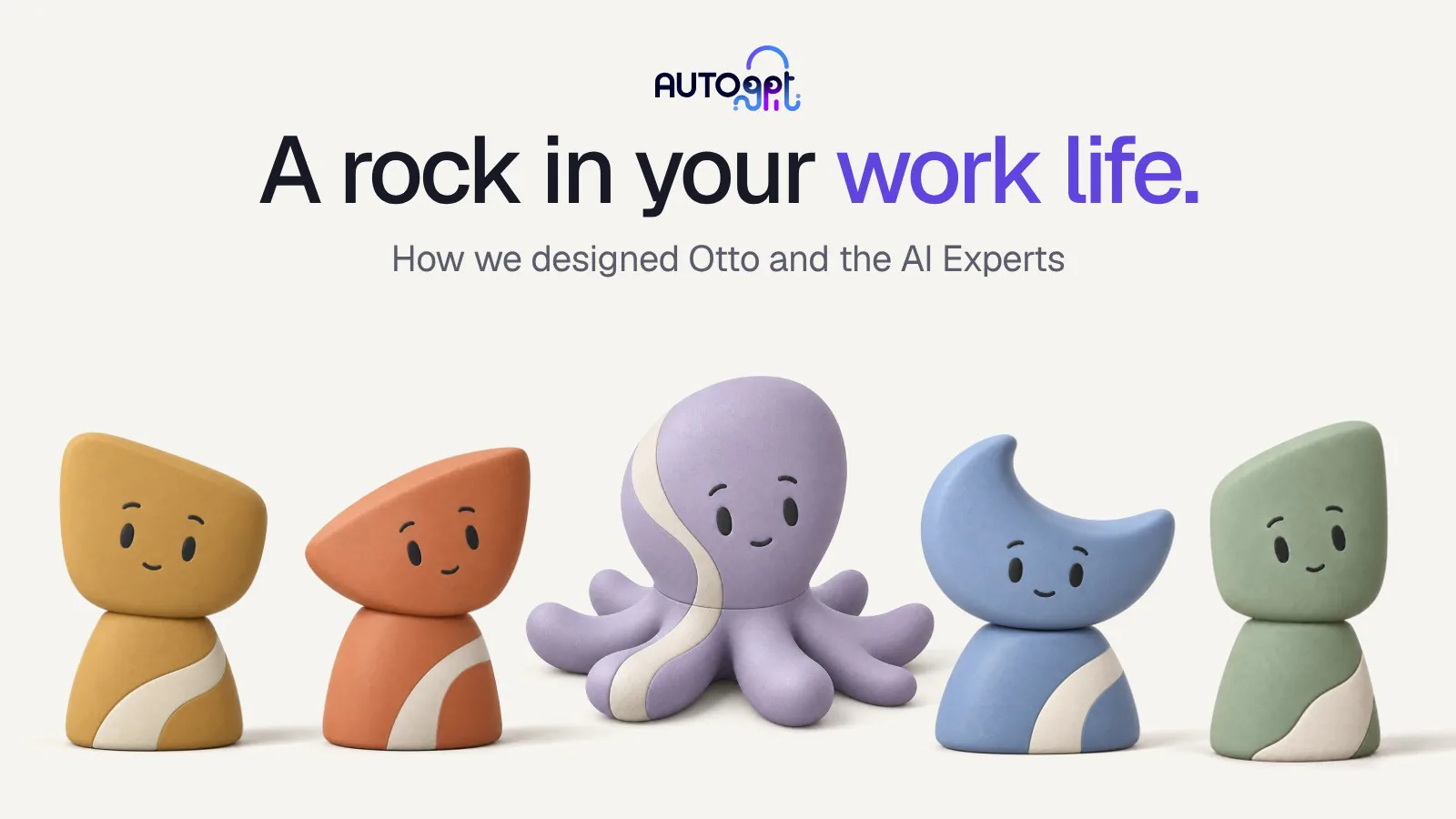
On the research date, the AutoGPT homepage promoted “33 AI Experts and counting,” while the official catalog displayed “32 Experts.” This difference may reflect counting conventions or page timing. The company did not publish a single reconciled definition on these two pages; both figures are reported with their source.
How AutoGPT agents work
A person describes an outcome and supplies files or context. Otto may select an appropriate specialist, and a workflow may call outside services through configured connections. The resulting research, draft or data is reviewed before subsequent sensitive actions. The arrows above are a conceptual user journey, not a claimed reverse-engineered architecture.
Planning and coordination
The LLM interprets instructions and may generate structured work or subtasks.
Tool invocation
Connected apps, APIs and blocks perform searches, file edits or business operations under account permissions.
State and memory
Task histories, user files, stored instructions and enabled memory mechanisms provide context; completeness is not guaranteed.
Human approvals
Reviews, permission boundaries and per-expert spending caps help manage risky or expensive operations.
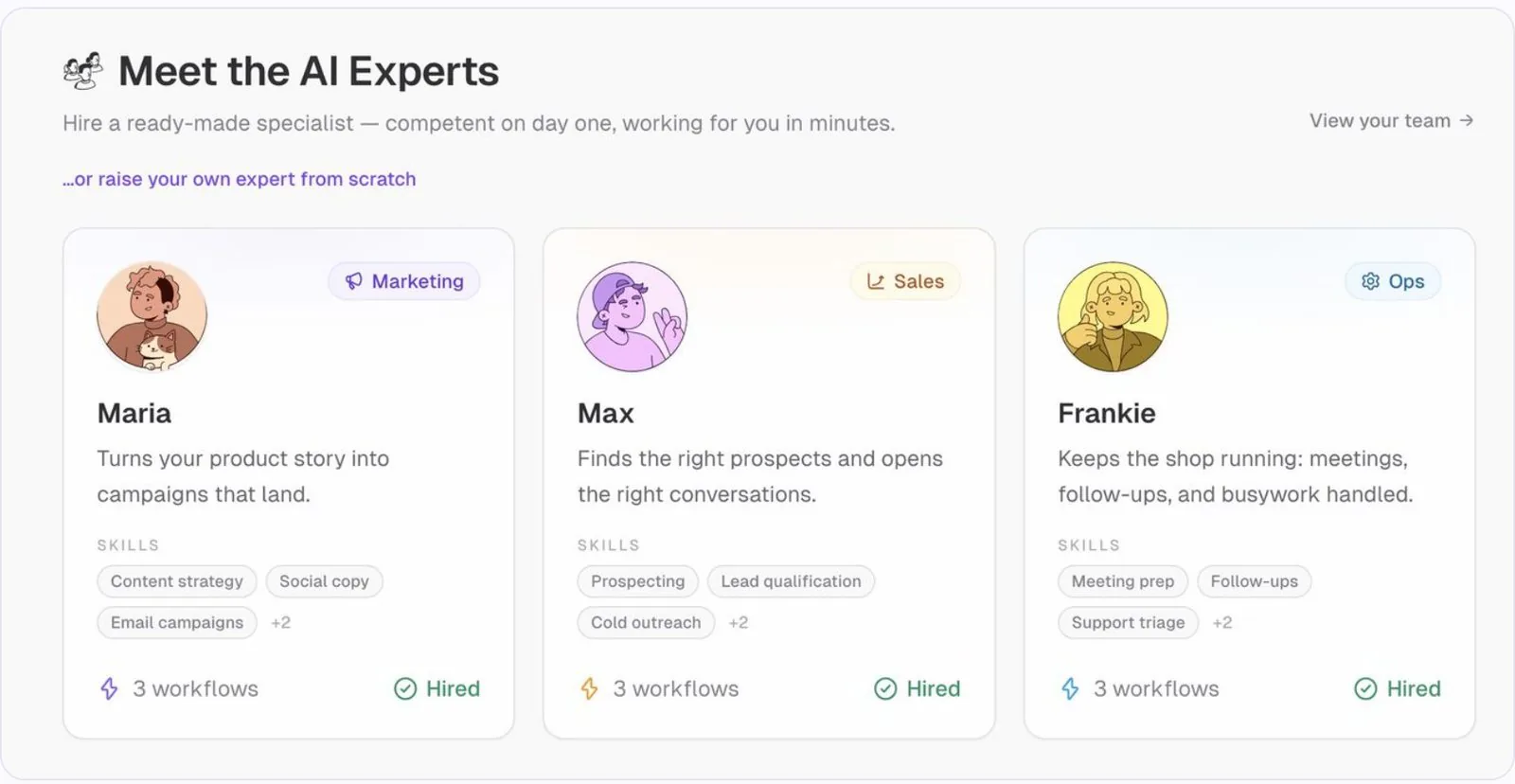
Meet the specialized AI Experts
Maria
Turns target keywords into briefs, drafts and improvements.
Max
Researches prospects and prepares outreach and deal conversations.
Frankie
Prepares meeting context, emails and daily digests.
Nadia
Compares competitors and distinguishes observed facts from interpretations.
Mina
Organizes expenses, invoices and statements for human review.
Robin
Drafts help-center-grounded support replies and follow-up priorities.
Devon
Reviews dependency risks and prepares upgrade recommendations.
Kai
Sorts inbox priorities and meeting preparation from connected context.
These are officially listed roles, not separate human employees or independently verified customer deployments. The Experts page shows other specialists as well; role capabilities depend on authorized accounts and available tools.
Technology, models and system architecture
The product depends on external model providers and connected services rather than a single undisclosed proprietary AutoGPT foundation model. Its official integration catalog lists OpenAI, Anthropic, OpenRouter, Groq, Ollama, NVIDIA and other providers or gateways, though available access methods and credentials can differ between cloud and self-hosted setups.
| Technical layer | Function | Evidence / important qualification |
|---|---|---|
| Large language models | Language understanding, synthesis and planning | Official model integration catalog; underlying models remain third-party. |
| Visual blocks | Repeatable logic and data transformations | Builder and platform features. |
| APIs, MCP, OAuth | Connect accounts, tools and data | Catalog describes built-in blocks and MCP servers. |
| Scheduling and triggers | Run work at configured times or on events | Cron and webhook framework on pricing feature table. |
| Runtime, monitoring, storage | Execution context, histories and outputs | Public pricing/docs and disclosed subprocessors; no claim of a universal internal architecture. |
On 29 October 2026 the integrations page listed 128 apps and services, 616 ready-made blocks and 68 official MCP servers. These are provider-published inventory figures, not counts of actual customers using each integration.
Open source, self-hosting and developer community
Open-source Classic
The Classic directory is MIT-licensed. Source can be reused under the MIT conditions, including license preservation.
Source-available Platform
The autogpt_platform/ directory is under PolyForm Shield, which restricts competing hosted services. It is not an OSI-approved open-source license.
Hosted product
AutoGPT operates the infrastructure and supplies integrated model access on paid plans.
Self-hosted deployment
The repository documents Docker-based deployment and alternative Docker Compose/source paths. Operators manage credentials, infrastructure, backups, updates and policies.
At the research check, the main GitHub page displayed approximately 187.8k repository stars and 45.9k forks, rounded by GitHub’s header to 188k and 45.9k. Stars, forks and commits represent development-community activity—not registered users or paying customers.
Self-hosting does not mean external model APIs are free. The documented Docker instructions require users to provide model credentials or configure suitable local options, and the deployment remains subject to its component licenses.
Business model and subscription pricing
The commercial model combines access to the hosted AutoGPT platform with consumption-based automation. A Pro or Max subscription covers product access and Otto/Expert chat allowance, while scheduled workflow runs are charged separately through a wallet. Self-hosted users bear their own infrastructure and model-provider charges.
| Plan | Monthly billing | Expert/chat allowance | Workflow execution | Important note |
|---|---|---|---|---|
| Pro | $50/month | Standard allowance; seven-day eligible trial | Pay-as-you-go from credit wallet | Card required for trial; cancellation rules apply |
| Max | $320/month | 8.5× Pro usage, 5× file storage | Pay-as-you-go from credit wallet | Priority support; additional product access |
| Team | Not publicly priced | Coming soon | Not yet published as generally available | Marketing page invites contact with sales |
| Self-host | No hosted subscription required to run self-managed code | Bring own models/credentials | Own infrastructure and API costs | License and operational obligations apply |
AutoGPT advertises 15% savings for annual billing; applying that published discount to the displayed monthly rates gives $42.50/month equivalent for Pro and $272/month equivalent for Max, billed annually. These are equivalents, not separate monthly-payment prices. Verify the checkout before purchase.
Revenue, profitability, ARR, paying-user counts and plan churn are not publicly disclosed in the primary material reviewed. None of those should be reverse-calculated from prices or GitHub popularity.
Verified integrations and business applications
Google Workspace
Google Sheets, Docs, Calendar and Gmail are listed as integration blocks. Authorization and individual action permissions vary.
Communication
Discord, Telegram, Slack and Gmail appear in current catalog; 2026 messaging release confirmed Discord/Telegram bot experience.
Sales and CRM
HubSpot, Apollo, Clay and related prospect research tools appear in the catalog; this is capability, not proof of partnership.
Publishing
WordPress, Medium and social publishing blocks help with approved content workflows.
Research and search
Exa, Tavily, Firecrawl, Google Maps and Jina AI are listed with specific block or MCP interfaces.
Development
GitHub and Linear workflows can support repositories, issues, planning and reporting.
An integration listing means the platform advertises a connection, not that a particular customer has configured it. OAuth, keys, provider plans and permitted scopes must be checked individually. Catalog entries are not evidence of a commercial agreement or independently measured outcomes.
Funding, ownership and company growth
Companies House records show Determinist Ltd as an active private limited company, with Richards the active person with significant control and sole listed director. The filing history also contains yearly accounts and company resolutions, but the materials reviewed do not support reporting a venture-capital amount, valuation or ARR.
Company ownership
Richards is reported as controlling at least 75% of shares and voting rights. A PSC threshold is not equivalent to proof of 100% ownership.
Venture funding
No publicly verified venture-capital round or named investment amount was established by the cited material.
Headquarters and team
The registered office is in Altrincham; a 2024 OpenUK study described a remote team associated with Edinburgh. The 2024 staffing count is historical, not verified current headcount.
OpenUK’s 2024 publication described eight full-time employees and seven part-time contractors at that time. This must not be displayed as October 2026 headcount. The OpenUK description of international funding opportunities is not a documented equity financing round.
AutoGPT versus alternative platforms
| Alternative | Core emphasis | Overlap and difference | Original source |
|---|---|---|---|
| n8n | Visual app and AI workflow automation | Both build connected workflows; n8n puts strong emphasis on explicit integration nodes and managed/self-hosted automation | Official documentation ↗ |
| Make | Visual scenarios, app integration and AI automation | Both support low-code orchestration; Make foregrounds integration workflows and visual scenarios | Official documentation ↗ |
| CrewAI | Developer framework for roles, crews and flows | Multi-agent work; CrewAI is chiefly a developer-oriented framework rather than a ready-made Otto roster | Official documentation ↗ |
| LangGraph | Low-level graph-based agent orchestration | Long-running agents; LangGraph focuses on explicit state, durable execution and code-level graph control | Official documentation ↗ |
These comparisons describe product positioning rather than measured benchmarks. The products differ in technical entry point, user experience, licensing and hosting choices; no unsupported speed, cost, reliability or market ranking is asserted.
Privacy, security and responsible automation
AutoGPT’s privacy policy identifies Determinist Ltd as controller of personal data processed through the platform, and the company publishes a subprocessor inventory including cloud hosting, authentication, payment, model and research services. Data-processing implications depend on the tools and models selected.
Permissions before action
Connect only required accounts, restrict OAuth scopes, and avoid granting broad send/publish/write access unnecessarily.
Approvals and spending
Review proposed outbound emails, publications, financial actions and code changes; configure expert spending caps and wallet monitoring.
Prompt-injection defense
Treat retrieved web pages, documents and third-party messages as untrusted inputs, especially when agents can invoke powerful tools.
Retention and third parties
Review AutoGPT’s policies alongside each connected model provider’s own handling and retention terms.
Auditability
Use available activity views, execution histories and cost-per-task tools to investigate errors and unexpected operations.
Legal caveat
The published platform terms include a personal/non-commercial-use clause despite business-oriented marketing. Commercial deployments should confirm applicable contractual permission directly with AutoGPT.
In August 2025 AutoGPT reported participating in GitHub’s Secure Open Source Fund and improving its incident response, dependency scanning and GitHub Actions safeguards. Participation is verifiable; this should not be rewritten as an independent SOC 2 or ISO 27001 certification.
Achievements, challenges and future direction
Why AutoGPT matters
The 2023 agent experiment helped bring goal-directed LLM software to mainstream developer attention.
Technical achievement
The visual platform and Agent Blocks added reusable orchestration and customization beyond the early Python loop.
Product opportunity
Reusable skills, better reviews and specialist delegation could reduce the manual effort of repetitive work—if customers measure quality and cost.
Material limitations
Model hallucinations, workflow breakage, API cost growth, credential exposure and tool-side mistakes remain material industry-wide risks.
Current direction
October 2026 product messaging emphasizes Otto, expert roles, recurring work, integrated tools and a human-review loop.
Not established
No independently audited customer ROI, general enterprise availability of the Team plan, valuation or current staff count was verified here.
Frequently asked questions
34 concise answers about the company, founder, platform and pricing.
What is AutoGPT?
AutoGPT is an AI-agent and workflow automation platform whose roots are a 2023 open-source autonomous-agent experiment.
Who created AutoGPT?
Toran Bruce Richards created the original project and is identified as AutoGPT founder and CEO.
Who is Toran Bruce Richards?
A British software creator and director of Determinist Ltd, known for Auto-GPT and the current AutoGPT product.
When did AutoGPT launch?
The widely cited public release/demo date is 30 March 2023; earlier development activity may predate that milestone.
Who owns AutoGPT?
Determinist Ltd operates the commercial service. Richards is its active person with significant control, holding 75% or more of shares and voting rights.
What is Determinist Ltd?
A UK private limited company incorporated on 17 May 2023, company number 14875560, trading as AutoGPT.
What is Significant Gravitas?
The name associated with the original project and the Significant-Gravitas GitHub software organization; not a substitute for the legal entity name.
Where is AutoGPT based?
Determinist Ltd is registered in Altrincham, UK. Older reporting refers to an Edinburgh-associated remote team; a separately confirmed operational headquarters is not publicly established here.
Is AutoGPT an AI company?
Yes, it operates software products for AI agents, connected tools and automated workflows.
What is an autonomous AI agent?
A system that uses a model and software tools to plan and execute steps toward a goal, with configurable human supervision.
How does AutoGPT work?
A user provides a brief; the product coordinates specialists or workflows, invokes configured tools and returns results for review.
What is Otto?
Otto is the current AutoGPT coordinator, described as the Head of AI.
What are AutoGPT AI Experts?
Named specialist agents with different roles, instructions, tools and reusable workflows.
Can AutoGPT perform tasks automatically?
Yes, within the permissions, models, tools, budgets and schedules configured by the user; reliable outcomes are not guaranteed.
Does AutoGPT support multiple AI models?
The official integration directory lists providers and gateways such as OpenAI, Anthropic, OpenRouter, Groq and Ollama.
Is AutoGPT free?
Source-code use may be free under its applicable license, but the hosted platform has paid plans and some usage-based charges.
How much does AutoGPT cost?
As checked on 29 October 2026, hosted Pro was $50/month and Max $320/month on monthly billing, with workflow usage charged separately.
What is the difference between Pro and Max?
Max advertises 8.5 times the Pro chat usage allowance, five times file storage and priority support.
Does AutoGPT charge for workflow execution?
Yes. Its pricing page states scheduled runs use a pay-as-you-go credit wallet.
Is AutoGPT open source?
Classic is MIT-licensed. The autogpt_platform/ directory is PolyForm Shield licensed and commercially restricted.
Can AutoGPT be self-hosted?
Yes. The main repository documents Docker and Docker Compose/self-managed deployment options.
What is AutoGPT Classic?
The earlier Python-based autonomous-agent project, distinct from the present commercial platform and AI Experts.
Does AutoGPT require coding?
Hosted Experts and the visual builder are designed for low-code or no-code use; advanced configuration and self-hosting can require technical skills.
What is the AutoGPT Marketplace?
A discovery library of existing agents and workflow templates that may be adapted for specific tasks.
Does AutoGPT support scheduled tasks?
Yes. The current feature comparison lists cron schedules, webhook triggers and recurring routines.
Can AutoGPT connect to Google Workspace?
Its official catalog lists Gmail, Calendar, Docs and Sheets blocks, subject to the account permissions and configuration required.
Can AutoGPT help marketing and sales teams?
Its official specialist roles and workflows cover SEO drafting, prospect research and meeting preparation; customer ROI is not proven by these examples.
Has AutoGPT raised venture capital?
No publicly verified venture funding amount or round was identified in the primary sources reviewed.
What are AutoGPT’s main competitors?
Relevant alternatives include n8n, Make, CrewAI and LangGraph, serving overlapping but not identical automation and agent-building needs.
How does AutoGPT differ from n8n?
AutoGPT emphasizes Otto and role-based AI Experts alongside workflows; n8n centers a node-based automation editor with AI capabilities.
How does AutoGPT compare with CrewAI?
CrewAI emphasizes developer-defined crews, agents and flows, while AutoGPT also offers a hosted, preconfigured AI Expert experience.
What are the risks of autonomous AI agents?
Incorrect answers, unwanted external actions, prompt injection, service failure, escalating API costs and data exposure are important risks.
What security controls does AutoGPT provide?
Documented controls include connection authorization, spending caps, activity reporting and workflow oversight; applicability varies by tier or deployment.
What is AutoGPT’s future direction?
Its public 2026 emphasis is on specialized Experts, delegated tasks, recurring routines, integrations and safer human oversight; unannounced launches cannot be asserted.
Research methodology, sources and limitations
The following original documents, government records and technology references support this research. “Checked” means accessed for this report; it does not imply a publication date.
Research limitations: Funding rounds, 2026 employee headcount, audited revenue, paying-user counts, enterprise ROI and complete executive roster were not publicly disclosed or independently established. Company marketing claims are labeled and are not treated as audited results. As an industry article this profile is informational, not legal or investment advice.
Explore More AI Companies
Continue researching organizations behind modern AI systems, and compare company profiles with verified AI case studies.