
Kapwing AI Company Profile: Founders, History, Funding & Products
From a browser-based meme maker in 2017 to AI-powered video creation, Kapwing has built a collaborative platform for creators and teams. Explore the verified people, financing, products, and strategy behind the business.

Authentic company and product imagery
The following founder portraits and product visuals link to original publicly accessible publisher media. Publication and reuse rights should be checked separately.


Independent company research for Artificial Intelligence Files · Information cutoff: 12 October 2026 · Company statements are identified as company-reported. Editorial inferences are labeled.
Executive company overview
Kapwing is a privately held software company based in San Francisco, California. Its product combines a browser-based video editor with tools for captions, translation, audio work, social-media repurposing, and generative media. Unlike a desktop editing application, Kapwing lets a user assemble footage, images, titles, subtitles, and audio in a cloud-connected workspace, then render and share the finished project. This reduces the friction of installation and file handoffs for teams, although upload speeds and internet access remain important. [S01] [S33]
Julia Enthoven and Eric Lu founded the company in October 2017 after working together at Google Image Search. At first Kapwing was an online meme maker, intended to make simple visual editing accessible to people who did not have professional software or editing experience. It grew into a wider multimedia suite and, over time, into a product with AI-assisted and generative workflows. The name “Kapwing AI” describes the platform’s current positioning; it is not evidence that the company personally invented the external image and video models users can select today. [S02] [S03] [S04]
Its customers range from solo creators to marketing teams, agencies, educational organizations and communications departments. A shared workspace, editable timelines and brand tools address traditional production needs, while AI tools support automatic subtitles, translation, clip selection, script generation and new assets created from prompts. A creator may generate an image or clip with a third-party model and continue conventional editing inside Kapwing. That combination—generation, editing, and distribution in one browser tool—is central to the company's current offer. [S10] [S32]
Kapwing is a freemium SaaS business: Free access can introduce users to the editor, while Pro, Business and negotiated Enterprise plans offer more credits, capacity, quality and team controls. Two publicly announced investment rounds totaled $12.7 million: a $1.7 million seed financing in 2018 and an $11 million Series A in 2019. Current revenue, profit, valuation and active paid-subscriber totals are not publicly disclosed in sufficiently reliable current sources. [S04] [S05] [S08]
Company information at a glance
| Attribute | Verified or appropriately qualified finding |
|---|---|
| Company / operating entity | Kapwing; Kapwing Inc. is named in its privacy policy |
| Official website | https://www.kapwing.com/ |
| Founded | October 2017; exact calendar day not reliably confirmed |
| Founders | Julia Enthoven and Eric Lu |
| Current leadership | Julia Enthoven, co-founder and CEO; Eric Lu, co-founder and CTO in official historical disclosures; no later leadership change verified |
| Headquarters | San Francisco, California, United States |
| Ownership | Privately held; detailed current cap table not publicly disclosed |
| Industry | Creative software, cloud video editing, AI-assisted video creation, SaaS |
| Main products | Online Video Editor, Kapwing AI/Kai, subtitles, dubbing, Repurpose Studio, smart audio, image/video generation, team workspaces |
| Monetization | Free plan, paid per-member subscriptions, AI credits, Enterprise contracts |
| Publicly announced funding | $12.7M (2018 + 2019 rounds); no subsequent verified announcement established |
| Latest directly sourced approximate team size | Approximately 25 people, Q1 2026, from CEO account; not a live headcount |
| User reach | 35M creators; 100,000+ videos/day; 190+ countries and regions: company-reported current-site indicators, not independently audited MAU |
| Revenue / ARR / profitability | Not publicly disclosed as current audited figures |
| Valuation | Not publicly disclosed as a verified current figure |
Sources: Kapwing About and legal policy, funding releases, the CEO's Q1 2026 article, and pricing documentation. [S01] [S24] [S26] [S08]
The founding story: from Google to an online meme maker
The founders were colleagues at Google Image Search. Julia has explained that they experimented with several startup ideas before finding one that attracted people willing to use it and pay. The first Kapwing site launched in October 2017 as a simple browser-based meme generator. The central insight was practical: many people wanted to resize, caption, trim, or remix images and video, yet conventional editing tools were expensive, complex, or oriented toward professional workflows. [S02] [S03]
In a November 2017 founder post, Julia wrote candidly about the new venture's modest early revenue and their experimentation with charging to remove a watermark. The first product was not presented as an original foundation AI system. It solved a relatively narrow creator task. The team later added more specialized tools, including video trimming, resizing and subtitling, and built a broader editor to let people move between those tasks without switching applications. [S02] [S30]
The early approach emphasized rapid feedback rather than a long development cycle hidden from users. The founders handled coding, design, support, content, and outreach themselves. Julia's account of raising capital describes six months of bootstrapping, customer conversations and early usage growth. The startup began to move beyond a one-off free tool toward an editing environment whose value could be monetized through shared projects and workspaces. [S07] [S05]
A distinctive growth mechanism was that users shared Kapwing-made creations across social networks, sometimes with the Kapwing watermark intact. Educational articles and search-friendly individual tools also helped people discover the service when they searched for how to perform a video task. These practices are documented by the founders, but a modern growth model is more complex than attributing adoption to one watermark or channel. [S31]
By September 2019, Kapwing reported more than nine million media projects created and more than 700,000 accounts. TechCrunch separately described rapid growth in its coverage of the Series A. These remain dated 2019 figures, not the platform's 2026 account count. The basic company thesis, however, remained consistent: editing should be approachable to users who are not full-time video professionals. [S05] [S06]
Julia Enthoven and Eric Lu: leadership and division of work
Julia Enthoven — co-founder and CEO
Julia Enthoven is the co-founder and publicly documented CEO of Kapwing. She previously worked on Google Image Search and has written unusually detailed first-person accounts of choosing a co-founder, leaving a large technology employer, testing ideas, raising venture capital, and building a customer-facing product. Her visible responsibilities include company strategy, customer communication, fundraising, editorial writing, and product direction. Public articles establish these activities; they do not establish that she single-handedly built every feature or developed a proprietary generative AI model. [S03] [S07]
Her writing makes the early strategy tangible: find a problem creators repeatedly experience, ship a simple solution, listen to users, then gradually build an economically sustainable product. Kapwing's move toward AI also appears in her 2025 Kai announcement, in which AI-generated assets were framed as editable creative material rather than a replacement for the human editor. In 2026, she also described organizational adoption of coding assistants—an operational story about Kapwing's internal software development, not a statistic about the Kapwing product's customers. [S12] [S26]
Eric Lu — co-founder and CTO
Eric Lu is the other Kapwing co-founder and its historically documented CTO. He worked with Julia at Google Image Search. In early company narratives, both founders coded and designed the original site, while Eric's role became more closely associated with engineering and technical development. The public record includes his writing about integrating lip-sync and video infrastructure services, including external providers such as sync., Sieve and Texel. Those articles demonstrate product engineering and integration work; they do not justify claiming Eric invented the suppliers' underlying AI models. [S04] [S05] [S16]
Their complementary responsibilities helped Kapwing combine technology, user experience and customer acquisition. Any detailed personal biography should avoid claiming undocumented degrees, birth dates or private relationships. For this company directory, their verified professional record matters more than speculation about personal background.
History and milestones: 2017–2026
| Date | Documented milestone | Why it matters |
|---|---|---|
| Oct 2017 | Launch of the browser-based meme maker | Established a narrow, accessible entry point for casual visual creators. |
| 2018 | $1.7M seed financing led by Kleiner Perkins | Funded broader tools and company growth. |
| Sep 2019 | $11M Series A led by CRV | Capital for the team, editor and collaborative workspaces. |
| 2019 | >9M media creations and >700K accounts, historically reported | Evidence of early traction; not current 2026 totals. |
| 2024 Mar | AI dubbing and Repurpose Studio updates | Broader AI-assisted localization and short-form production. |
| 2024 Sep | AI Personas announced, with external lip-sync integrations | Expanded synthetic presenter options; third-party technology identified. |
| 2025 Nov | Kai AI assistant launched | Prompt-driven generation connected to an editable project timeline. |
| 2026 Jan | Tess.Design, a separate royalty-based AI art experiment, closed | Demonstrates product prioritization; Tess is not a current Kapwing feature. |
| 2026 Q1 | CEO documented AI coding-agent adoption across ~25-person team | Internal engineering process change, not consumer-product adoption. |
| 2026 Jul | Additional models, PDF inputs, enhanced subtitle styling | Larger menu of model-backed creative workflows. |
| 2026 Aug | Autonomous Kai mode, reference-media support and updated subtitle presets | More agentic, multi-step creation; vendor-reported product changes. |
Sources: founder memoirs, Kapwing funding statements, official product announcements and 2026 release notes. [S02] [S04] [S05] [S12] [S13] [S14] [S27]
Some years have no separate milestone in this table because a sufficiently specific, dated, primary-source change was not established; it would be misleading to manufacture yearly launches.
The current product ecosystem
Kapwing combines traditional editing features with AI services. That distinction is important: dragging clips on a timeline, resizing a frame and sharing a workspace do not become generative AI simply because the product also offers text-to-video. The following classifications reflect what Kapwing publicly describes as available in October 2026. [S01] [S32]
| Product or feature | Function | Technology classification | Ideal users |
|---|---|---|---|
| Online Video Editor | Trim, combine, arrange and resize footage; add audio, graphics and transitions | Core software editing | Creators, teams, educators |
| Kai AI assistant | Interprets prompts, uses references, plans and creates editable projects | AI orchestration plus external generative models | Marketers, creative teams |
| AI Video Generator | Creates clips or multi-scene projects from text, images and documents | Generative AI / model selection | Short-form and advertising creators |
| AI Subtitles | Speech-to-text captions and caption styling | Speech recognition / automation | Education, creators, accessibility teams |
| AI Dubbing & Translation | Produces translated subtitles or spoken language versions | Speech + translation + voice AI | Multinational teams |
| Repurpose Studio / Clip Maker | Identifies excerpts and reframes video for social platforms | AI-assisted clip selection plus editing | Agencies, podcasters |
| Smart Cut | Removes long pauses or silences | Automated editing | Interview and tutorial producers |
| Clean Audio | Reduces unwanted sound or improves voice | Audio processing AI | Remote speakers and educators |
| AI Personas / voice tools | Generates narrated avatar-style content where offered | Third-party-enabled AI; availability and terms vary | Training, business communication |
| Shared workspace, Brand Kit | Cloud projects, collaboration and reusable brand assets | Software collaboration, not generative AI | Businesses and marketing teams |
How Kai changes the workflow
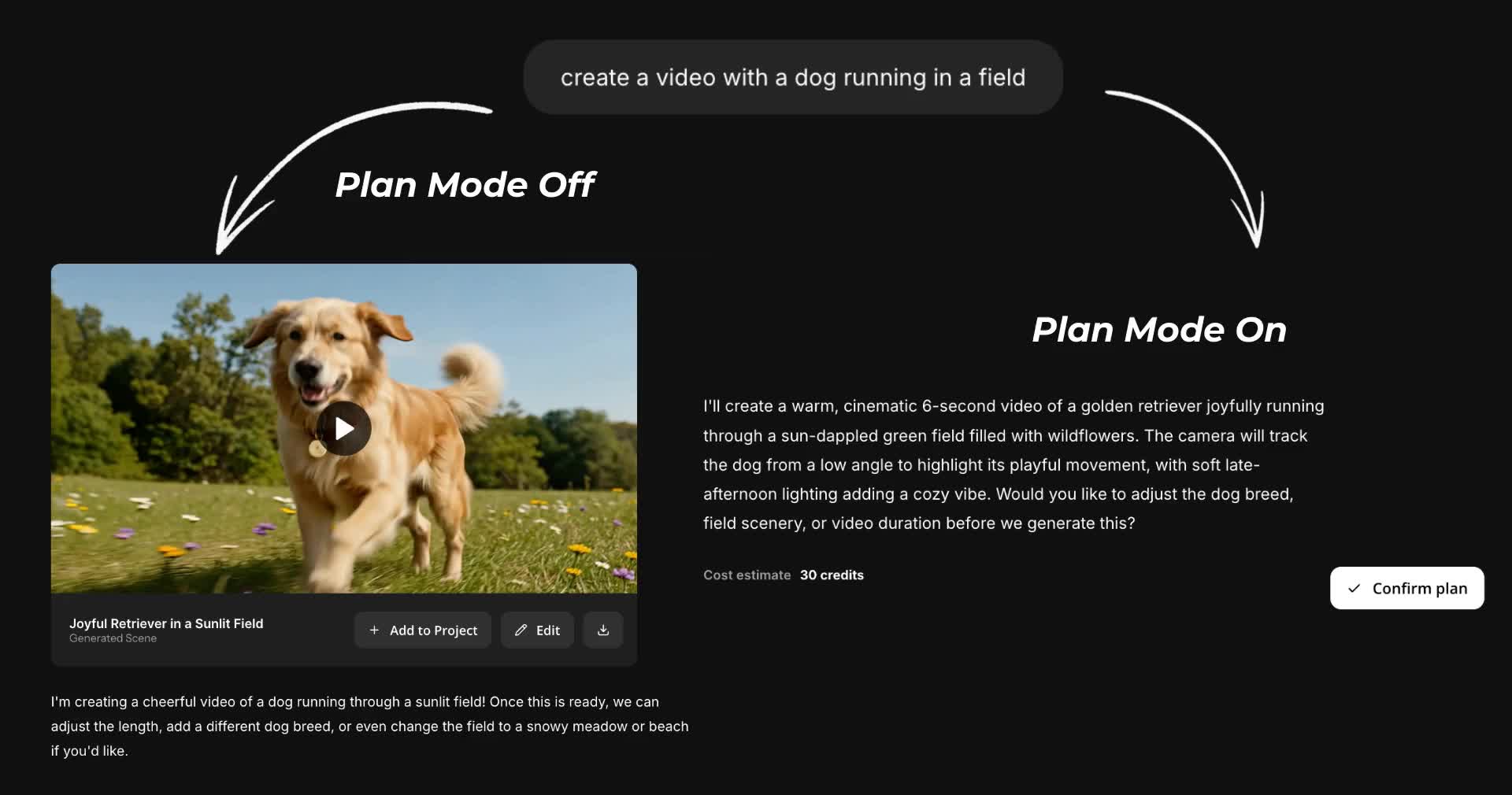
A conventional editing workflow often starts with recorded footage: upload files, arrange clips, trim pauses, add text and music, review, and export. Kai can begin earlier—from an idea, script, reference image, PDF, or recorded media. The assistant interprets the request, chooses actions and model integrations, assembles content, and passes an editable result back to Kapwing's editor. Human review is still needed for factual correctness, likeness rights, timing, and brand accuracy. The August 2026 release notes specifically describe autonomous mode and references to named uploaded media. [S12] [S13] [S29]
The difference between generation and video assembly
A generated clip synthesizes new visual frames using a model; AI-assisted assembly may instead create a sequence using source footage, library assets, scripted voice, titles and editing operations. Both may begin with a prompt. The user should check the chosen model, credit estimate, output license and review requirements. Kapwing's own model catalog helps distinguish what different models can accept and produce. [S10] [S11]
AI technology: what is developed, integrated or undisclosed?
Kapwing builds the browser editor, collaboration interface, prompt workflows and orchestration layer. It also integrates independently developed AI models. Official model listings include technologies associated with Google Veo, ByteDance Seedance, Kling and MiniMax, among others. Kapwing's product should not be described as the inventor of those providers' foundation models. Its competitive value may instead lie in selection, accessibility, editing continuity and workflow design. [S10] [S11]
The 2024 AI Personas announcement explicitly names sync. as a lip-sync technology partner. Eric Lu's technical posts also name Sieve and Texel as providers involved in video infrastructure or model-based processing. These disclosures illustrate a hybrid architecture that can change as vendors, prices and available AI models evolve. Claims about undocumented training corpora, GPU clusters, model architecture or exact inference algorithms would be speculative. [S16]
Plain-language model explanations: speech recognition changes recorded words into text; machine translation changes language; text-to-speech synthesizes a spoken version; video generation produces new frames; computer vision analyzes visual content; editing automation applies cuts, reframes and timing changes. Kapwing can combine these functions in one project even when different underlying models power them. A reliable production workflow includes a human final check, particularly for accessibility captions and sensitive multilingual content.
Business model, freemium acquisition and monetization
Kapwing operates a usage-limited free tier and paid per-seat plans. The free editor lowers the barrier for individual users who want to test video editing. Subscription plans then unlock higher export quality, longer projects, removal of the watermark, larger cloud storage allocations, workspace controls and additional AI credits. Enterprise sales add custom credit and support arrangements, billing and identity-management options. This is a recurring-revenue software model, but it is not proof of any specific ARR figure. [S08]
The credit model matters because AI work imposes variable generation or transcription expense. According to the September 2026 credit guide, subtitle transcription and AI dubbing consume credits at different rates, and other editing features can have distinct charges. The economic trade-off for a user is not only the plan price but also how frequently they use high-cost tools. Credits do not equal minutes of generative video in a simple one-to-one relationship. [S09]
Current pricing displayed on the US-dollar page at the October 2026 check:
| Plan | Monthly billing | Annual-billing equivalent | Credits and key limits |
|---|---|---|---|
| Free | $0 | $0 | 10 credits shown on pricing page; watermark; up to 4-minute 720p exports |
| Pro | $24 per member/month | $16 per member/month | 1,000 credits/month, watermark removal, 4K and shared workspaces |
| Business | $64 per member/month | $50 per member/month | 4,000 credits/month, voice cloning and lip-sync eligibility |
| Enterprise | Contact sales | Custom quote | Custom credits, SSO, support and billing |
These are USD figures displayed on Kapwing's public pricing page, not guaranteed prices in every country or tax jurisdiction. The August release notes state that free users were given 50 credits, while the currently retrieved pricing and September help page show 10: this is a live documentation conflict. For publishing, use the pricing page as the checkout reference and advise readers to confirm their displayed workspace credit balance. [S08] [S09] [S13]
What is not known about finances
Kapwing's current revenue, ARR, operating profit, paid subscription count, gross margins and valuation were not publicly disclosed in verifiable up-to-date source materials reviewed for this report. The historical early-revenue statements in Julia's 2017–2018 writing cannot responsibly be extrapolated into 2026 company revenue. Similarly, the funding amount is capital raised, not company revenue. [S02] [S07]
Funding and investors
| Date | Round | Confirmed amount | Lead investor | Other announced investors |
|---|---|---|---|---|
| 2018 (announced July) | Seed | $1.7 million | Kleiner Perkins | Shasta Ventures, Sinai Ventures, Village Global, Shrug Capital, ZhenFund |
| September 2019 | Series A | $11 million | CRV | Follow-on investors Village Global, Sinai, Shasta; reported new investors Jane VC, Harry Stebbings, Vector, Xoogler Syndicate |
| After September 2019 | Other rounds | Not independently verified | Not publicly disclosed | No additional confirmed round included |
Documented total = $12.7 million across the two verified rounds. Some commercial databases duplicate the 2018 seed under different months and produce a higher total; this report avoids double counting the same seed financing. No present-day private valuation can be inferred from round sizes alone. [S04] [S05] [S06]
Users, reach and company size: dated metrics only
Different company metrics answer different questions. A person who visits the website is not necessarily registered, a registered account is not necessarily an active subscriber, and a video creation is not a person. Kapwing's public materials include examples of all of these categories at different times:
| Reference date | Metric | Reported figure | Interpretation |
|---|---|---|---|
| July 2018 | Generated videos | 500,000+ since October 2017 launch | Historical cumulative creations |
| September 2019 | Media projects created | 9 million+ | Historical total output |
| September 2019 | Account registrations | 700,000+ | Historical accounts, not MAU |
| 2019 founder account | Monthly website visitors | Over 1 million | Website visitors, not paying subscribers |
| Q1 2026 | Employees | Approximately 25 | Approximate team size reported by CEO in April |
| 2026 official About page | Creators | 35 million | Company-reported reach; active status not defined |
| 2026 official About page | Videos per day | 100,000+ | Company-reported current production indicator |
| 2026 official About page | Geographic reach | 190+ countries/regions | Company-reported distribution |
The older figures are valuable because they trace adoption, but readers should not treat them as measurements taken on the same day. The company's own About page and homepage use slightly different audience language; the About page's 35M figure is the principal current figure used in this report. [S01] [S04] [S05] [S26]
Who uses Kapwing? Selected documented customers
Kapwing markets to solo creators, education institutions, marketing agencies, small businesses, communications departments and teams with repetitive social video needs. That describes potential markets; named customer stories are a separate evidentiary category. The official archive contains nine customer or creator stories, of which the following provide useful implementation details. [S18]
Longhouse Media — marketing agency
A 2023 Kapwing customer story describes Longhouse Media's use of Kapwing for short-form video creation, including AI-assisted features. It reports 43% growth in the video-production segment and other company growth, but the story does not establish a controlled experiment showing that Kapwing alone caused these changes. The practical lesson is that faster editing and captioning can support increased production capacity; the exact marginal contribution of each tool is not quantified. [S19]
Share.One — customer testimonials
Dan Lievens and Share.One described a previous production system involving separate recording, editing, feedback and file-storage services. Their geographically distributed team used Kapwing's shared cloud environment, subtitling and Smart Cut to simplify revisions and handoffs. A published customer account says turnaround fell from four or five business days to as little as one day. This is a customer-reported workflow result, not an independently audited average saving for every project. [S20]
National University — student guidance
National University's Project Access team produced peer-to-peer learning and orientation videos, including English and Spanish versions. The February 2025 story reports about 65 faculty-reviewed videos, 120 in editing and approximately 350 awaiting editing. Clean Audio was among the tools reported, but conventional editing, collaboration and student participation were central. The three figures indicate a pipeline, not improvement in student grades or course completion. [S21]
Brandon Arvanaghi / Meow — founder-led content
Kapwing's August 2024 article connects Brandon Arvanaghi's short-form LinkedIn workflow to auto-captioning, trimming and collaboration. It reports his audience growing from almost zero to 85,000 followers over the broader period. This is not a controlled causal measure of Kapwing's effect on follower growth, financial assets, or revenue; the founder's publishing consistency, content choices and audience behavior also matter. [S22]
The separate Artificial Intelligence Files Kapwing Case Studies directory page is the appropriate place for full customer workflows, quotes and metric provenance. This company profile preserves enough examples to demonstrate market relevance without implying every success story is solely an AI result.
Market positioning and competitors
Kapwing competes across several related categories rather than one uniform market. A team choosing a browser-based timeline editor will compare different products from a developer wanting synthetic B-roll or an enterprise learning team needing avatars at scale. The following summary describes product orientation rather than declaring winners.
| Platform | Principal focus | Overlap with Kapwing | Difference in emphasis |
|---|---|---|---|
| VEED | Online video editor and AI tools | Subtitles, dubbing, editing and teams | Different workflow and product/AI model offerings |
| Canva | Broad visual-design suite | Short videos, brand assets and AI assistance | Wider document, graphic and presentation ecosystem |
| Descript | Text-oriented media editing | Transcription and repurposing | Transcript-centered audio/video production |
| InVideo AI | Prompt-to-video creation | AI creation and social production | Greater emphasis on script/prompt-led assembly |
| Runway | Generative visual tools | AI clips and image/video generation | Generative-media-first creative workflows |
| Synthesia | Enterprise AI presenter video | Synthetic presenters and training | Avatar-led business video specialization |
| Adobe Express | Lightweight Adobe creative tools | Social editing and branded content | Ties to broader Adobe creative ecosystem |
[Analysis] Kapwing's clearest strategic differentiation is the combined browser editor, media workflow and selectable AI models within one product. That is a positioning judgment supported by its current interface, not an independent quality benchmark or a guarantee that it beats particular competitors in speed or price. [S10] [S11]
Growth strategy and how the business works
The founding team's first distribution tactics were closely tied to product utility. Search-friendly tools brought people with specific editing problems to the site, educational writing explained those tasks, and exported media spread the brand through creator sharing. Those tactics illustrate product-led discovery: instead of requiring a sales conversation before someone tries the product, the service gives a user a concrete result and offers more capability through paid access. [S31] [S02]
In the modern version, the conversion mechanism is more layered. Creators encounter limits on credits, watermarking, project length, storage and export quality. Team customers may also value consistent branding, collaboration and administrative controls. [Analysis] A major business challenge is balancing AI inference expense against predictable subscriptions while leaving enough free access to demonstrate product value. The actual unit economics, churn and customer acquisition costs are not publicly available. [S08] [S09]
Product development is another element of Kapwing's strategy. Founder publications often describe iteration and public lessons from experiments. The Tess.Design project provides a rare concrete example of an attempt that did not work: launched in May 2024 to support artists with usage royalties for their AI styles, it closed in January 2026. Julia said resources were refocused on Kapwing AI. This should be understood as a discontinued separate experiment—not a current feature, nor proof that every Kapwing AI initiative is commercially successful. [S27]
Security, data governance and responsible AI
Kapwing's May 2026 Security and Data Privacy Center reports use of Google Cloud in US regions and MongoDB Atlas, encryption at rest and in transit, and SAML SSO for Enterprise. It says Kapwing itself does not train models on customer data, while Enterprise agreements can include commitments about subprocessors' training use. The company also states that it does not publish a SOC 2 Type II report. These are vendor disclosures, not a substitute for an independently reviewed security audit. [S23]
The public privacy policy describes processing of account and service data, third-party services, and special handling of uploaded voice recordings for cloning. It also describes deletion controls and certain retention arrangements. Businesses should read both the policy and available data processing agreements before uploading employee recordings, customer footage, medical information, or confidential material. The fact that a service is browser-based does not mean no data leaves the user's device. [S24]
Generative workflows introduce further obligations. AI-generated speakers, substituted voices and synthetic scenes can be misleading if presented without context. Subtitles, translations and dubbing may contain errors that distort meaning. Copyright permissions for source footage, stock assets, music and likenesses remain important. Kapwing's 2026 release notes describe constraints around face swapping real people inside Kai, and its founders have publicly discussed the misuse potential of synthetic media. Responsible use requires consent, editing review and appropriate disclosure, especially for marketing and education. [S13] [S25]
SWOT analysis — independent editorial assessment
| Strengths [Analysis] | Weaknesses [Analysis] |
|---|---|
| Browser access, editable timelines and AI integrations support multiple creation tasks. | Cloud workflow depends on connectivity; demanding video and AI operations carry processing costs. |
| Documented history, 2018–2019 venture backing and named customers give evidence of durable market presence. | Many user and revenue figures are vendor-reported or unavailable; model providers can change. |
| Broad mix of conventional and AI capabilities offers flexibility. | Generative outputs, translation and captions require human correction and policy review. |
| Opportunities [Analysis] | Threats [Analysis] |
|---|---|
| Teams seeking multilingual marketing, social repurposing and production automation. | Strong competition from traditional software companies and AI-native generation platforms. |
| Better AI assistants combined with human-editable results. | Licensing, impersonation, privacy and platform-policy risks around AI media. |
| Expansion of team and enterprise collaboration needs. | Changes in vendor model access, pricing and inference economics. |
These entries are reasonable analysis informed by the research. They are not a SWOT assessment published or endorsed by Kapwing.
Leadership, culture and strategic direction
Kapwing's About page describes values around improvement, finishing and learning, inclusion, fun, original thinking and speaking up. These are company-declared cultural aspirations, not independent evidence of employee satisfaction. Julia's April 2026 article gives one more tangible example of operational experimentation: she reported that every member of the approximately 25-person team contributed code to production during Q1 using AI coding agents, with training and processes designed to make non-engineering roles able to handle certain low-complexity tasks. Those results describe internal practices and cannot be generalized to other companies without context. [S01] [S26]
Confirmed developments
Kapwing launched Kai in late 2025 and expanded its autonomous generation and editing capabilities during 2026. Its release notes name new external AI models and more granular controls over reference media, caption animation, audio and image/video workflows. These are documented releases, not promised future features. [S12] [S13] [S14]
Forward-looking analysis, not company guidance
[Analysis] Kapwing is likely to compete increasingly on how reliably users move between AI generation and manual editing rather than on any one model alone. New model generations may make raw clips easier to create, while customer expectations for consistent branding, approvals, factual reliability, privacy and efficient teamwork may become more demanding. This is an independent interpretation, not a confirmed company roadmap. The closure of Tess suggests maintaining focus matters when experimental AI products compete for limited team attention. [S27]
Research limitations and conflicting information
- Free AI credits: August 2026 release notes mention 50 credits for free users, while the September guide and current pricing view show 10. The pricing table uses the public pricing page; readers should verify in-account allowances. [S08] [S09] [S13]
- Creators versus active users: Company About states 35M creators; elsewhere older copy shows 30M+. Neither figure can be assumed to equal monthly active users or paying subscribers. [S01] [S33]
- Employee count: Q1 2026 “~25” comes from the CEO's post, not an audited October 2026 roster. [S26]
- Funding totals: The seed announcement has inconsistent webpage metadata around June/July 2018. It is one $1.7M round, not two separate transactions. Two independently supported announcements sum to $12.7M. [S04] [S05]
- Revenue and valuation: No verifiable present-day figures were established. Historical project volume and fundraising do not resolve that gap.
- Images: Authentic photos and source-linked product screenshots are published with their origin links. Public viewing is not a grant of republication rights; check licenses or secure permission before deployment.
Conclusion
Kapwing's history is best understood as a practical editing startup that expanded into AI-assisted production. It started with one small, shareable meme-making task, won adoption by making video work easier in the browser, raised venture capital, and built collaboration around a growing editor. By October 2026, Kai and model integrations make generative media a visible part of the product, but traditional editing, subtitles, localization and team workflows remain central to its value.
The strongest public evidence supports its founders, origin, funding rounds, released product categories and customer stories. It does not support invented financial valuations, blanket claims of AI causality, or assertions that Kapwing created every model it integrates. For business buyers, the practical question is how well its blend of generation, editing, permissions, credits and collaboration fits their real production requirements.
Frequently asked questions
What is Kapwing AI?
Kapwing is a web-based video editor with AI features including prompt-led generation, automatic captions, dubbing, audio tools and repurposing. Its central editor also offers traditional timeline editing and shared projects. [S01, S32]
Who founded Kapwing?
Julia Enthoven and Eric Lu founded Kapwing after working together at Google Image Search. The company first launched a meme-making web tool in October 2017. [S03, S04]
When was Kapwing founded?
Kapwing launched in October 2017. Its exact calendar launch day was not consistently verified from the main primary sources. [S02, S04]
Where is Kapwing headquartered?
Kapwing is based in San Francisco, California, United States. [S01, S05]
Who are the CEO and CTO?
Julia Enthoven is documented as co-founder and CEO. Eric Lu is documented as co-founder and CTO. A later leadership change was not independently verified. [S04, S05]
Is Kapwing an AI company?
Yes, it sells AI-assisted and generative video features, but it is also a conventional online editor. Many popular actions, such as trimming and combining footage, are standard editing functions. [S32]
What products does Kapwing offer?
Its product family includes a web editor, Kai, AI Video Generator, subtitles, translation/dubbing, Repurpose Studio, audio cleanup, AI images and team workspaces. Availability depends on plan and credits. [S08, S32]
Does Kapwing develop its own AI models?
Kapwing develops creative software and AI workflows. It also integrates models from third parties such as Google, ByteDance, Kling and MiniMax. Public evidence does not establish that it trained all of those foundation models. [S11, S16]
What is Kai?
Kai is Kapwing’s AI assistant for creating and editing media from text instructions and references. Released in November 2025, it gained additional planning, autonomous execution and media-reference capabilities in 2026. [S12, S13]
Is Kapwing free?
Kapwing offers free access with watermark, resolution, duration and credit restrictions. Its publicly displayed prices and usage limits can change, so check the live pricing page. [S08]
How does Kapwing make money?
Kapwing sells recurring subscriptions to creators and teams. More expensive plans offer higher usage allowances and workspace features, while Enterprise arrangements are negotiated. [S08]
How much funding has Kapwing raised?
Two confirmed public rounds total $12.7 million: $1.7 million in 2018 and $11 million in 2019. No later public round was independently verified for this report. [S04, S05]
Who invested in Kapwing?
Kleiner Perkins led the 2018 seed round and CRV led the 2019 Series A. Other investors named in the company announcements include Shasta Ventures, Sinai Ventures, Village Global and others. [S04, S05]
Is Kapwing profitable?
Current profitability, revenue and audited annual recurring revenue were not publicly disclosed in the sources reviewed. Funding and creator-count figures cannot establish profitability.
How many people use Kapwing?
Kapwing’s About page reports 35 million creators worldwide and 100,000-plus videos created daily. Those are company-reported platform indicators, not verified monthly active users or paying subscribers. [S01]
What industries use Kapwing?
Published customer stories cover marketing agencies, customer testimonial production, university support videos and founder-led social content. Other typical audiences include educators and communications teams. [S18]
What are the limitations of Kapwing?
Users need internet access, sufficient credits and human review of generated or translated content. Sensitive media also raises privacy, licensing and consent requirements. [S08, S23]
How does Kapwing compare with VEED?
Both offer browser-based video editing and AI features such as captions and translation. Differences depend on workflow, model choice, subscription limits and collaboration tools; no blanket superiority ranking is supported.
Does Kapwing provide enterprise security controls?
Kapwing reports encryption, enterprise SAML SSO and optional data agreements. Its security page says it does not publish a SOC 2 Type II report; organizations should request current documentation. [S23]
What is Kapwing’s future direction?
The official 2025–2026 releases emphasize Kai, model choice, more autonomous editing, reference assets and workflow controls. Any further product trajectory beyond announced features is analysis, not a confirmed roadmap. [S12, S13]
Sources and verification index
| ID | Source | Publisher | Date | Direct URL | Supports |
|---|---|---|---|---|---|
| S01 | About us | Kapwing | Current page, checked 12 October 2026 | Open | Company identity, mission, company-reported 35M creators, 100K+ daily videos, 190+ countries |
| S02 | Why I’m founding a startup I don’t really care about | Julia Enthoven / Kapwing | 1 November 2017 | Open | Meme maker origin, initial revenue |
| S03 | Find a cofounder before you find an idea | Julia Enthoven / Kapwing | 19 September 2018 | Open | Co-founder history and work at Google |
| S04 | Seed financing announcement | Kapwing / Kleiner Perkins | 16 July 2018 announcement; post metadata differs | Open | October 2017 founding; $1.7M seed and investors |
| S05 | Online Multimedia Editor Kapwing Announces Series A From CRV | Kapwing | 24 September 2019 announcement | Open | 2019 $11M Series A; investors; 2019 account and output metrics |
| S06 | Meme editor Kapwing grows 10X, raises $11M | TechCrunch | 24 September 2019 | Open | Independent historical funding and growth reporting |
| S07 | Why We Decided to Raise Money for Our Startup | Julia Enthoven / Kapwing | 16 July 2018 | Open | Bootstrapping and financing decisions |
| S08 | Pricing | Kapwing | Checked 12 October 2026 | Open | Free, Pro, Business and Enterprise plans and price presentation |
| S09 | How do Kapwing Credits Work? | Kapwing Help Center | Updated 10 September 2026 | Open | Credit accounting and plan allocations |
| S10 | AI Video Generator | Kapwing | Checked 12 October 2026 | Open | Kai, text/image/document inputs and video editing |
| S11 | AI Video Models in Kapwing | Kapwing | Checked 12 October 2026 | Open | Third-party models and options |
| S12 | Giving AI a Canvas to Paint On | Julia Enthoven / Kapwing | 18 November 2025 | Open | Introduction of Kai |
| S13 | Release Notes – August 2026 | Kapwing Help Center | 1 September 2026 | Open | Autonomous Kai, August model integration and product changes |
| S14 | Release Notes – July 2026 | Kapwing Help Center | 1 September 2026 | Open | New model families, PDFs and subtitles |
| S15 | Introducing AI Personas | Julia Enthoven / Kapwing | 18 September 2024 | Open | Historical AI persona launch |
| S16 | Kapwing x sync.: Taking Lip Sync to New Heights | Eric Lu / Kapwing | 18 September 2024 | Open | External lip-sync model partner disclosure |
| S17 | Meet the New Repurpose Studio | Kapwing | 13 March 2024 | Open | Repurpose Studio chronology |
| S18 | Customer Stories | Kapwing Resources | Archive checked 12 October 2026 | Open | Nine named official customer/creator stories |
| S19 | 7-Figure Agency Grows Video Production 43% | Kapwing Resources | 20 November 2023 | Open | Longhouse Media self-reported production growth |
| S20 | How Share.One Streamlines Video Testimonial Production | Kapwing Resources | 16 December 2024 | Open | Share.One editing time, collaboration and AI subtitling |
| S21 | National University’s Project Access Elevates Student Success with Kapwing | Kapwing Resources | 19 February 2025 | Open | Project Access workflow and content pipeline |
| S22 | From 0 to 85,000 LinkedIn Followers | Kapwing Resources | 9 August 2024 | Open | Brandon Arvanaghi social audience report; correlation caution |
| S23 | Security and Data Privacy Center | Kapwing Help Center | Updated 26 May 2026 | Open | Cloud providers, SSO, training data, SOC 2 disclosure, encryption |
| S24 | Privacy Policy | Kapwing | Effective 3 August 2022, checked 12 October 2026 | Open | Personal data, sharing, voice-cloning and data deletion |
| S25 | Terms of Service | Kapwing | Checked 12 October 2026 | Open | Content ownership and usage rights |
| S26 | How We Achieved 100% Adoption of AI Coding Agents | Julia Enthoven / Kapwing | 7 April 2026 | Open | ~25 people in Q1 2026; internal AI use |
| S27 | Learnings from Paying Artists Royalties for AI-Generated Art | Julia Enthoven / Kapwing | 9 March 2026 | Open | Tess.Design May 2024–Jan 2026 and discontinued experiment |
| S28 | Apple’s Inadequate Response to App Store Trademark Fraud | Julia Enthoven / Kapwing | 8 June 2026 | Open | Company-described copycat risks |
| S29 | How to Use Kapwing’s AI Video Generator | Kapwing Help Center | Updated 12 August 2026 | Open | Kai prompts, editing workflow and access |
| S30 | Unexpected challenges of making money on the internet | Julia Enthoven / Kapwing | 23 January 2018 | Open | Early monetization and lean product |
| S31 | VIRAL: How We Used Watermarks to Grow our Startup | Julia Enthoven / Kapwing | 2019 | Open | Historical organic growth and watermark effect |
| S32 | Kapwing AI Overview | Kapwing | Checked 12 October 2026 | Open | Current AI tool categories |
| S33 | Company homepage | Kapwing | Checked 12 October 2026 | Open | Current product positioning, market audiences |
Explore more AI companies and creator tools
Continue researching the people, technology and business evidence behind leading artificial intelligence products.
Visit Artificial Intelligence Files ↗