InsuranceLEVEL A
Pathwork
Underwriting records become usable context
Pathwork replaced a brittle medical-record parsing pipeline with a more scalable ingestion layer for life-insurance underwriting.
LlamaParse RAG
 LlamaIndex / research
What happens when real teams connect documents, databases and business knowledge to AI? This evidence-led collection examines LlamaIndex implementations across insurance, research, HR, software and more—separating documented results from marketing claims and unmeasured outcomes.
A conceptual pipeline. Individual customer projects use different components and configurations; the visual is not a claimed deployment diagram.
Find a customer by industry, technology or strength of published evidence. Every named organization below links to its own official LlamaIndex customer story.
12 case studies match. “Level A” means the customer or vendor reports a number; it does not mean independent auditing.
Underwriting records become usable context
Pathwork replaced a brittle medical-record parsing pipeline with a more scalable ingestion layer for life-insurance underwriting.
One reusable platform replaces siloed chatbot builds
Jeppesen’s engineering team assembled a unified agent framework based on LlamaIndex event-driven workflows.
A faster first response for AI customer-support agents
Experian describes customer-service agents using LlamaIndex for retrieval and production development.
Parsing becomes infrastructure for document agents
StackAI uses LlamaParse in its enterprise agent builder to transform mixed customer files into retrieval-ready content.
Onboarding context for autonomous sales agents
11x integrated LlamaParse to help its sales agents ingest company material and generate more relevant outbound content.
Making scientific figures searchable
MavenBio routes visual-heavy biomedical publications and regulatory materials through LlamaParse for downstream research intelligence.
From condo-paperwork overload to searchable risk reports
Calgary-based CondoScan parses condominium records and uses agent workflows to help buyers assess property risks.
Natural-language questions grounded in database schemas
SkySQL uses LlamaIndex to orchestrate agents that translate conversational questions into SQL for operational data.
Cleaner source content for AI creator “minds”
Delphi parses creator PDFs, transcripts and spreadsheets into a knowledge pipeline supporting personalized AI mentor experiences.
Employee answers grounded in HR handbooks
Netchex built AskHR and Netchex AI to answer workforce queries against employers’ own HR policies and benefits documents.
Less ingestion engineering, faster client prototypes
Scaleport.ai says LlamaParse simplified building custom AI applications for clients across several industries.
Context retrieval inside a broader agent-building platform
Lyzr uses LlamaIndex components for access to customer data and contextual retrieval within its autonomous-agent platform.
No cases match. Try clearing a filter or changing your search.
Bars reflect only the twelve cases selected for this article—not market share, adoption by all LlamaIndex users, or global sector rankings. Choose a sector to filter the library.
The stories cover visual-heavy parsing, policy-document retrieval, natural-language database queries and orchestration of business agents. Their architectures differ significantly.
Clicking a bar changes the customer filter. The counts update only when the editorial case list is changed.
Open filtered library ↗Each story separates the business challenge, described technical design, reported outcomes and what the source does not establish. Photos and diagrams appear only when sourced from the official customer story and are never cropped.
Pathwork replaced a brittle medical-record parsing pipeline with a more scalable ingestion layer for life-insurance underwriting.
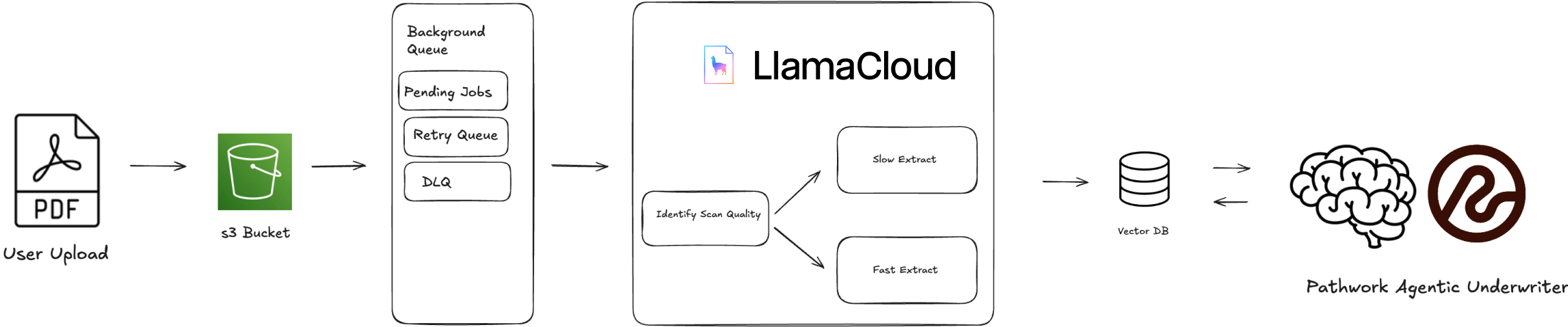
Insurance cases arrive with medical records, handwritten notes, lab reports and older scanned PDFs. Pathwork’s original page-by-page model pipeline was hard to maintain and could not keep up with rising document volume.
LlamaIndex-supported ingestion parses incoming medical records into information used by downstream underwriting systems. The company also parses carrier guidelines and refreshes retrieval-based underwriting knowledge.
Reported inputs include medical PDFs and underwriting manuals; parsing and downstream RAG are documented. The customer does not publish a complete system diagram of all models and infrastructure.
Weak scans from the 1970s and mixed layouts required more robust processing. The published account does not specify a controlled parsing-accuracy benchmark.
Pathwork reports an eightfold increase in weekly processing capacity. Its impact section describes 5,000 to 40,000 documents per week, while other sections call the 40,000 figure pages per week.
What to learn: Parsing reliability is an operational constraint, not just a model-quality issue. Verify units before copying throughput claims.
Jeppesen’s engineering team assembled a unified agent framework based on LlamaIndex event-driven workflows.
Teams had independently built chatbots, duplicated integrations and navigated compliance checks repeatedly. Creating an agent from scratch reportedly required about 512 engineering hours.
A five-to-seven-person team built its Unified Chatbot Framework with reusable templates, connectors, policy controls, configurable models and vector stores. LlamaIndex workflows coordinate agent state and execution.
The customer names GraphQL, SQL, REST, Neo4j and Databricks connectors, several model providers, and Azure AI Search or Qdrant retrieval options. These are supported choices, not a claim that every agent uses each.
Individual teams needed a shared compliance and deployment standard. The published article does not explain its hours-saved measurement or audit method in full.
Jeppesen reports a development-effort reduction from 512 to 64 hours per agent, with 1,792 collective hours already saved. Approximately 4,900 annual hours is only a projection.
What to learn: A reusable, policy-aware agent platform can eliminate repeated setup work across enterprise teams.
Experian describes customer-service agents using LlamaIndex for retrieval and production development.
Support agents need relevant information quickly enough to maintain conversational responsiveness and deliver useful answers.
The official customer listing credits LlamaIndex with retrieval improvements and faster deployment. The full technical write-up is not available as text on the linked page.
LlamaIndex-based customer-support agent and retrieval are stated; exact model, index, database and infrastructure are not publicly specified in the accessible source.
Latency depends on model configuration, infrastructure and streaming. The accessible public material does not disclose test population or measurement conditions.
LlamaIndex’s customer listing reports time to first token falling from eight seconds to one second. It also says NPS improved but does not publish a specific change in NPS.
What to learn: Do not confuse initial response latency with total answer time or customer-satisfaction uplift.
StackAI uses LlamaParse in its enterprise agent builder to transform mixed customer files into retrieval-ready content.
Enterprise clients uploaded scanned insurance forms, finance reports, spreadsheets and other inconsistent files. Standard PDF readers and OCR results varied too much for dependable downstream agents.
StackAI placed the LlamaParse API at its core ingestion step, connecting its structured outputs to knowledge bases used by downstream AI agents.
The case confirms LlamaParse API integration and knowledge-base ingestion. It does not publish all private embedding, storage, model or evaluation configurations.
Small upstream parsing errors can undermine downstream answers. Customers’ input quality and processing-volume needs are highly variable.
StackAI reports more than one million documents processed for enterprise customers. Accuracy improvements are described qualitatively, without a published accuracy percentage or study period.
What to learn: When an agent product spans many industries, a consistent parsing interface reduces one-off engineering.
11x integrated LlamaParse to help its sales agents ingest company material and generate more relevant outbound content.
Sales customers supplied PDFs, presentations, website information and other content; manually reading and rewriting that context made onboarding harder to scale.
The company added document parsing to the agent knowledge-base experience, choosing parsing fidelity according to content complexity and connecting processing through its TypeScript workflow.
The customer explicitly mentions TypeScript SDK, asynchronous webhook retrieval, varied documents and configurable parsing-depth selection. Its complete agent orchestration stack is not detailed.
11x tried a home-built OCR approach but found maintenance, engineering effort and quality difficult. SDK issues were addressed during testing according to the customer.
The customer reports moving the parsing integration from prototype to production in three days. The case title references ramp-time shrinking to days, but gives no uniform before/after SDR ramp-time trial.
What to learn: Document-ingestion capability can remove a product-onboarding bottleneck without proving every sales KPI improved.
MavenBio routes visual-heavy biomedical publications and regulatory materials through LlamaParse for downstream research intelligence.
Traditional Python PDF parsers could capture standard text but missed plots, posters, figure legends and other scientific visual evidence.
Visual-rich documents are classified and sent to LlamaParse. Descriptions and structured text are then enriched and connected to MavenBio’s biomedical knowledge and retrieval layers.
The customer documents file routing, LlamaParse visual description, model-selection tuning, size optimization and asynchronous webhooks. The end-to-end platform also uses domain ontologies and LLM enrichment.
Complex charts and figures must retain their scientific context. No independent document-level accuracy benchmark or quality baseline is published.

MavenBio reports overall analytical workflows 10–20 times faster for users. That end-to-end speedup is attributed to its wider platform, not isolated to LlamaParse.
What to learn: Visual parsing matters most when charts and diagrams carry decision-critical scientific evidence.
Calgary-based CondoScan parses condominium records and uses agent workflows to help buyers assess property risks.
Property review can involve 10–40 records, budgets and meeting minutes spanning hundreds of pages. Manual expert reviews may take around two weeks.
LlamaParse prepares records for retrieval while LlamaIndex supports ingestion, reasoning and question-answering across condo documents and relevant regulations.
The published customer architecture identifies Google Cloud Storage, OCR, LlamaParse, Pinecone, MongoDB, FastAPI, Cloud Run and agent workflows. The diagram is customer-provided and may change.
Information can be legally and financially consequential. The source does not publish a controlled risk-detection accuracy evaluation.

CondoScan says its production solution can reduce reviews from weeks to minutes. That is the vendor/customer description, not an independently verified comparison.
What to learn: Retrieval and agents can make large document sets easier to inspect, but should not replace professional due diligence.
SkySQL uses LlamaIndex to orchestrate agents that translate conversational questions into SQL for operational data.
Complex schemas and weak table relationships can cause inaccurate joins, stale assumptions and misleading database answers.
SkySQL combines retrieved schema context, query generation, expert correction and response evaluation to guide its text-to-SQL agents.
The case names LlamaIndex’s SQL Table Retriever Engine, human context editing, LLM-as-judge review and MariaDB Vector. SkySQL describes in-database execution and fallback mechanisms.
Schema evolution, permissions, cost and accuracy need continuing attention. Published claims of better SQL correctness lack a numerical benchmark.
SkySQL reports improved query quality and developer experience, but does not disclose comparable quantitative production outcomes.
What to learn: Text-to-SQL needs schema grounding, explicit evaluation and a route for expert corrections.
Delphi parses creator PDFs, transcripts and spreadsheets into a knowledge pipeline supporting personalized AI mentor experiences.
Malformed PDFs, tables and unusual encodings introduced ingestion failures and weakened source citation quality.
Delphi adopted LlamaParse, including balanced parsing modes, to create readable Markdown that feeds the platform’s storage and knowledge representation.
The story explicitly mentions a downstream S3 data lake and knowledge graph as well as markdown-first parsing. Exact citation evaluation metrics are not disclosed.
Citation fidelity depends on retaining source text and document structure. A numerical benchmark or cost comparison is not provided.
Delphi describes fewer manual ingestion fixes and better citation fidelity, but publishes no measured accuracy or hours-saved figure.
What to learn: Poor parsing can affect citation trust even when the language model behaves as designed.
Netchex built AskHR and Netchex AI to answer workforce queries against employers’ own HR policies and benefits documents.
Small HR teams were handling recurring employee questions while handbooks and benefits information remained difficult to search.
LlamaIndex ingests Office files and PDFs, chunks policy content and retrieves relevant excerpts before drafting cited employee answers.
The story names Azure OpenAI embeddings, customizable retrievers, citation to source pages, query engines and semantic routing across document sets.
HR policy information is sensitive and can become stale. The public article does not present a formal answer-accuracy test or reduction in staff workload.
Netchex says two engineers built the system in around one month, with approximately 20% of their time devoted to LlamaIndex-related work. Business productivity gains remain unquantified.
What to learn: Document citations and routing matter when answers must trace back to company-specific HR policies.
Scaleport.ai says LlamaParse simplified building custom AI applications for clients across several industries.
Custom ingestion pipelines and inadequate OCR made proofs of concept laborious and delayed demonstrations of value.
The firm used LlamaParse plus LlamaIndex indexing and retrieval tooling so teams could spend less effort writing document-ingestion plumbing.
Its customer story describes use of document parsing, OCR, indexing and retrieval, without disclosing client-specific infrastructure or a public evaluation dataset.
The reported comparison applies to one client project and a prior equivalent application; the source does not disclose a normalized labor audit.
Its CTO reports roughly 50–60% fewer development hours for one client compared with an equivalent earlier project. This should not be generalized across all deployments.
What to learn: The most defensible automation ROI sometimes starts with developer effort rather than flashy model metrics.
Lyzr uses LlamaIndex components for access to customer data and contextual retrieval within its autonomous-agent platform.
Agents serving different use cases must work across heterogeneous customer documents, connectors and retrieval configurations.
Lyzr describes LlamaIndex connectors and retrieval features behind custom data access and its AutoRAG selection process.
The customer story specifies data connectors, tailored chunk settings and retrieval optimization. Proprietary full-agent deployment architectures are not disclosed.
Commercial growth has many causes, from distribution to product fit; technical dependency does not prove an individual library generated revenue.
A LlamaIndex story reports Lyzr’s ARR increasing from approximately $100,000 to $1.5 million in under 60 days. No causal attribution to LlamaIndex is established, so the figure is not treated as a LlamaIndex performance metric.
What to learn: Treat revenue growth in a technology vendor’s customer story as background, not proof of direct platform ROI.
These figures come from customer accounts hosted by LlamaIndex. They use different units, periods and methods; they must not be averaged into a single AI “performance score.” Select a category to focus the dashboard.
Reported capacity increase
5,000 → 40,000 weekly units; source mixes “documents” and “pages”.Read original evidence ↗Reported effort per agent
1,792 hours reported already saved; ~4,900 hours/year only forecast.Read original evidence ↗Time to first token
Company-published comparison; test methodology not supplied. NPS increase unquantified.Read original evidence ↗Documents processed
Cumulative customer-reported volume; reporting period not disclosed.Read original evidence ↗Prototype to production
Reported integration timeline, not customer ROI or a controlled onboarding study.Read original evidence ↗Reported analytical workflow speed
Broad platform outcome; not a controlled LlamaParse-only improvement.Read original evidence ↗Reported document review change
Uncontrolled customer claim; human oversight remains essential for property decisions.Read original evidence ↗Reported build timeline
Two engineers; time to build is not measured employee-hours savings.Read original evidence ↗Fewer development hours
Self-reported, single client comparison; baseline hours not published.Read original evidence ↗Caution: reported metrics include customer self-assessments, implementation timelines and end-to-end platform outcomes. Details and attribution limits are included in each card.
A clickable conceptual architecture, not a reconstruction of a particular customer’s private system. Click any step to understand its role; some deployments skip or combine steps.
Organizations start with records, manuals, spreadsheets, databases or other business information. Permission and data quality checks matter before AI processing begins.
Educational diagram · real deployment components vary.Illustrative sample insurance intake only. There is no live LlamaIndex API connection and the synthetic content does not describe a real customer.
These are conceptual education scenarios, not measured results from a named customer. Select a workflow and compare a manual or limited process with an AI-assisted alternative.
An analyst opens PDFs one by one, locates the relevant fields and manually checks whether important attachments are present.
Illustration only · no measured customer baseline.Use the same library filters above; this table updates with them. Sort names alphabetically or expand a row to inspect its most important caveat.
| Industry | Challenge | Technology | Published outcome | Level | More | |
|---|---|---|---|---|---|---|
| Pathwork | Insurance | Underwriting records become usable context | LlamaParse, RAG | 8× — Reported capacity increase | A | |
| Pathwork: Pathwork reports an eightfold increase in weekly processing capacity. Its impact section describes 5,000 to 40,000 documents per week, while other sections call the 40,000 figure pages per week. Primary source ↗ | ||||||
| Jeppesen | Aviation | One reusable platform replaces siloed chatbot builds | Workflows, AI Agents | 512 → 64h — Reported effort per agent | A | |
| Jeppesen: Jeppesen reports a development-effort reduction from 512 to 64 hours per agent, with 1,792 collective hours already saved. Approximately 4,900 annual hours is only a projection. Primary source ↗ | ||||||
| Experian | Financial Services | A faster first response for AI customer-support agents | RAG, AI Agents | 8 → 1s — Time to first token | A | |
| Experian: LlamaIndex’s customer listing reports time to first token falling from eight seconds to one second. It also says NPS improved but does not publish a specific change in NPS. Primary source ↗ | ||||||
| StackAI | Enterprise Software | Parsing becomes infrastructure for document agents | LlamaParse, RAG | 1M+ — Documents processed | A | |
| StackAI: StackAI reports more than one million documents processed for enterprise customers. Accuracy improvements are described qualitatively, without a published accuracy percentage or study period. Primary source ↗ | ||||||
| 11x.ai | Sales Automation | Onboarding context for autonomous sales agents | LlamaParse, AI Agents | 3 days — Prototype to production | A | |
| 11x.ai: The customer reports moving the parsing integration from prototype to production in three days. The case title references ramp-time shrinking to days, but gives no uniform before/after SDR ramp-time trial. Primary source ↗ | ||||||
| MavenBio | Life Sciences | Making scientific figures searchable | LlamaParse, RAG | 10–20× — Reported analytical workflow speed | A | |
| MavenBio: MavenBio reports overall analytical workflows 10–20 times faster for users. That end-to-end speedup is attributed to its wider platform, not isolated to LlamaParse. Primary source ↗ | ||||||
| CondoScan | Real Estate | From condo-paperwork overload to searchable risk reports | LlamaParse, RAG | Weeks → minutes — Reported document review change | A | |
| CondoScan: CondoScan says its production solution can reduce reviews from weeks to minutes. That is the vendor/customer description, not an independently verified comparison. Primary source ↗ | ||||||
| SkySQL | Data Infrastructure | Natural-language questions grounded in database schemas | RAG, AI Agents | Not quantified | B | |
| SkySQL: SkySQL reports improved query quality and developer experience, but does not disclose comparable quantitative production outcomes. Primary source ↗ | ||||||
| Delphi | Creator Technology | Cleaner source content for AI creator “minds” | LlamaParse, RAG | Not quantified | B | |
| Delphi: Delphi describes fewer manual ingestion fixes and better citation fidelity, but publishes no measured accuracy or hours-saved figure. Primary source ↗ | ||||||
| Netchex | HR Technology | Employee answers grounded in HR handbooks | LlamaIndex Framework, RAG | ~1 month — Reported build timeline | A | |
| Netchex: Netchex says two engineers built the system in around one month, with approximately 20% of their time devoted to LlamaIndex-related work. Business productivity gains remain unquantified. Primary source ↗ | ||||||
| Scaleport.ai | AI Consultancy | Less ingestion engineering, faster client prototypes | LlamaParse, RAG | 50–60% — Fewer development hours | A | |
| Scaleport.ai: Its CTO reports roughly 50–60% fewer development hours for one client compared with an equivalent earlier project. This should not be generalized across all deployments. Primary source ↗ | ||||||
| Lyzr | Enterprise Software | Context retrieval inside a broader agent-building platform | LlamaIndex Framework, RAG | Not quantified | B | |
| Lyzr: A LlamaIndex story reports Lyzr’s ARR increasing from approximately $100,000 to $1.5 million in under 60 days. No causal attribution to LlamaIndex is established, so the figure is not treated as a LlamaIndex performance metric. Primary source ↗ | ||||||
These themes are editorial inferences from the selected customer stories—not claims about the entire AI industry. Successful integrations still need validation, maintenance and governance.
Messy PDFs, charts and inconsistent encodings can break downstream retrieval. Test parsing on representative production documents, not ideal examples.
Time to first token, full response time, retrieval quality, citation precision and user satisfaction answer different questions.
Insurance, financial, medical and property decisions can be consequential. Provide clear sources, confidence processes and escalation to specialists.
Before sending documents to hosted AI services, assess sensitive information, security controls, retention and region-specific obligations.
Include parsing credits, model tokens, embedding updates, storage, retries and human quality checks. “Faster development” is not the same as lower total cost.
Build an evaluation set containing varied layouts and real user questions; rerun it after changes to prompts, retrieval settings and models.
The stories are primarily hosted by the technology vendor and frequently contain customer statements. They establish that named organizations publicly described particular implementations; they do not automatically establish third-party validation, controlled experiments or the causal share of LlamaIndex in every business outcome. Level A flags reported numbers, not independently audited numbers.
The twelve documented examples in this report include Pathwork, Jeppesen, Experian, StackAI, 11x, MavenBio, CondoScan, SkySQL, Delphi, Netchex, Scaleport.ai and Lyzr. Each has a named customer story linked below.
LlamaIndex is a framework for connecting data to language-model applications, including retrieval and workflows. LlamaParse is a document-parsing service for transforming complex inputs into more usable machine-readable content. Customer systems may use one or both.
No. It means a named customer, an implementation, and a publicly reported numerical outcome appear in traceable material. Here, most numbers remain vendor- or customer-reported without a disclosed independent audit.
MavenBio’s customer story describes using LlamaParse for plots, figures and visually dense publications. Quality depends on document conditions and needs testing for each use case.
No. Retrieval-augmented generation (RAG) supplies relevant external context for generating answers. An agent may decide which tools to call, sequence tasks or maintain state. Agents often use retrieval, but not every RAG application is an agent.
Only if the necessary components, data permissions and operational requirements fit. Many published stories omit private infrastructure or evaluation details, so diagrams should be treated as educational references rather than turnkey blueprints.
The selected public stories offer qualitative quality claims, but few disclose standardized test sets, accuracy baselines or independent quality evaluations. Reproduce evaluation with your own representative datasets.
Choose a narrow use case, prepare representative source documents, prototype ingestion and retrieval, measure grounded-answer quality, add human review for consequential decisions and define deployment/security costs before scaling.
Reviewed 28 October 2026. The references below are direct customer-specific pages on LlamaIndex’s official website; the technology documentation and customer directory are separately linked. Publication dates are not assigned when the public page does not clearly expose them.
Across this sample, the strongest operational lessons are about preparing usable context, standardizing workflows and measuring the right outcomes. The evidence is promising—but its limits should stay visible alongside its successes.