ARTIFICIAL INTELLIGENCE FILES / COMPANY INTELLIGENCE / 2026
NO-CODE MACHINE LEARNING HISTORICAL COMPANY PROFILE
Obviously AI.
The company that brought predictive machine learning to business users—before evolving into Zams, an enterprise AI-agent brand, and announcing a wind-down.
 USER-PROVIDED BRAND ASSET
CRITICAL COMPANY STATUS · 2026
Obviously AI is not a verified active standalone product.
Co-founder Nirman Dave announced the Obviously AI → Zams rebrand in February 2025 and later announced a decision to wind down Zams in 2026. The old Obviously AI website, pricing and sign-up language can still be viewed, but page availability does not establish active service, working subscriptions, continued support or a new trading entity. This article documents the company's evolution; it is not a current purchasing recommendation. [6][7]
Obviously AI at a glance
Obviously AI was a US venture-backed company developing no-code predictive analytics. Its original platform helped users turn structured business data into classification models, numeric predictions and forecasts. It later combined software with human data-science support, shifted into agentic enterprise AI and changed its name to Zams. Its founder has since publicly announced a wind-down. [1][6][7][8][9]
What did Obviously AI do?
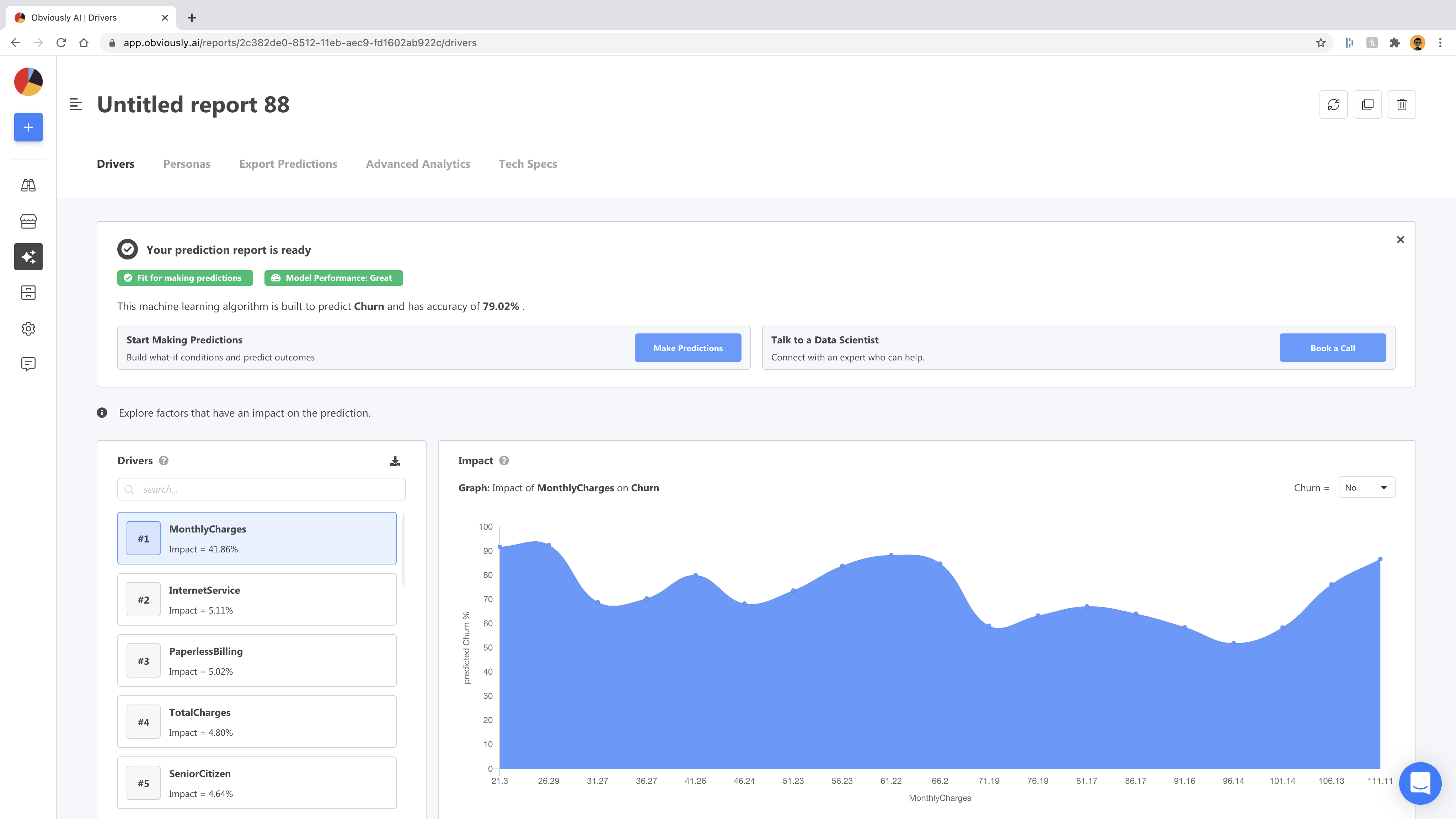
A sales or marketing analyst could connect a dataset, choose the result to predict (such as churn, loan repayment or sales), and let the software prepare features, test algorithms and return a prediction report. Its goal was to reduce dependence on code-heavy data-science projects. [9][10][11]
Why was it different from a BI dashboard?
Business intelligence generally explains what happened using charts, measures and filters. Predictive ML estimates what could happen next using a trained statistical model. Neither guarantees a causal answer or a valid business decision.
Company identity & ownership
| Brand and legal entity | Obviously AI; Obviously AI, Inc. appears in its February 2025 privacy notice. |
|---|---|
| Country and historical HQ | United States; San Francisco and Berkeley locations are both documented historically. A currently operating office is not verified. |
| Founding discrepancy | Founders' college and 2020 reporting date startup work to 2018; public beta launched in 2020. Some databases use 2019/2020 as company formation years. Exact legal incorporation date: could not be independently verified. |
| Legal / operating status | The successor Zams announced a wind-down in 2026. Legal dissolution filings, final date of service and asset disposition: not publicly verified. |
| Private or public? | Privately held in its venture-funded phase; no evidence of a public listing. |
| Parent / acquisition | No verified acquisition or separate parent company; Zams was presented as a rebrand, not an acquisition. Subsidiaries: not publicly disclosed. |
| Ownership percentages / valuation | Not publicly disclosed. Venture investment does not reveal individual stakes. |
| Official web and contact | obviously.ai · historical policy email info@obviously.ai · contact details are not independently verified as monitored. |
| Social / developer profiles | Zams official rebrand post; historical API docs developers.obviously.ai (inaccessible during research). Other official social profiles / repositories: not independently verified. |
Evidence: official privacy policy, founders' alumni institution, company rebrand and wind-down notices. [4][6][7][17]
Founders & leadership
CO-FOUNDER · HISTORICAL CEO
Nirman Dave
Hampshire College alumnus. Previously worked in data science at Streamlabs; also founded the electronics education project CircuiTricks. Identified the gap between business users asking predictive questions and the technical tools required to answer them. Subsequently led the Zams rebrand and issued the wind-down statement. [3][4][6][7]
CO-FOUNDER · HISTORICAL CTO
Tapojit Debnath
Hampshire College alumnus and former machine-learning intern at retail technology startup b8ta. Helped develop the technical stack and accessible no-code model-building experience. His latest executive responsibilities following the 2026 announcement are not publicly verified. [3][4][11]
Leadership verification: the CEO/CTO titles are historical, documented in 2021. A complete, up-to-date post-wind-down COO, CPO, Head of ML, Sales or Engineering roster could not be verified. No names are invented to fill these roles.
THE FOUNDING INSIGHT
Business teams understood the questions—but lacked practical access to the people and programming tools needed to turn them into predictive models.
The initial trigger came during Dave's Streamlabs internship, when non-technical colleagues needed to predict customer outcomes. Dave and Debnath worked on the concept in 2018 and went through Berkeley SkyDeck's startup ecosystem. Early accounts describe running the company on minimal resources, including a makeshift workspace in San Francisco. [1][3][4]
A timeline from AutoML to AI agents
$3.6m seed total announced
TMV leads the announced financing with a board role. Other named investors include B Capital, Golden Gate Ventures and Arka Venture Labs. [2]
Seed extended to $4.7m cumulative
UTEC leads the $1.1m extension with Trail Mix Ventures and B Capital participating. $4.7m is the cumulative 2021 seed total, not an additional round on top of $3.6m. [3]
Obviously AI becomes Zams
Founder announcement positions the successor as an enterprise AI-agent platform rather than only a predictive-model builder. [6]
Founder announces a wind-down
Dave publicly says the Zams business, formerly Obviously AI, is being wound down. Exact corporate closure, support and legal outcomes have not been independently established. [7]
Ownership, funding & business model
| Date | Financing evidence | Amount | Investors / interpretation |
|---|---|---|---|
| Early 2020 | Pre-seed / early VC and accelerator backing | Undisclosed | Arka Venture Labs, Berkeley SkyDeck cited in independent reporting. [25] |
| 3 May 2021 | Announced seed total | $3.6m | TMV lead; B Capital, Golden Gate Ventures, Arka Venture Labs and angels; TMV board role reported. [2] |
| 5 July 2021 | Seed extension | +$1.1m | UTEC led, Trail Mix Ventures and B Capital participated; cumulative seed $4.7m. [3] |
| 15 Dec 2023 | OSV investment announcement | Not disclosed | O'Shaughnessy Ventures announced an investment without stating size or valuation. [5] |
Who owned Obviously AI?
It was privately backed by founders and investors. Historical official investor listings also name Sequoia Scouts Fund, Facebook B3 Group and Makerpad Fund, but do not provide each party's security type, ownership stake or board seat. A 2021 financing release specifically reported a TMV board role. No reliable cap table or later shareholder changes were identified. [1][2]
How did the company monetize?
Documented commercial model: no-code software subscriptions and a software plus dedicated human data scientist service, including support for cleaning, merging and implementation. Enterprise access and custom governance appear in historical plans. Revenue split, profitability, ARR and API metered revenue are not publicly disclosed. [8][9]
Funding caution: Some commercial directories report higher cumulative totals or a dollar amount for the 2023 investment. Those amounts were not substantiated by the reviewed primary 2023 announcement and are not incorporated into this verified total. No official valuation or audited revenue figures could be established.
What Obviously AI offered
These capabilities are documented as historical product offerings. Availability, API credentials, contracts and ongoing model hosting after the Zams wind-down are unverified.
No-code predictive models
Input: tabular historical business data. Output: classifications, numeric estimates and report summaries. Users: analysts, marketers, sales and finance teams. [9][10]
Time-series forecasting
Input: time-indexed targets such as sales or demand. Output: forward-looking forecast and error metrics. Documented by 2022. [12]
Deployment, reports & APIs
Historical product pages describe shareable model apps, real-time REST predictions, exported results, model monitoring and Zapier-connected actions. API endpoints, current quotas and uptime were not verified. [8][9]
Managed data science
Dedicated specialists were marketed for data preparation, model building, statistical work, interpretation and integrations. This indicates a hybrid SaaS + services model, not pure self-service software. [8][14]
Agentic AI & automation
Later pricing and the Zams rebrand describe AI agents, task orchestration, reports and enterprise workflows. These are later-era claims, not evidence that the original AutoML engine itself was an LLM. [6][8]
Enterprise functionality
Historical plan pages list SAML/SSO, governance, audit trails, custom data sources, data residency and private-cloud setup. They do not establish each feature's active availability in 2026. [8]
How the predictive AI workflow worked
Historical workflow reconstructed from the company's product, algorithm and preparation documentation; it is not an observed 2026 product test. [9][10][11][13]
Confirmed AutoML automation
- Dataset property examination and candidate-algorithm shortlisting
- Preprocessing, missing-value treatment and normalization
- Multiple hyperparameter combinations and model selection
- Held-out validation, prediction reports and reported feature drivers
- Historical model sharing, API deployment and monitoring claims
Obviously AI claimed testing 10,000+ candidate algorithm/settings combinations on some workloads; this is a vendor claim, not an independently reproduced benchmark. [10][11]
Not established from reviewed records
- Complete source-code implementation or model architectures
- Consistent availability of SHAP, causal explanations or fairness testing
- Current retraining schedules, live drift-monitoring guarantees or API SLAs
- A current list of underlying LLMs and vendors in the successor agent stack
- Independent evidence of typical model accuracy across customers
Machine-learning models & evaluation
The company publicly named several conventional ML methods. Its August 2023 algorithm documentation describes dataset profiling and hyperparameter search but puts the complete algorithm list in an image, so only independently readable company text is treated as evidence below. [10][11][12]
| Model / family | Typical task | Evidence status |
|---|---|---|
| Logistic regression | Binary classification | Named in 2020 official technical article |
| Naive Bayes | Probabilistic classification | Named in 2020 official technical article |
| Perceptrons | Classification / neural-network family | Named in 2020 official technical article |
| Elastic net | Regularized linear modeling | Named in 2020 technical article; context does not establish exact configuration |
| ARIMA, SARIMA, Holt–Winters, Prophet, XGBoost | Time-series prediction | Listed in 2022 official forecasting explanation |
| Random forest, LightGBM, CatBoost | Classification / regression | Not independently confirmed as deployed options in reviewed source text |
Metrics specifically documented
Time-series: WAPE, MAPE, RMSE, MAE and MSE appear in the product's 2022 technical article. Classification accuracy is mentioned in company case studies and historical interface imagery. [12][14]
Metrics not firmly established
Consistent product-wide availability for precision, recall, F1, ROC-AUC, R², lift or calibration was not established from current accessible documentation. These are relevant statistical metrics but should not be marked as shipped features without source evidence.
Prediction types & practical use cases
| Use case / team | Historical data needed | Predicted output | Business action |
|---|---|---|---|
| Churn · Customer Success | Activity, renewals, cancellation labels | Likelihood of churn | Prioritize retention outreach |
| Lead conversion · Sales | CRM stages, interactions, won/lost labels | Lead conversion probability | Prioritize follow-up |
| Loan repayment · Finance | Past applications and repayment outcomes | Risk classification | Support expert credit review—not autonomous approval |
| Sales / deal value · Growth | Historical transactions, product attributes | Numeric revenue or deal estimate | Plan commercial activity |
| Demand · Operations | SKU sales by date and inventory history | Forecast by future period | Adjust reordering and safety stock |
| Student outcomes · Education | Attendance and previous performance data | Student-success classification | Provide human-reviewed interventions |
Examples represent documented product categories and selected company customer stories; they are illustrative of the historical workflow rather than evidence of currently operating models. [9][14][15][16]
Data sources, integrations & API
Integrations require careful historical interpretation. A list on an old marketing page may include products merely planned, and a tool mentioned in a blog is not automatically a supported native connector.
| Source / destination | Historical evidence | Evidence grade | 2026 status |
|---|---|---|---|
| CSV | Upload format and structural requirements in official documentation | Confirmed historical | Unverified |
| Dropbox / Airtable / Google Sheets | Named as sources in 2022 company technical walkthrough | Company-reported historical | Unverified |
| MySQL / BigQuery | Named as sources in 2022 blog | Company-reported historical | Unverified |
| Zapier | Automation described on official homepage and Lifepack case study | Documented workflow | Unverified |
| Google Sheets / Power BI output | Lifepack story describes prediction delivery using Zapier | Customer story, company published | Unverified |
| Salesforce / HubSpot / Shopify / Snowflake | Names appear in older promotional comparison material with some integrations in development | Native status not proven | Unverified |
| REST prediction API | Listed as product feature and on legacy pricing page | Confirmed historical marketing claim | Developer docs inaccessible; unverified |
How production deployment was intended to work
Historical CRM / database records → Trained predictive model → Output score → API, downloadable prediction or Zapier-triggered workflow → Human-approved action. The company discussed real-time prediction and shareable model applications, but current authentication requirements, rate limits, webhooks and SDKs were not independently verified. [8][9][12][16][27]
Predictive ML is not the same as an AI agent
2018–2024 · ORIGINAL CENTER OF GRAVITY
Predictive ML / AutoML
Uses structured past outcomes to learn patterns and predict a class, a number or a future sequence. Example: Which customers may cancel? Outputs probabilities, forecasts or estimated values.
Classification · Regression · Forecasting2024–2026 · LATER POSITIONING
Generative / agentic AI
Uses language understanding and tool-connected workflows to interpret requests, prepare analysis, generate reports and orchestrate tasks. Example: Review at-risk accounts and draft a follow-up sequence.
LLM interface · AI agents · Business workflowsThe legacy pricing page mentions AI agents, custom LLMs, RPA automation and recurring reports, while the 2025 Zams announcement explicitly emphasizes enterprise AI agents. Those claims are later positioning, not evidence that all original predictive models used LLMs. The exact OpenAI/Anthropic/Google model mix, proprietary agent stack and current provider contracts are not publicly verified. [6][8]
Obviously AI pricing: historical, not a current quote
The official pricing URL remained readable on 30 October 2026, but that does not verify live checkout, active service, or any rights to provision a model after the wind-down. The following table records the marketing page rather than offering current plans. [7][8]
| Historical plan | Advertised price | Listed capacity / emphasis | Present status |
|---|---|---|---|
| Free | Free (historical page) | Lists 1,200 predictions, one seat, CSV input, classification / regression and REST API; labels on some additional features may represent excluded options | Sign-up / service unverified |
| Startup | Amount not displayed | Up to one use case; up to 100 MB files; up to 1 million rows; managed expert support presented | Not available as verified offer |
| SMB | Amount not displayed | Up to three use cases; up to 1 GB files; up to 100 million rows; managed expert support presented | Not available as verified offer |
| Enterprise | Contact Sales (historical) | Up to five use cases; up to 10 GB files; up to 250 million rows; SSO, data residency and private cloud are mentioned | Not available as verified offer |
Earlier 2021 blog posts mention Basic and Pro prices ($75 and $145 per month), but those terms were superseded by later website positioning. Do not publish them as current prices. [8][27]
Customers, case studies & market traction
OFFICIAL CASE STUDY · FINTECH
Creditt
The company describes loan repayment scoring integrated into an underwriting workflow and a monthly administrative time saving. These are Obviously AI-published customer claims, not independent audit findings. [14]
OFFICIAL CASE STUDY · EDTECH
LearningLeaders
Student-success modeling and in-app predictions; official story additionally claims a reduction from two weeks to five minutes per model and $70,000 annual savings. Figures are company-published. [15]
OFFICIAL CASE STUDY · RETAIL / HEALTH
Lifepack
Forecasting inventory needs using data from MySQL and workflow outputs to Google Sheets and Power BI through Zapier. Timelines vary within the company's own page, so no single speed-up is asserted. [16]
Direct customer evidence
TechCrunch quoted a representative from Dai Nippon Printing describing faster analyst onboarding. This is named-customer testimony in independent reporting; it is stronger than a standalone logo and should not be mistaken for independently tested model accuracy. [3]
Case-study integrity: The Max Van Trading page gives inconsistent return figures within the same story (1.15%, 1.18% and 4–5% weekly). This profile excludes those performance figures; investment returns should not be assumed from unaudited vendor case studies. [26]
Privacy, security & responsible AI
Privacy & training data
The February 2025 privacy policy identifies categories of personal information, uses, disclosures, retention and deletion handling. It says certain personal data is not needed beyond 90 days after account termination except for permitted exceptions. That statement should not be generalized into a specific uploaded-model-training-data deletion SLA. [17]
Does the platform use uploaded business data to train general-purpose AI models? The reviewed privacy notice does not establish a sufficiently specific, universal answer. Could not be independently verified.
Published security claims
The security page claims SOC 2 Type II, GDPR measures, CCPA controls, HIPAA readiness/BAA support, TLS in transit, AES-256 encryption and Google Cloud hosting. These are Obviously AI-reported claims from a historical page. No current audit letter or 2026 certification status was obtained. Data center certifications are not automatically company certifications. [18]
Risk controls a buyer would still need
Verify present legal operator and data processor, access control, current SOC 2 report, deletion terms, sub-processors, DPA/BAA, deployment region and disaster-recovery plan before sharing sensitive data. For credit, employment, healthcare or other high-impact uses, validate fairness, bias, leakage, calibration and human oversight independently.
General AutoML limitations — not company-specific accusations
Bad or sparse data weakens predictions. Historic discrimination can be learned, leakage can inflate validation scores and good accuracy does not prove causality. Time-series behavior may change suddenly, and model performance can decay. Business-domain experts must choose valid targets and evaluation windows before any scores drive real decisions.
Reviews, strengths & limitations
G2 displays a small collection of historical reviews, with praise for ease of model prototyping and data-scientist support. Some reviewers mention limited customization or needing time to understand input datasets. The sample is too small to support broad market sentiment or a strong 2026 recommendation. [19]
Evidence-backed strengths
- Predictive modeling without requiring end-user Python skills
- Classification, regression and time-series support
- Documented hyperparameter and preprocessing automation
- Historical REST and no-code workflow options
- Human data-science assistance for preparation and implementation
Material limitations
- 2026 wind-down means no verified active service
- Historical pricing may mislead prospective customers
- Less transparent or flexible than full custom ML stacks for specialist work
- Independent benchmarks and complete provider lists are unavailable
- Case-study ROI and customer metrics are largely vendor-reported
Obviously AI competitors & alternatives
Compare the historical Obviously AI AutoML proposition with vendors whose current product pages are available, not with an assumed operational 2026 Obviously AI service.
| Platform | Product category | No-code entry | Predictive ML / AutoML | Primary orientation |
|---|---|---|---|---|
| Obviously AI (historical) | Predictive AutoML + managed services | Yes | Yes / Yes | Business analysts; no current offering verified |
| Akkio | AI workflow / analytics automation | Yes | Advertises no-code modeling | Media, agencies and business operations |
| Pecan AI | Predictive AI for business teams | Yes | Yes / automated modeling | Churn, LTV, conversion and demand |
| DataRobot | Enterprise AI platform | Guided interfaces | Yes / yes | Model operations, governance and specialists |
| Dataiku | Enterprise analytics, ML & agents | Yes + code | Yes / yes | Governed collaboration and full lifecycle |
| H2O Driverless AI | Enterprise AutoML | Visual workflows | Yes / yes | Automated feature engineering and interpretability |
| Power BI / Tableau | Business intelligence / visual analytics | Yes | Not primarily standalone AutoML | Dashboards, reporting and analysis |
Competitor descriptions derived from current vendor product pages; this is a category-level comparison, not an independently benchmarked feature test. [20][21][22][23][24]
Obviously AI vs Akkio
Both emphasized making data analysis easier without code. Modern Akkio is oriented around connected AI workflows and chat-with-data, whereas Obviously AI's original distinctive task was one-click predictive modeling. Their respective 2026 service status is not comparable because Obviously AI's successor announced a wind-down. [20]
Obviously AI vs Pecan AI
Pecan is a close functional overlap for churn, customer LTV, marketing response and operational forecasts. Its published 2026 positioning emphasizes automating predictive workflows for business teams. [21]
Obviously AI vs DataRobot
DataRobot targets broad enterprise AI development, governance, deployment and observability. Obviously AI historically reduced the entry barrier for relatively focused business-user prediction tasks. [22]
Obviously AI vs Dataiku
Dataiku spans no-code, low-code and full-code workflows, collaborative data preparation, MLOps and governance; the older Obviously AI proposition was narrower and simpler to start. [23]
Who should use Obviously AI?
For historical evaluation: business analysts, marketers, sales teams, startups and mid-market groups looking to understand how accessible AutoML worked are the core audience for this profile. Experienced ML engineers wanting algorithm-level control, organizations demanding formal validation and teams handling high-risk decisions needed deeper technical evaluation even before the wind-down.
For a new deployment in October 2026: do not assume Obviously AI is a buyable platform. Evaluate presently supported alternatives such as Pecan AI, Akkio, DataRobot, Dataiku or H2O.ai according to the required prediction type, governance, engineering depth and integration path.
Frequently asked questions
1. What was Obviously AI?
A US-based no-code predictive analytics and AutoML company that helped business users create models using structured historical data. [1][9]
3. When was it founded?
Founding work began in 2018; public beta launched in February 2020. Some databases use different formation dates. [2][4]
4. Where was it based?
Historically San Francisco/Berkeley, California. A currently operating office has not been verified. [1][3]
5. Does Obviously AI still operate?
Founder Nirman Dave announced a wind-down of Zams, formerly Obviously AI, in 2026. Current paid product availability has not been established. [7]
6. What became of Obviously AI?
It rebranded to Zams in February 2025 with an enterprise AI-agent focus, followed by a 2026 wind-down announcement. [6][7]
7. Was Obviously AI really no-code?
Its target-selection and model-building UI was no-code. Data understanding, target design and production review still required judgment. [9][13]
8. Which predictions could it make?
Classification, numeric regression and time-series forecasts were marketed. Churn, repayment, sales and demand are documented examples. [9][12]
9. Which algorithms did it use?
Official writings named logistic regression, Naive Bayes, perceptrons, elastic net, ARIMA, SARIMA, Holt–Winters, Prophet and XGBoost in relevant historical contexts. [11][12]
10. Was it based on LLMs?
The original predictive platform primarily centered on conventional ML. Later agentic products and legacy pricing pages mention LLM-related functionality, but a complete provider/model list was not independently verified. [6][8]
11. Did it provide an API?
Yes, a REST prediction API was historically advertised. Current API service and rate limits were not verified. [8][9]
12. What data sources were supported?
CSV, and historical company-reported connections including Google Sheets, Airtable, Dropbox, MySQL and BigQuery. Current availability is unknown. [12][13]
13. How much did it cost?
A historical free option and Startup, SMB and Enterprise plans are shown, but current subscription availability and paid rates are not verified. [8]
14. Did it provide human data scientists?
Yes, the company marketed dedicated expert help for preparation, implementation and models in addition to its software. [8]
15. How much funding did it raise?
Its seed financing reached a disclosed cumulative $4.7 million by July 2021. A December 2023 investment was publicly announced without a stated size; a verified lifetime total is therefore unavailable. [2][3][5]
16. Who invested in the company?
Reported backers included TMV, UTEC, B Capital, Golden Gate Ventures, Arka Venture Labs, Trail Mix Ventures and O'Shaughnessy Ventures, among others. [1][2][3][5]
17. Was its valuation disclosed?
No reliable current or exit valuation was established from primary public records reviewed.
18. Which customers used Obviously AI?
Official customer stories featured Creditt, LearningLeaders and Lifepack; TechCrunch quoted Dai Nippon Printing. Case outcomes remain attributed to their sources. [3][14][15][16]
19. Did it have security certifications?
Its security page claims SOC 2 Type II and describes regulatory controls, but the current audit and post-wind-down compliance posture were not independently verified. [18]
20. Did it train general models on customer uploads?
A definitive general-purpose model-training policy for uploaded datasets could not be established from the reviewed privacy statement. [17]
21. What differs from Power BI and Tableau?
Obviously AI focused on predictive models; Power BI and Tableau primarily provide dashboards, data exploration and reporting. These are adjacent rather than identical categories.
SEO & directory information
Explore Obviously AI's founders, funding, no-code AutoML, predictive analytics, pricing history, customers, rebrand to Zams and 2026 wind-down.
Other SEO title options
- Obviously AI Company Profile: AutoML, Technology & Funding
- Obviously AI: Founders, Predictive AI, Customers & History
- Obviously AI and Zams: Company History & Product Evolution
- Obviously AI: No-Code Predictive Analytics Company Explained
Short company-directory description
Obviously AI was a US-based company that made predictive analytics and no-code machine learning accessible to business users. Founded by Nirman Dave and Tapojit Debnath, its platform helped analysts and operations teams create forecasts and prediction models from structured data. The business later rebranded as Zams, an enterprise AI-agent platform, before announcing a wind-down in 2026.
Suggested related topics: AutoML companies, predictive analytics tools, no-code AI platforms, AI data analytics tools, Obviously AI case studies and Obviously AI alternatives. Internal destination links are omitted until their existence is verified.
Sources & references
All sources accessed or checked on 30 October 2026. Publication dates and author names are provided where discoverable; undated materials are labeled as such. A source from the company's own site is evidence of what the company stated—not proof that outcomes or infrastructure remain operational today.
Obviously AI · Published: n.d. (historical page) · Accessed: 30 Oct 2026
Company positioning, founder names, historical headquartersObviously AI / GlobeNewswire · Published: 3 May 2021 · Accessed: 30 Oct 2026
Official funding and public-beta timelineCatherine Shu / TechCrunch · Published: 5 July 2021 · Accessed: 30 Oct 2026
Independent funding confirmation and founder interviewsAmy Diehl / Hampshire College · Published: 12 August 2021 · Accessed: 30 Oct 2026
2018 founding work, education and founder storyO'Shaughnessy Ventures / PRNewswire · Published: 15 December 2023 · Accessed: 30 Oct 2026
Later investment; amount not reportedNirman Dave / Zams, LinkedIn · Published: February 2025 · Accessed: 30 Oct 2026
Company rebrand and enterprise agent focusNirman Dave / LinkedIn · Published: 2026 (exact post date not independently established) · Accessed: 30 Oct 2026
Founder's primary-source wind-down announcementObviously AI · Published: Undated, accessible 30 October 2026 · Accessed: 30 Oct 2026
Archived/live website claims, not verified checkout availabilityObviously AI · Published: Undated, historical site · Accessed: 30 Oct 2026
Former classification, regression, time-series, API and deployment positioningObviously AI · Published: 9 August 2023 · Accessed: 30 Oct 2026
Documented model selection and tuningTapojit Debnath (words), Jack Riewe (contributor) / Obviously AI · Published: 14 May 2020 · Accessed: 30 Oct 2026
Preprocessing, validation and named algorithm familiesObviously AI · Published: 4 August 2022 · Accessed: 30 Oct 2026
Forecasting methods, data source examples, time-series metricsObviously AI · Published: 12 April 2021 · Accessed: 30 Oct 2026
Historical dataset format and minimum-data guidanceObviously AI · Published: Undated, historical case study · Accessed: 30 Oct 2026
Customer case study and self-reported workflow resultObviously AI · Published: Undated, historical case study · Accessed: 30 Oct 2026
Education case study and company-reported resultsObviously AI · Published: Undated, historical case study · Accessed: 30 Oct 2026
Demand forecasting and Zapier/Sheets/Power BI integrationObviously AI, Inc. · Published: 4 February 2025 · Accessed: 30 Oct 2026
Legal entity, contact, privacy and retention languageObviously AI · Published: 3 January 2024 (page also carries 2022 version) · Accessed: 30 Oct 2026
Company's security and regulatory self-attestationsG2 · Published: 2022–2023 reviews; page checked 30 October 2026 · Accessed: 30 Oct 2026
Small-sample user sentimentAkkio · Published: Checked 30 October 2026 · Accessed: 30 Oct 2026
Present-day adjacent predictive/analytics automation offeringPecan AI · Published: Checked 30 October 2026 · Accessed: 30 Oct 2026
Present-day predictive AI for business teamsDataRobot · Published: Checked 30 October 2026 · Accessed: 30 Oct 2026
Enterprise AI and predictive ML comparisonDataiku · Published: Checked 30 October 2026 · Accessed: 30 Oct 2026
Enterprise visual ML and AI governance comparisonH2O.ai · Published: Checked 30 October 2026 · Accessed: 30 Oct 2026
Enterprise AutoML comparisonShashank Didmishe / TechCircle · Published: 2 April 2020 · Accessed: 30 Oct 2026
2018 founding and 2020 early investmentObviously AI · Published: Undated, historical case study · Accessed: 30 Oct 2026
Example of inconsistent company-published performance claimsFrederik Bussler / Obviously AI · Published: 27 January 2021 · Accessed: 30 Oct 2026
Historical integrations and superseded 2021 pricingResearch notes & evidence quality
Editorial standard: Verified historical facts are distinguished from vendor-reported claims, inferences and unknowns. This is a research profile, not financial advice, legal certification, a security audit, an endorsement or a guarantee of ongoing access. No made-up founder photographs, financial results, integration claims or customer metrics are included.