Deep Learning Specialization
Course Details

Course Curriculum & Description
Deep Learning Specialization by DeepLearning.AI
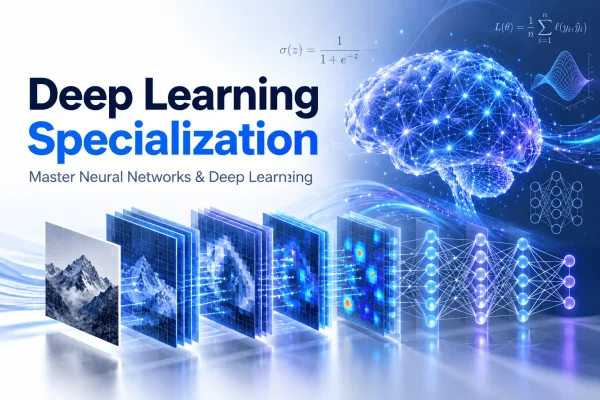
The Deep Learning Specialization is an intermediate-level, five-course online program developed by DeepLearning.AI and delivered through Coursera. Led by Andrew Ng and fellow instructors, it teaches learners how to design, train, evaluate, and improve deep learning models using Python and TensorFlow.
The program combines neural network fundamentals, optimization techniques, computer vision, sequence modeling, and natural language processing. Learners gain practical experience through programming exercises while developing a stronger understanding of how modern AI systems work.
What Will You Learn?
- Build and train artificial neural networks and deep learning models.
- Understand forward propagation, backpropagation, and vectorization.
- Optimize neural networks through regularization, initialization, and hyperparameter tuning.
- Implement machine learning workflows using Python and TensorFlow.
- Develop Convolutional Neural Networks for computer vision applications.
- Work with Recurrent Neural Networks, LSTMs, and GRUs.
- Understand attention mechanisms and Transformer architectures.
- Apply deep learning techniques to natural language processing and image recognition.
- Evaluate model performance and diagnose errors.
Course Curriculum
Course 1: Neural Networks and Deep Learning
Duration: Approximately 25 hours
Learn the essential principles behind artificial neural networks and how deep learning systems identify complex patterns in data.
- Introduction to deep learning and neural networks
- Logistic regression and neural network fundamentals
- Forward and backward propagation
- Python programming and vectorization
- Shallow and deep neural network architectures
- Building and training neural networks
Learning Outcome: Implement foundational neural networks and understand how their parameters are learned during training.
Course 2: Improving Deep Neural Networks: Hyperparameter Tuning, Regularization and Optimization
Duration: Approximately 24 hours
Discover techniques that improve the performance, reliability, and efficiency of deep neural networks.
- Training, development, and test datasets
- Bias and variance analysis
- L2 regularization and dropout
- Weight initialization and gradient checking
- Mini-batch gradient descent
- Momentum, RMSprop, and Adam optimization
- Hyperparameter tuning and batch normalization
- Neural network implementation with TensorFlow
Learning Outcome: Optimize neural network training and improve model generalization.
Course 3: Structuring Machine Learning Projects
Duration: Approximately 7 hours
Develop practical judgment for organizing machine learning projects, identifying model weaknesses, and choosing effective improvement strategies.
- Machine learning strategy and project planning
- Evaluation metrics and error analysis
- Diagnosing bias and variance
- Handling mismatched training and test distributions
- Transfer learning and multi-task learning
- End-to-end deep learning approaches
Learning Outcome: Make informed technical decisions when improving machine learning applications.
Course 4: Convolutional Neural Networks
Duration: Approximately 36 hours
Explore computer vision and learn to create deep learning systems that process and interpret images.
- Convolutional neural network fundamentals
- Convolution and pooling operations
- Classic CNN architectures and residual networks
- Transfer learning with pretrained networks
- Object detection and localization
- Facial recognition concepts
- Neural style transfer
- Image segmentation and visual recognition
Learning Outcome: Build and apply CNN-based models to image classification, detection, and related computer vision problems.
Course 5: Sequence Models
Duration: Approximately 37 hours
Learn to work with sequential information, text, and language-processing models.
- Recurrent Neural Networks (RNNs)
- Long Short-Term Memory networks (LSTMs)
- Gated Recurrent Units (GRUs)
- Word embeddings and language representation
- Natural language processing fundamentals
- Attention mechanisms and Transformers
- Hugging Face tokenizers
- Named Entity Recognition
- Question answering and language applications
Learning Outcome: Develop sequence-based models and apply Transformer techniques to selected NLP tasks.
Practical Learning and Applications
The specialization uses programming assignments and applied exercises to connect theory with practical implementation. Its techniques are relevant to image recognition, object detection, natural language processing, speech recognition, machine translation, and other machine learning applications.
Who Should Take This Course?
- Students with programming experience who want to study deep learning
- Aspiring machine learning and AI engineers
- Software developers transitioning into AI
- Data scientists expanding their neural network knowledge
- Technical professionals interested in computer vision and NLP
Prerequisites
Intermediate Python programming experience is expected. Familiarity with basic machine learning concepts and linear algebra, including vectors and matrices, is recommended.
Course Format and Duration
This is a self-paced, online specialization containing five courses. Coursera estimates approximately three months of study at ten hours per week. Actual completion time varies according to previous knowledge and learning pace.
Certificate and Career Development
Learners who fulfill the relevant completion requirements can earn a shareable certificate through Coursera, subject to the applicable enrollment and payment conditions. The credential can be added to a professional profile, resume, or LinkedIn account.
The program supports the development of skills relevant to machine learning engineering, deep learning research, computer vision, natural language processing, and AI application development. Completing it does not guarantee employment.
Conclusion
The Deep Learning Specialization offers structured, hands-on instruction in neural networks and modern deep learning techniques. It is particularly valuable for learners who already understand programming and want to build stronger foundations for developing practical AI systems.
What You Will Learn
- Build Deep Neural Networks
- Train Artificial Neural Networks
- Implement Backpropagation
- Optimize Neural Network Performance
- Apply Hyperparameter Tuning
- Develop CNN Models
- Build RNN and LSTM Models
- Implement Transformer Models
- Perform NLP Tasks
- Use TensorFlow
- Evaluate Machine Learning Models
Course Prerequisites
Intermediate Python programming, familiarity with loops and data structures, basic linear algebra recommended, foundational machine learning knowledge recommended
Course Highlights
100% Online, Self-Paced Learning, 5-Course Specialization, Hands-on Programming Assignments, Python and TensorFlow, Computer Vision, Natural Language Processing, Transformer Models, Industry Expert Instructors, Shareable Certificate Available